
Enterprises are facing challenges when it comes to modernizing applications. How do we modernize applications without losing the control, security, and performance of private cloud? Teams need to ship features faster, adopt microservices and AI workloads, and retire technical debt, all on infrastructure they trust. The market rewards speed, and organizations that modernize well gain agility and competitive advantage.
The core problem is not ambition. It is the gap between where applications run today and the operational model needed to support what comes next. Many organizations juggle fragmented tooling, manual provisioning, and disjointed governance across traditional and cloud-native workloads. That fragmentation slows delivery, raises risk, and drives up cost.
A Standardized, Secure Path to Production
VMware Cloud Foundation (VCF) closes that gap with a consistent, secure private cloud that supports all applications. As the leading private cloud platform for application modernization, VCF gives organizations the platform to modernize their application portfolio without abandoning the control and security of private cloud. With Cloud Native Computing Foundation (CNCF) certified built-in Kubernetes runtime delivered through VMware vSphere Kubernetes Service (VKS), VCF transforms private cloud into a modern platform that delivers the agility of public cloud with the governance and hardened security your business demands.
Let’s look at what this means in practice. The platform delivers several capabilities that directly improve operational outcomes:
- A complete platform to securely deploy and manage modern applications at scale through three core services: KubeVM Service, VKS, and Container Service.
- Self-service access through CLI and Kubernetes APIs and GUI, empowering application teams to provision VMs, Kubernetes clusters, and containers on demand without waiting on IT tickets.
- Native integrations with CNCF tools like Argo CD, enabling source-controlled GitOps workflows without replacing what already works.
- Unified lifecycle management that streamlines provisioning, patching, and upgrades across the stack.
- Automated governance and security guardrails across infrastructure, enabling consistent policy enforcement and rapid remediation without slowing innovation.
Operational Insight: Where Velocity Meets Control
The friction in app modernization is familiar to most platform teams. Developers want self-service speed. Security and operations teams want control and consistency. Too often, one comes at the expense of the other.
VCF resolves this by making governance part of the automation, not a gate in front of it. VCF Automation acts as the central orchestration engine, dynamically applying security and compliance postures at deployment time. By defining network and security constructs within blueprints, platform teams enable a zero-trust policy that is consistently codified across every environment. VCF optimized Ubuntu operating system image delivery locks image sourcing to verified repositories, so every team works from trusted, standardized content.
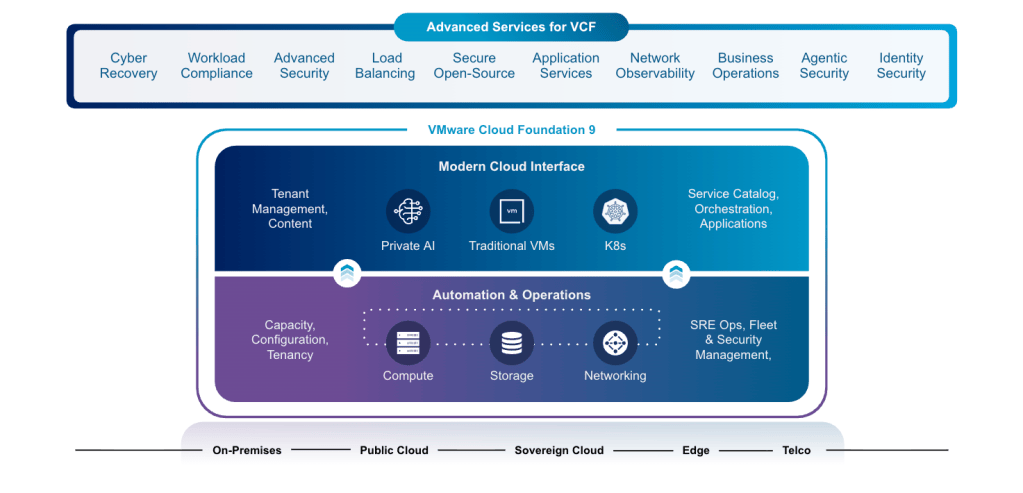
For total cost of ownership (TCO), the math is straightforward. A single platform that supports traditional and modern workloads reduces the need to maintain separate stacks. VCF Automation drives down capital expenditures (CapEx) through automated lease expirations and resource reclamation, while built-in cost tracking dashboards give application teams real-time visibility into running costs. VCF Operations reduce operational expenditure (OpEx) by consolidating management, automating lifecycle tasks, and giving teams the visibility to act before costs compound. A Broadcom survey1 of VCF 9 customers found an average 51% reduction in infrastructure management time and a 46% reduction in monitoring time, driven by a single converged console that unifies metrics, logs, and flows.
VCF streamlines AI model deployment by integrating automated data preparation, standardized API access, simplified agent deployment, and full stack observability into a unified platform. VCF Automation transforms complex AI infrastructure into on-demand, consumable services. By publishing pre-configured AI infrastructure blueprints through a self-service catalog, platform teams eliminate manual provisioning bottlenecks. Developers instantly receive standardized environments, fully configured with the necessary compute and guardrails, allowing them to focus entirely on rapid model development and cost-effective CPU-based inferencing. Developers can compose AI agents that run flexibly on CPUs or GPUs, allowing cost-effective CPU deployment when dedicated GPUs aren’t required.
Broadcom’s Contribution in CNCF Community
This commitment extends beyond the platform itself. Broadcom has been a top three contributor to Kubernetes for the past decade and recently elevated to Platinum membership in the Cloud Native Computing Foundation (CNCF). Broadcom’s presence at KubeCon + CloudNativeCon North America 2026 in Salt Lake City, November 9 to 12, underscores this commitment. Broadcom returns as a Platinum Sponsor and supports Cloud Native AI + Inference Day on November 9 as a Diamond Sponsor.
Broadcom’s broad independent software vendor (ISV) partnerships extend the platform’s compatibility and reach, so teams can build on a foundation that grows with their needs. At KubeCon, Broadcom announced the latest wave of partner validations for VKS and its contribution to the VM API, a common, provider-neutral standard for managing virtual machines across infrastructure environments.
This track record runs deeper than membership and sponsorships. Broadcom originated CNCF projects including Harbor, Antrea, Velero, and Contour, and maintains core projects such as Cluster API, etcd, containerd, Kubernetes CSI, and controller-runtime. These contributions reflect a sustained investment in open source innovation and the technologies powering the next generation of cloud native and AI workloads.
Beyond Infrastructure: The secure platform for agents
VMware Tanzu Platform extends the value of VCF, giving teams a dedicated application platform that turns infrastructure capability into developer productivity for modern applications and agents.
App Portfolio Assessment and Compliance
VMware Tanzu Platform enables teams to scan application repositories at scale, analyzing each one for technical debt, business criticality, and language to build a complete picture of the portfolio. It identifies specific risks such as unpatched dependencies or unsupported frameworks that are often hidden in the maintenance tax of production environments. Platform engineers can then prioritize workloads for patching and onboarding based on objective metrics, eliminating latent security risks before they become incidents. The result is a data-driven modernization roadmap that strengthens the organization’s security posture and helps improve app portfolio compliance through continuous, automated assessment rather than manual audits.
Agentic Runtimes for Autonomous Agents
VMware Tanzu Platform provides an Agentic Platform as a Service (PaaS) with Spring AI integration, centralized Model Context Protocol (MCP) management, and identity-driven governance to help teams build and govern agentic applications. Organizations can deploy and scale autonomous AI agents on a deny-by-default runtime with brokered service bindings to curated models, data products and services, isolated sandboxes, and deterministic compliance controls.
Defense-in-depth for Apps and Agents
Security is enforced across three distinct layers:
- Application framework level: TrueSource Spring Enterprise delivers continuous patch and dependency management, including commercial day-0 validated security-only patches from core Spring maintainers and clean-room builds of Java dependencies for Spring Boot.
- Platform level: Tanzu Platform enforces a deny-by-default runtime with an isolated credential store outside the execution sandbox, preventing prompt injection attacks, while an integrated AI gateway centralizes, audits, and rate-limits agent tool calling.
- Infrastructure level: VMware vDefend enforces zero-trust networking, micro-segmentation, and security policies at deployment time.
Together, these layers give engineering teams consistent, full-stack protection from underlying infrastructure up through the application and agent runtime.
The Future State of Application Modernization
The path forward is a private cloud that adapts to how applications actually evolve. Broadcom continues to advance this platform with enhanced TCO optimization, efficient deployment and management of modern workloads, and stronger security for production AI workloads. Organizations gain a standardized, secure path to production that supports every workload, empowers developers, and boosts productivity.
Ready to accelerate your app modernization journey? Dive into the resources below and discover how VCF can help your teams ship faster, simplify operations, and keep security built in:
- Product and Solution Pages: VMware Cloud Foundation, VCF Application Modernization, and VMware Tanzu Platform
- Read the latest App Modernization Solution Brief and Top 5 App Modernization Challenges ebook
- Blogs:
- vSphere Kubernetes Service 3.8 Announcement
- Advancing Cloud-Native Ecosystems Through Open Collaboration
- Broadcom at KubeCon North America 2026
- Forrester TEI: See How Organizations Achieved 137% ROI with VMware Cloud Foundation 9
- Introducing KubeVM Service: Why Declarative VM Management Matters Now
- VCF 9.1: The Secure, Cost-Effective Private Cloud Platform for Production AI
- Broadcom Customer Survey, VMware Cloud Foundation (VCF) 9 customers (n = 44), March 2026.
↩︎
Discover more from VMware Cloud Foundation (VCF) Blog
Subscribe to get the latest posts sent to your email.