
When you hear that AI has “accelerated the pace” or other such urgency talk, what does that mean? Here’s an example. At 2:00 AM, an automated security researcher running an autonomous Frontier AI model parses a commit on an open-source repository. Within minutes, the model synthesizes the diff, identifies an unhandled buffer boundary, and constructs an exploit payload.
Historically, this is where the vulnerability would enter a quiet holding pattern. The finding would be submitted to an industry clearinghouse or embargo list, granting software vendors a grace period of weeks to develop, test, and distribute a patch before public disclosure. But the modern ecosystem is far more fragile. Too often, these established embargo practices are broken by an individual actor who thinks they know “best.” Whether it is a third-part observer racing for credit or a researcher leaking details to the public under the guise of transparency, the resulting chain reaction is devastating.
The moment that uncoordinated disclosure hits a public repository, social media, Reddit forum, or mailing list, the clock accelerates drastically. It no longer takes a bad-actor weeks or months to manually reverse engineer the vulnerability. Instead, malicious use of AI models immediately scrape the leaked vulnerability, optimize the attack path, and weaponize it. By daybreak, fully weaponized Remote Code Execution (RCE) scripts are circulating across dark web channels.
Recent headlines are no longer theoretical anomalies: from the discovery of PHP2Shell—a critical vulnerability affecting code that powers roughly 70% of the web, unearthed via OpenAI technologies—to the Node2Shell (CVE-2026-111497) Brotli decoder flaw that instantly exposed Node.js, Bun, and Python environments, the timeline of digital defense has shattered.
The traditional vulnerability lifecycle used to grant enterprises a grace period: weeks between public disclosure and a functional exploit. Today, that buffer has collapsed entirely. Critical vulnerabilities are routinely exploited in the wild within 24 hours; in notable cases like LMDeploy (CVE-2026-33626), weaponization took a mere 13 hours.
Yet, walk into almost any enterprise board room or IT steering meeting, and the operating model looks virtually identical to 2014. Organizations still negotiate “monthly maintenance windows,” route spreadsheet alerts through change-advisory boards, and treat vulnerability management as an administrative ticketing queue.
If your organization’s defense strategy relies on humans reading CVE advisories, cutting Jira tickets, and scheduling patches for next month’s maintenance cycle, you’re strolling away from catastrophes instead of running as fast as you can. To survive the era of Frontier AI, patching can no longer be an ad-hoc calendar event. It must become a continuous, automated platform response.
The Enterprise Delusion: The DIY Platform and Ticket-Driven Security
For the past decade, IT leadership embraced the promise of “do-it-yourself” (DIY) platform engineering. Enterprises built application platforms out of dozens of open-source (OSS) components, stitching together community orchestrators, ingress controllers, runtimes, and monitoring agents. They often did this on their own, building bespoke, artisanal platforms.
Then reality set in.
According to Black Duck’s 2026 Open Source Security and Risk Analysis (OSSRA) Report, over 98% of today’s enterprise codebases rely on OSS components, accounting for more than 75% of the code in typical enterprise applications, and over 95% of organizations deploy at least one open-source database. Now, the aggressive adoption of generative AI coding assistants has flooded corporate repositories and open source repositories.
While AI makes code cheaper to write, it also dramatically increases exposure: mean vulnerabilities per codebase have surged, and studies show that automated AI patch generation alone introduces new vulnerabilities or alters intended application behavior 74% of the time. As an example, a recent study showed Fable 5, one of the most powerful Frontier AI models, was only able to generate mergeable code 29.3% of the time via the FrontierCode Diamond benchmark. Relying purely on generative AI “patch factories” creates an unacceptable operational and financial risk.
When an exploit drops, that typical enterprise we met above initiates a slow, painful chain reaction:
- A scanner fires a raw alert.
- A ticket is created and assigned to an application owner.
- The developer stops roadmap work, hunts through dependency trees, edits Dockerfiles, rebuilds images, tests locally, and submits a pull request.
- Operations waits for an approved maintenance window to roll out the updated container across hundreds of fragmented clusters.
Every handoff burns precious hours while the exploit window is measured in minutes. Developers spend upwards of one month per application every single year solely managing dependencies and patches.
Worse still, DIY platforms force internal platform engineers to assume the full liability of maintaining the infrastructure itself. To understand the magnitude of the task of making a DIY platform enterprise-ready, see the difference between core open source Cloud Foundry, which delivers roughly 14.6 million lines of code, where VMware Tanzu Platform integrates over 99.3 million lines of code—a massive enterprise fabric engineered specifically to automate lifecycle management, governance, self-healing, secret rotation, and declarative fleet patching. Expecting internal platform teams to replicate, secure, and continuously patch that scale of bespoke infrastructure with off-the-shelf OSS components shifts an unsustainable operational tax onto the business.
To emphasize this point, look at the rate of CVE growth in recent years:
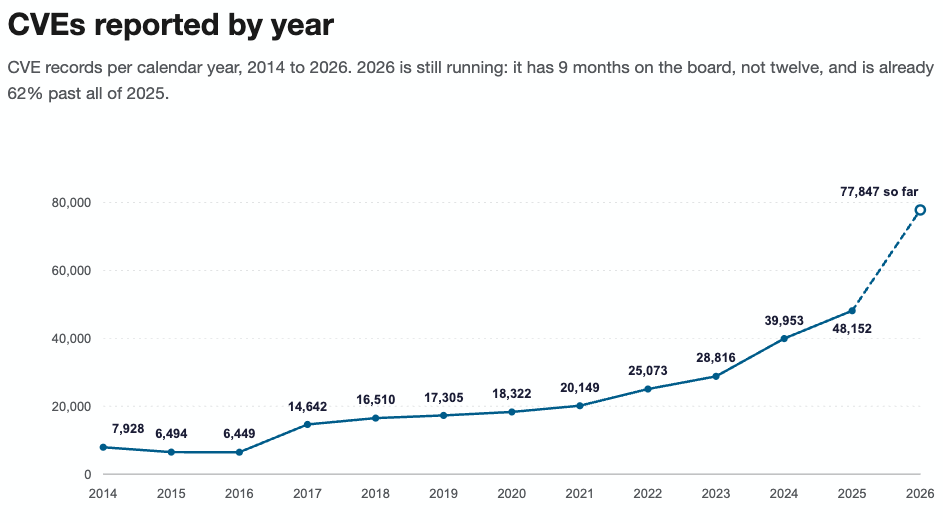
Figure 1: Chart showing CVE record counts per calendar year. 2026 counts records published through 2026-10-13; every other year is complete. Published records, not vulnerabilities found or exploited that year. Source: CVE.ICU, built from NVD and the CVE List V5 repository. Data as of 2026-10-13.
That rate has already been increasing before this year, but now the number of security vulnerabilities has gotten out of control. Your platform builders need to pay attention to and analyze each CVE to see if their artisanal platform requires a fix. And, of course, apply the fix when it’s needed. This is in addition to handling the applications and the services that need the fix. At some point your team will be consumed by security and the regular “keep the lights on” maintenance needed to run and update the platform.
As detailed in our continuous security whitepaper, this DIY approach turns patch latency into a dangerous systems problem, where every manual handoff consumes a critical part of your useful remediation window. The defensive answer isn’t to force your team to work faster, nor is it to bolt another security scanner onto the side of a bespoke architecture. Instead, organizations must shift to a continuous platform control loop. By adopting a pre-engineered architecture, the undifferentiated heavy lifting of staying secure is built-in natively, rather than built by you.
Securing the Application Building Blocks: TrueSource by Broadcom
A platform control loop is only as strong as the artifacts injected into it. You cannot patch quickly if you do not trust what you are deploying.
To solve this upstream exposure, TrueSource by Broadcom delivers commercially supported, verifiably built software that covers 80% to 90% of the open source used in the enterprise. Rather than pushing private forks that fragment codebases and create technical debt, TrueSource applies maintainer-first engineering across three dedicated offerings: TrueSource Spring Enterprise, TrueSource Trusted Artifacts, and TrueSource Data Services.
The Registry Trap: Why Clean-Room SLSA Level 3 Builds Matter
Many IT executives assume open-source risk is strictly a matter of “buggy code”—a logic flaw in a parser or an unhandled buffer boundary. But what happens when the source code is clean, and the build pipeline itself is compromised?
Consider the real-world compromise of the LiteLLM release pipeline in October 2026. Attackers breached the project’s release mechanisms and pushed a poisoned build (v1.107.0) containing an infostealer and a Remote Access Trojan (RAT) directly to PyPI and Docker Hub. Systems did not even need to run LiteLLM to be infected; a simple pip install or dependency sync in a developer terminal or CI runner was enough to trigger full compromise.
In a DIY platform architecture, standard internal package mirrors simply proxy upstream registries. When a poisoned binary hits PyPI, npm, or Docker Hub, your internal proxy dutifully downloads and distributes the malware.
This is precisely why TrueSource operates a private clearinghouse and enforces SLSA Level 3 clean-room build factories. TrueSource Trusted Artifacts provides a private content repository of thousands of Python, npm, and Java development libraries built securely from source. Rather than blindly ingesting pre-built community binaries, artifacts are compiled in isolated, clean-room environments with cryptographic signatures, attestation, and Software Bills of Materials (SBOMs). End-to-end checksums guarantee that what lands in your repository originates strictly from verified source code, blocking release-pipeline hacks before they ever reach an enterprise developer.
To fill this gap, TrueSource Spring Enterprise introduces Spring Application Advisor, an automated upgrade and patching engine that represents a massive operational differentiator:
- Automated Source Remediation: Instead of forcing developers to research breaking changes and manually bump versions, Application Advisor discovers out-of-date libraries and issues automated patch pull requests (via commands like
advisor patch applyandadvisor upgrade-plan apply). - Measurable Velocity: In production estates, engineering leadership has leveraged Application Advisor to patch a thousand Spring applications overnight, saving development teams upwards of 500 developer hours per developer, per year.
- Agentic SDLC Ready: Application Advisor includes Model Context Protocol (MCP) primitives and IDE tooling. Organizations adopting AI-driven development workflows can allow autonomous coding agents to consume maintainer-verified patches safely, eliminating hallucinated code drift.
Tanzu Buildpacks: The Marvel of Zero-Touch Patching
Supplying trusted ingredients addresses only half the problem; the platform must be able to deploy them fleet-wide without manual friction. This is where the decoupled architecture of VMware Tanzu Platform completely diverges from conventional container environments.
In standard Kubernetes or DIY Docker setups, the container image is a monolithic black box. The operating system libraries, the language runtime (JVM, Node.js engine, Python interpreter), middleware frameworks, and application code are compiled into static layers baked together inside a developer’s Dockerfile. If an exploit like Node2Shell hits the underlying Brotli decoder in Node.js, every single application image must be rebuilt by a developer and passed back through the full CI/CD deployment chain.
Tanzu Platform eliminates this entire bottleneck by decoupling application code from the runtime and root operating system.
The Anatomy of a Restage
Tanzu Buildpacks automatically inspect application source code, determine runtime requirements, assemble necessary dependencies, and compile an immutable, secure runtime droplet.
Because the platform completely decouples the application code from the runtime and root operating system, patching becomes an infrastructure operation rather than an application development backlog:
- The Runtime Vulnerability Arrives: A critical zero-day is disclosed in an underlying Node.js runtime or Java virtual machine.
- Centralized Buildpack Ingestion: Platform administrators update the central Tanzu Buildpack with the patched binary from TrueSource.
- The Fleet-Wide Restage: The platform triggers a non-disruptive restage command. Without touching a single line of application source code or waiting for developers to edit configuration manifests, the platform pulls the original code, combines it with the new buildpack, recompiles the container image, and performs a rolling, zero-downtime update across the entire fleet.
The developer never leaves their IDE. For the platform engineer, this is a single-click action to perform a rolling upgrade with no application downtime. Thousands of applications running across global foundations are secured simultaneously at machine speed. Beneath the buildpack, standardized Stacks (the hardened root filesystem) allow platform teams to update underlying operating systems across every workload in a single action. And at the platform infrastructure foundation, hardened OS Stemcells are used to recreate the underlying virtual machines.
Systemic Immunity: The Three R’s and the Closed-Loop Platform
Fast runtime patching must be backed by an equally responsive operating foundation. Tanzu Platform operationalizes continuous resilience through the Three R’s of Enterprise Security:
- Repair: Known vulnerabilities in application runtimes and operating systems are remediated instantly via buildpack updates and stack refreshes, supported past public OSS end-of-life.
- Repave: Virtual machine infrastructure is not treated as permanent pets. Utilizing BOSH, Tanzu continuously recreates underlying virtual machines (stemcells) from a verified, pristine image. If an adversary manages to execute an unpatched in-memory implant or rootkit, the VM is wiped and repaved beneath them without application downtime.
- Rotate: Credentials, certificates, and API tokens expire and rotate automatically via CredHub integration every few hours, preventing stolen credentials from being reused for lateral movement.
Eliminating Scanner Noise via Environmental Rescoring
One of the primary reasons enterprises stall during CVE response is alert fatigue. Security scanners dump thousands of vulnerabilities on operations teams, who lack the runtime context to determine exploitability.
Inside Tanzu Hub, vulnerability management transforms from an open-ended spreadsheet into an active, product-aware control loop:
- Environmental Rescoring: The platform analyzes whether the vulnerable subcomponent is exposed or neutralized by built-in platform guardrails (such as unprivileged containers and deny-by-default networking). In real production environments, this context slashes active triage requirements—taking estates with 312 raw critical CVEs down to just 89 true, reachable threats.
- Connected Estate Inventory: Rather than asking “Do we run this vulnerable library somewhere?”, Tanzu Hub immediately isolates the exact object hierarchy: the foundation, the service instance, the buildpack, and the downstream application.
- Verifiable Proof: When remediation plans execute, the platform directly confirms that the running state matches the desired patched posture, closing the audit loop automatically.
Moving from Defense to Velocity
When exploit cycles contract from months to thirteen hours, the enterprise can no longer operate on monthly patching schedules, fragmented open-source toolchains, or human-dependent change ticket queues.
By unifying TrueSource by Broadcom and VMware Tanzu Platform, organizations remove the burden of supply-chain triage from developers and eliminate the brittle overhead of DIY infrastructure. Instead of requiring teams to hand-stitch remediation across fragmented layers, the platform helps automate and operationalize continuous security workflows—supporting rapid remediation from clean-room-built code dependencies down to stemcell hypervisors. Every workload executes inside an isolated, unprivileged sandbox with dynamic secret injection and deny-by-default networking.
To achieve true defense in depth, this automated patching engine is reinforced by perimeter defenses from VMware vDefend and VMware Avi Load Balancer. While TrueSource and Tanzu Platform actively repair underlying code and runtimes, vDefend and Avi Load Balancer provide an immediate complementary shield at the web application firewall layers. Together, they utilize virtual patching to inspect inbound traffic, strip AI-driven exploit attempts at the platform edge, and restrict lateral movement of known vulnerabilities across namespaces. Down at the hypervisor tier, VMware Cloud Foundation anchors the estate with attested hosts, secure boot, and zero-downtime vSphere Live Patching.
In the era of Frontier AI, security is not a ticket to be resolved; it is a platform capability to be run. Organizations that embrace continuous, automated patching alongside robust perimeter defenses do not just defend their environments—they outpace threat velocity and free their developers to innovate without fear.
See the Technical Proof
Ready to see how to operationalize continuous resilience?
- Read the complete technical whitepaper: Download Continuous Security with VMware Tanzu Platform in the era of Frontier AI for a deep dive into the platform control loop, environmentally adjusted CVSS scoring, and a real-world teardown of automated CVE remediation.
- Learn how TrueSource is defending the web’s most critical infrastructure: Dive into our latest analysis on the PHP2Shell vulnerability and see how cleanroom builds protect the software supply chain: TrueSource by Broadcom Delivers Remediated PHP Software in Under 60 Minutes.
- New Broadcom Enhancements to TrueSource Spring Enterprise with Hub and App Advisor Help Customers Assess their Open Source Security Posture, Prioritize Fixes, and Automate Patching.