How the native platform as a service for VMware Cloud Foundation 9.1 unites the push experience, simplifies data fleet management, and enables sovereign AI
Enterprise IT is navigating a generational transition shaped by two converging priorities: the need to operationalize autonomous, agentic AI across enterprise workflows, and the pressing demand to curb runaway infrastructure costs. Between climbing silicon and memory pricing, unpredictable cloud costs, and the resource-intensive footprint of AI workloads, enterprise leaders can no longer afford wasted capacity or unforecasted cloud spend. Maximizing resource efficiency and reclaiming cost predictability on private cloud infrastructure has become a non-negotiable financial imperative.
We’re pleased to announce the general availability of VMware Tanzu Platform 11.0, the agent platform for VMware Private AI Cloud and the native platform as a service for VMware Cloud Foundation 9.1. By bringing the simplicity of our cf push experience directly to Kubernetes, decoupling and modernizing enterprise data fleets, unifying multi-region operations, and delivering an end to end security model from source code to infrastructure, Tanzu Platform 11.0 gives organizations the foundation to build, run, and scale traditional microservices and autonomous agents with confidence.
The agent platform for VMware Private AI Cloud and VCF 9.1
Deploying AI in the enterprise has rapidly evolved past conversational chatbots and raw model experimentation. The real business imperative is deploying agentic workflows that act autonomously on enterprise data, invoke business APIs, and execute tasks across complex systems. However, running nondeterministic workloads in production introduces serious risks around prompt injection, data leakage, and unmonitored infrastructure access.
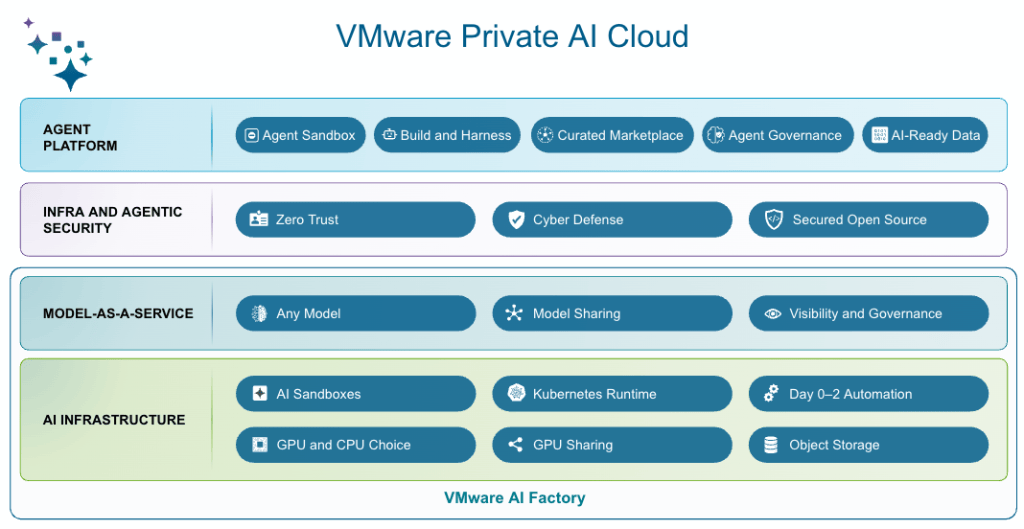
Fig. 1: The VMware Private AI Cloud stack, highlighting VMware Tanzu Platform at the top as the Agent Platform, supported by Infrastructure and Agentic Security provided by AgentMinder by Broadcom, VMware vDefend, and Avi Load Balancer, Model-as-a-Service from VCF AI services, and the VMware AI Factory infrastructure layer of VMware Cloud Foundation.
Tanzu Platform serves as the agent platform sitting at the top layer of the VMware Private AI Cloud. It directly abstracts underlying infrastructure complexity to deliver faster application and agent delivery. Within this unified stack, Tanzu Platform provides the complete agent execution environment: secure sandboxes, pre-built agent harnesses, governed model and tool marketplaces, centralized agent governance, and access to AI-ready data.
This integration extends directly into VMware Cloud Foundation 9.1. Platform teams can deploy Tanzu Platform into a VCF organization through a streamlined virtual appliance (OVA) architecture. The platform automatically provisions core platform resources directly into VCF constructs, automating projects, virtual private clouds, application and service subnets, and native VCF load balancing across routing tiers.
Whether your organization adopts VCF Automation for broad multi-tenant cloud orchestration or deploys directly via supervisor services on VCF 9.1, Tanzu Platform delivers an immediate, pre-engineered path to production.
Governing and debugging autonomous agents in production
Running autonomous agents requires an operational model designed for nondeterministic software. Unlike traditional microservices, agents formulate dynamic execution plans, call external tools, and query internal repositories. Tanzu Platform 11.0 enhances the purpose-built agent foundations engineered specifically to manage and secure these workloads.
To establish safer agent autonomy, Tanzu Platform now provides:
- Disposable agent sandboxes: Every agent executes inside an isolated sandbox with a deny-by-default security posture. Sandboxed environments lack direct shell access, cannot run arbitrary command line tools, and are destroyed after completing tasks to prevent exploit persistence.
- Isolated credential stores: Agents must authenticate to enterprise systems to perform work, but exposing static API keys or embedding secrets in application configuration creates unnecessary exposure. Tanzu Platform manages agent-ready secrets within an isolated credential store with policy-driven rotation. When agents invoke external tools through Model Context Protocol (MCP) servers, the platform brokers the connection directly through the MCP gateway, meaning the agent and underlying model never see or handle raw backend credentials, designed to eliminate credential leakage via prompt injection.
- Agent memory service: Managing conversation history and session persistence across complex interactions is often a manual, bespoke chore. Tanzu Platform introduces an out-of-the-box agent memory service, offloading state infrastructure so developers can build contextual, multi-turn agents without having to provision or manage their own dedicated conversation databases.
- Model Context Protocol (MCP) tool governance: Tanzu Platform routes tool interactions through a governed gateway. Platform teams apply role-based access control, tool filtering, and rate limiting to MCP servers, so that running agents only invoke curated, enterprise-approved actions.
- Agentic observability and debugging: Traditional application monitoring falls short when troubleshooting nondeterministic AI. Tanzu Platform introduces the agentic performance dashboard, agentic trace detail view, and structured logging. Platform engineers and developers can trace the entire invocation lifecycle: inspecting prompt inputs, token consumption, latency, Model Context Protocol tool calls, and retrieval context to instantly pinpoint why an agent took a specific action or where an execution stalled.
- New AI-Ready Data Foundations: Enterprise agents require trustworthy context to generate accurate responses. Tanzu Platform 11.0 introduces AI-ready data foundations to manage the complete data-to-AI lifecycle, structuring and enriching multimodal data with a semantic layer that maximizes response accuracy, curbs hallucinations, and minimizes token consumption. By federating queries across existing enterprise repositories without data migration, teams can publish governed, auditable data products directly to the marketplace for agents to consume.
Bringing the “push” experience natively to Kubernetes
For over a decade, the iconic “cf push” developer experience at the core of Cloud Foundry and VMware Tanzu Platform has defined developer velocity: give the platform your application code or a container, and it automates staging, container image builds, routing, health monitoring, service binding, and auto scaling.
With Tanzu Platform 11.0, that proven workflow arrives natively on Kubernetes via vSphere Kubernetes Service (VKS).
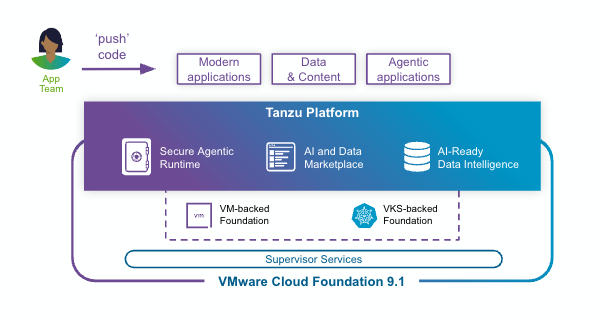
Fig 2.: Developer workflow diagram showing source code pushed via a single command, seamlessly building and routing workloads to either VMs or VKS on demand based on platform policy.
Platform teams no longer face a tradeoff between developer productivity and infrastructure standardization. Tanzu Platform can schedule and run application workloads directly on VKS or VMs on demand. Developers continue using standard commands, application manifests, and buildpack workflows. They do not need to write complex Kubernetes YAML manifests, manage Helm charts, or interact with kubectl.
Regardless of the runtime the Platform Engineer chooses, Tanzu Platform continues to provide the capabilities enterprises require to run applications and services at enterprise scale and availability. This includes features such as zero-downtime rolling updates of both applications and underlying infrastructure, canary based deployments, custom sidecars, task execution, exporting logs and metrics, and dynamic application security groups.
Defense in depth: Protecting the software supply chain and runtime at every boundary
Securing modern application environments requires defense in depth across every layer of the software supply chain and runtime. Threat actors exploit small flaws across libraries, dependencies, and OS layers. Tanzu Platform operationalizes continuous security by anchoring the three R’s of enterprise security: repave, repair, and rotate.
Application security begins with TrueSource, a new portfolio of offerings from Broadcom delivering maintainer-verified, cleanroom builds of open source software, including Spring and its dependency tree, curated libraries for Java, Python, and Node.js, and enterprise data engines. On Tanzu Platform, security starts directly at this application layer, executing every workload and autonomous agent inside an isolated, unprivileged sandbox with dynamic secret injection and deny-by-default networking. Surrounding the application tier, perimeter defenses from VMware vDefend and VMware Avi Load Balancer inspect inbound traffic, strip exploit attempts at the platform edge, and restrict lateral movement across namespaces. That defense extends downward into VMware Cloud Foundation, where attested hosts, secure boot, and zero-downtime vSphere Live Patching continuously shield the environment from exploits without scheduled maintenance windows or developer intervention.
One of the biggest breakthroughs in Tanzu Platform 11.0 is new environmentally-adjusted CVE scoring within the vulnerability insights dashboards.
Traditional vulnerability scanners operate in a vacuum. They inspect software packages, see a known vulnerability, and assign a generic, worst-case CVSS (Common Vulnerability Scoring System) score. Platform engineers and developers are left triaging hundreds of critical or high alerts, even when the code path cannot possibly be exploited due to the guardrails of the runtime environment.
Tanzu Platform leverages the CVSS concepts of environmental adjustments by evaluating vulnerabilities against the actual, active security controls enforced by the platform:
- Egress Deny by Default: Most remote code execution exploits are two steps: trigger the vulnerability, then reach back out to fetch a payload or take instructions from a command-and-control server. With application security groups, Tanzu Platform blocks and monitors outbound network traffic from application containers unless a route is explicitly allowed. A vulnerability that depends on that callback still exists in the package, but the exploit chain breaks at step two. The platform-adjusted score reflects that break.
- Unprivileged, non-root containers: Many high-severity CVEs assume the attacker can escalate from the application process to the host. On Tanzu Platform, applications run as an unprivileged user inside a container with a restricted syscall surface, including seccomp profiles, AppArmor or SELinux, and dropped capabilities. Root inside the container is not root on the node. CVEs whose impact depends on privilege escalation or host access are rescored against that boundary.
- Ingress-aware vulnerability prioritization: By default all public routes need to be configured for any application instance. For application instances with public routes, every request passes through platform-managed ingress and isolates routes from one another. If the application does not have a public route, it is not susceptible to a large segment of vulnerabilities. This is reflected in the environmental rescoring of CVE severity, allowing for greater prioritization where only functionally vulnerable workloads are highlighted.
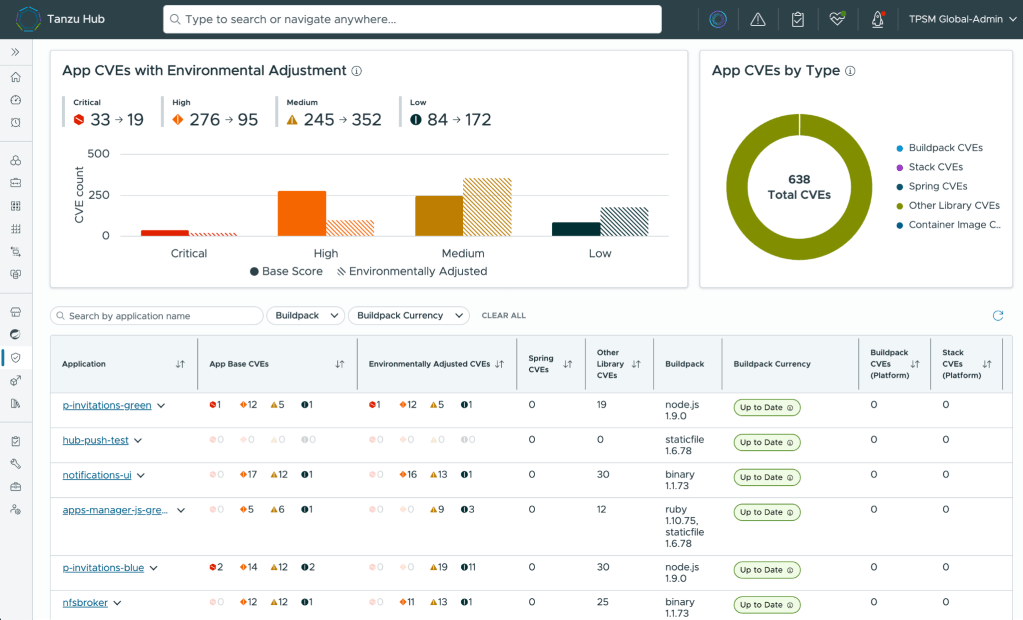
Fig 3.: The Tanzu Vulnerability Insights dashboard visualizes the shift from raw scanner severity to real runtime exposure by applying environmental modifiers to each application vulnerability. Environmentally contained vulnerabilities are rescored downward, cutting critical and high alerts across the fleet so engineers stop chasing scanner noise.
By applying environmental metrics factor by factor, Tanzu Platform recalculates raw CVSS severity into an environmentally adjusted score. A theoretical base 10.0 or 9.8 vulnerability (such as Spring4Shell or modern authorization bypasses) is automatically recognized as contained–meaning its actual in-place score is much lower than critical. Platform engineers no longer spend days chasing phantom critical alerts, allowing teams to direct their patching bandwidth toward vulnerabilities that pose actual, reachable business risk.
When a true fix is required, platform engineers trigger a restage. The platform pulls the original application source, compiles a fresh container image using the updated buildpack and TrueSource transitive dependencies, and performs a zero-downtime rolling update across the entire fleet without requiring a single developer code commit.
Declarative foundation lifecycles and regional resilience
As enterprise footprints expand across multiple data centers and sites, platform teams must manage high availability without multiplying administrative overhead. Tanzu Platform 11.0 introduces regions as first-class architectural entities, directly mirroring VMware Cloud Foundation constructs.
Regions unify capacity pools into geographically organized environments. Rather than configuring separate foundations, organizations manage spaces and applications as single logical units across regional capacity, while platform operators retain granular insight into underlying foundation nodes.
To maximize infrastructure efficiency, Tanzu Platform 11.0 introduces dynamic capacity rebalancing and self-healing workloads. When capacity is added to an existing region or foundation, application instances dynamically redistribute across availability zones and member foundations. If an availability zone experiences degraded performance or capacity constraints, the platform redistributes instances to maintain resilient, balanced performance.
Foundation provisioning is also completely declarative. Platform engineers define foundation specifications, network policies, and out of the box profiles within Tanzu Hub prior to deployment. Standardized T-shirt sizing (Small, Medium, Large) abstracts low-level VM definitions, while automated generation of TLS certificates and encryption keys accelerates GitOps-driven vending across the private cloud.
Decoupling data engine upgrades across the enterprise data services fleet
Enterprise applications depend on reliable data services, yet keeping stateful data engines patched and compliant has traditionally forced organizations into disruptive, after-hours maintenance windows. Tanzu Platform 11.0 aims to solve this challenge by decoupling platform data service tile lifecycles from underlying database engine upgrades.
Platform engineers can apply tile updates, base OS stemcell patches, and platform security fixes on demand without forcing database engine upgrades on application teams. At the same time, service managers gain dedicated views to manage database engines independently, choosing when to upgrade specific workloads across multiple supported engine releases, such as running PostgreSQL 16 and 17 or Apache Kafka 4.2 or 4.3 concurrently on the same platform.
To streamline service fleet management, Tanzu Platform delivers:
- Separation of Concerns: Clear role-based boundaries give platform engineers ownership of infrastructure parameters, routing, and HA topologies, while service managers control engine versions, maintenance windows, and plan-level backup policies.
- Operator-Based Data Tiles: New Kubernetes-native operator tiles for enterprise distributions of Postgres, MySQL, Valkey, RabbitMQ as well as VMware Tanzu GemFire and VMware Tanzu Greenplum, provide efficient lifecycle management and high-availability topologies while preserving standard create and bind CLI commands for developers.
- Service Publishing and InnerSource: Application teams can publish their own APIs, microservices, custom MCP servers, and agents directly into the Tanzu Platform marketplace. This transforms deployed internal applications into first-class, consumable service instances that other teams can bind to using standard commands.
- Cross-Region Disaster Recovery: Out of the box disaster recovery orchestration provides visible replication lag metrics and coordinated failover for Postgres and MySQL fleets across regions.
Accelerating the future of enterprise software
Whether you are optimizing mission-critical line-of-business applications or delivering an autonomous fleet of enterprise AI agents, Tanzu Platform 11.0 provides the governance, speed, and reliability that enables organizations to go from concept to production in days rather than months.
By establishing the native platform as a service for VMware Cloud Foundation 9.1, Tanzu Platform helps remove the legwork of infrastructure plumbing. Workloads schedule seamlessly on VMs or VKS on demand using the same proven push experience, removing the operational friction of writing bespoke Kubernetes YAML, building complex deployment pipelines, and managing clusters manually.
The ultimate metric of a modern platform is business agility. Tanzu Platform 11.0 frees your developers and platform engineers to deliver software faster, react to market demands instantly, and drive measurable impact for the business.
Ready to Learn More?
- Explore the release details: Review the full technical specifications and upgrade paths in the VMware Tanzu Platform 11.0 release notes.
- See the platform in action: Visit the official VMware Tanzu Platform product page to learn more or contact your sales team to discuss scheduling a hands-on demo or deploying Tanzu Hub in your environment.
- Deep dive into Private AI: Read our companion guide on Tanzu Platform: The Agent Platform for VMware Private AI Cloud to learn how to operationalize sovereign agentic workloads.