

Enterprises running private cloud face a common question: what does the investment actually deliver? To answer it, we commissioned Forrester Consulting to conduct an independent New Technology Total Economic Impact™ (TEI) study on VMware Cloud Foundation 9 (VCF 9). Forrester interviewed decision-makers at organizations running VCF 9 and surveyed additional customers to develop a composite organization and financial model that quantifies the potential financial and operational impact of the solution.
The results are compelling and they are now available for you to explore in depth, both in the full study and in our recent on-demand webinar featuring guest speakers from the Forrester team.
About the Study and the Customers Behind It
Forrester Consulting conducted a 2026 commissioned New Technology Total Economic Impact™ (TEI) study based on eight one-on-one customer interviews and a survey of 55 customers. The study was modeled over a three-year period. The study reflects the experiences of large, complex enterprises running VCF 9 in production — organizations with significant infrastructure footprints, diverse workloads, and the operational challenges that come with scale. Their experiences informed the composite organization, assumptions, and financial analysis presented in the study.
Key Findings at a Glance
Forrester’s three-year projected financial analysis shows that VCF 9 delivers significant, measurable value across cost, efficiency, productivity, and risk.
| Metric | Result |
| Projected ROI | Up to 137% |
| Reduction in infrastructure operations time | Up to 33% reduction in time spent through automation and fleet management |
| Time-to-delivery improvement | Up to 50% faster application delivery |
| Developer time saved | Up to 13 hours per developer per month through self-service and automation |
| Manual network ticket reduced | Up to 72% reduction in manual network ticket volume |
Where the Value Comes From
The study quantifies benefits across six categories. In the study’s high-impact scenario, the projected benefits break down as a share of total quantified benefits as follows:
| Benefit category | Share of total benefits |
| Reduced infrastructure costs (improved resource utilization and workload consolidation) | 37% |
| Reduced operations effort (infrastructure, storage, and network operations through automation and unified management) | 34% |
| Reduced downtime impact (unplanned infrastructure and storage downtime) | 12% |
| Faster infrastructure and application delivery (automation and standardized provisioning) | 10% |
| Eliminated third-party tooling costs (infrastructure and management consolidation) | 4% |
| Security and compliance (reduced exposure to security incidents, vulnerability remediation, and audit effort) | 3% |
| Total | 100% |
The big takeaway: in the study’s high-impact scenario, over 70% of quantified benefits came from two areas: lowering infrastructure costs through better utilization and workload consolidation, and reducing the operational effort needed to run infrastructure. Downtime reduction and faster delivery each contributed roughly 10-12%, while tool consolidation and security/compliance round out the remaining value.
The Customer Journey: Why Organizations Chose VCF 9
Before adopting VCF 9, interviewed organizations described complex, fragmented infrastructure environments built up over time through a mix of legacy systems and point solutions. Common challenges included slow provisioning, heavy manual coordination, tool sprawl, higher downtime risk, and mounting security and compliance overhead.
VCF 9 gave these organizations a way to unify and automate — bringing the agility, self-service, and consumption experience of public cloud together with the resilience and cost control of on-premises infrastructure. The TEI study quantifies what that transformation is worth in dollars, hours, and risk avoided.
Watch the Webinar: The Forrester TEI Study, on Demand
To go deeper into the methodology, the composite model, and the metrics that matter most to your business case, watch our on-demand webinar with the Forrester team.
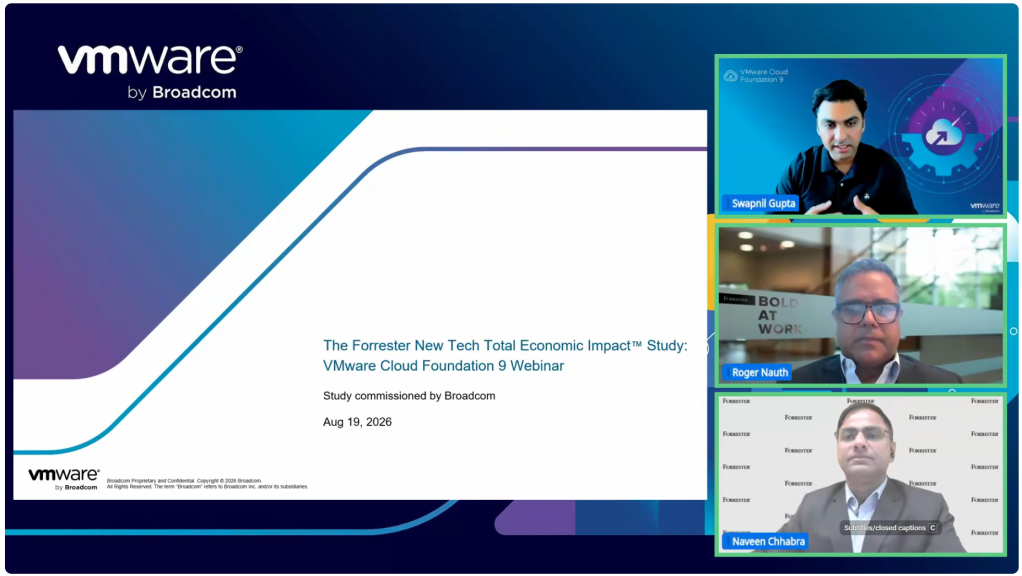
[On-Demand video – Webinar video link here]
What you’ll learn
- The TEI methodology and how Forrester built the composite financial model
- The headline findings on infrastructure cost reduction, operational efficiency, developer productivity, and risk mitigation
- The metrics that matter most when building an internal business case or benchmarking your current environment
- Analyst perspective on what these results mean for enterprises evaluating or running VCF
Speakers
- Roger Nauth – Senior Consultant, Total Economic Impact™ Consulting Practice, Forrester
- Naveen Chhabra – Principal Analyst, Forrester Research
- Swapnil Gupta – Senior Product Marketing Manager, VCF Division, Broadcom
Whether you’re evaluating VCF, building an internal justification, or benchmarking your current environment, this session delivers the data and analyst perspective you need.
Read the Full Study
The complete Forrester Consulting TEI study walks through the methodology, the composite organization profile, the full benefits and costs analysis, and the risk-adjusted financial model behind these numbers.
Access the full Forrester New Technology TEI study for VMware Cloud Foundation 9 →
The Bottom Line
The Forrester TEI study makes the business case for VCF 9 concrete. The large, complex enterprise in the study stands to gain up to 137% projected ROI, along with meaningful improvements in delivery speed, developer productivity, and risk reduction.
These aren’t vendor claims. They come from an independent study based on real customer interviews and a disciplined financial model. Explore the study, watch the webinar, and use the findings to inform your own VCF 9 journey.
Discover more from VMware Cloud Foundation (VCF) Blog
Subscribe to get the latest posts sent to your email.