
Executive Summary
For critical infrastructure providers such as Telecom providers, platform reliability and uptime are not just operational metrics; they are strict regulatory requirements and the foundation of customer trust. However, keeping these sprawling environments patched, secure, and up-to-date has historically required complex, multi-stage maintenance windows that drive up Operational Expenditure (OpEx) and introduce scheduling risks.
To address these challenges, Broadcom has introduced a suite of transformative lifecycle management capabilities across VMware Cloud Foundation (VCF) components, especially with VMware vSphere Kubernetes Service (VKS). Platform teams can now execute infrastructure updates at unprecedented speeds with key capabilities such as Fast Deploy (introduced in VCF 9.1), In-Place Updates (introduced in VKS 3.7), and Chained Upgrades (introduced in VKS 3.8). By optimizing the management of worker nodes and drastically reducing the time required to provision and upgrade clusters, organizations can minimize their maintenance windows, eliminate unnecessary node rebuilds, and dramatically lower the OpEx associated with managing critical infrastructure.
High Stakes of Maintenance Windows in Critical Infrastructure
In critical infrastructure environments, applications are deeply intertwined with the underlying compute platform. Performing Kubernetes cluster upgrades typically requires rerouting traffic, deploying new nodes, cordoning and draining existing worker nodes, and validating continuously to avoid service degradation. This process was repeated for every intermediate Kubernetes version given the fact that Kubernetes upgrades have to be sequential.
For very large environments, this traditional approach creates several severe pain points:
- Bloated Maintenance Windows: Manual multi-step upgrades require extended, multi-hour maintenance windows, often forcing operation teams into expensive overnight and weekend shifts.
- High OpEx: The manual oversight, extended execution times, and infrastructure churn associated with rolling upgrades consume valuable engineering hours.
- Increased Risk: Every time a pod is drained and rescheduled, or a new virtual machine is provisioned, there is a risk of disruption. Manual multi-stage upgrades multiply this risk.
The latest releases of VCF Telco directly target these inefficiencies, rethinking the upgrade strategy to prioritize speed, safety, and in-place efficiency.
Transformative Lifecycle Capabilities
1. Fast Deploy for Rapid Provisioning
Introduced in VCF 9.1, Fast Deploy is a key capability designed to dramatically accelerate both standard virtual machine and VKS cluster provisioning. By leveraging advanced backend storage and cloning technologies, Fast Deploy completely alters the timeline for spinning up new infrastructure. Instead of waiting for traditional thick provisioning or full image copies across the network, Fast Deploy uses accelerated storage-level cloning that allows platform teams to stand up clusters in a fraction of the time.
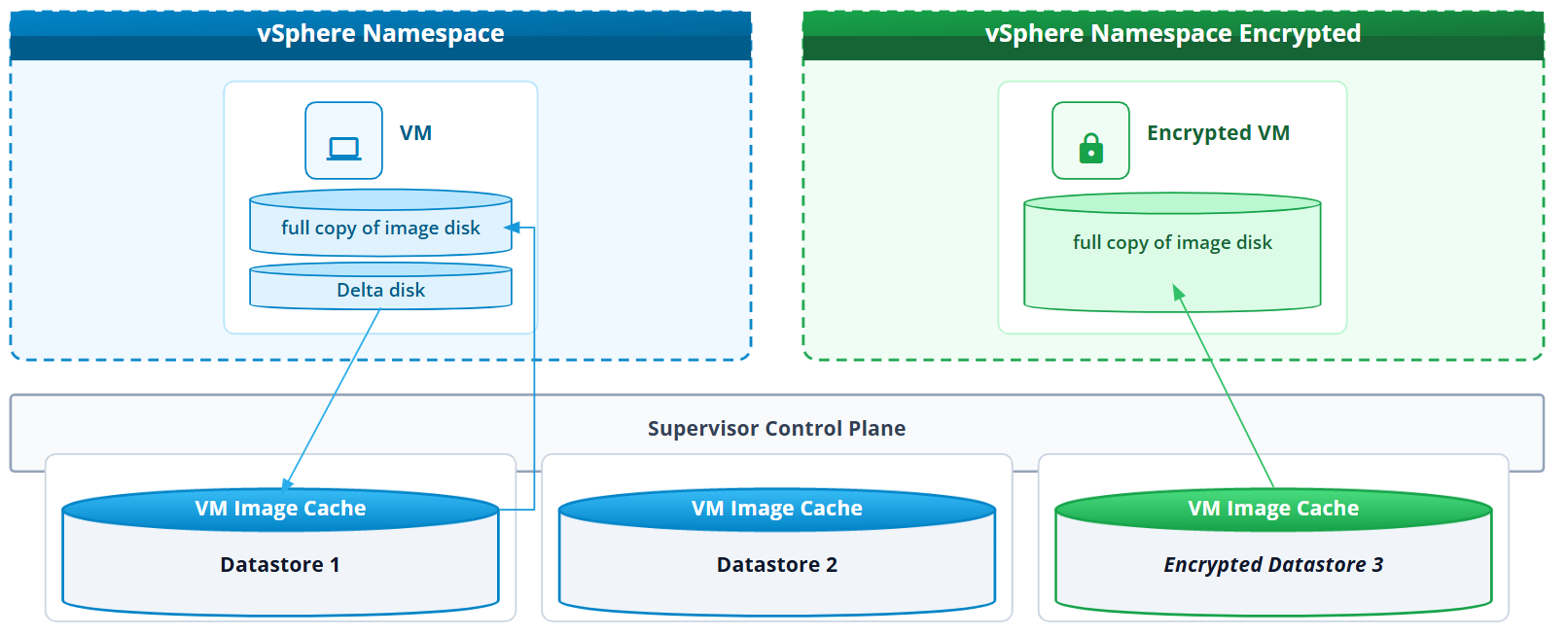
Figure 1: Fast Deploy in VCF
2. In-Place Updates for Worker Nodes
Standard upstream Kubernetes lifecycle management relies heavily on the “rolling update” model. If a configuration needs to change, the control plane spins up a brand-new worker node virtual machine, joins it to the cluster, moves workloads to it, and deletes the old node. With VKS 3.7, Broadcom introduced intelligent In-Place Updates (utilizing configurations like MinimizeSpareNodes and RespectMaxUnavailable). This feature prevents the system from unnecessarily rolling out and replacing worker nodes for certain platform configurations. Instead of multiple rollouts, the configuration is applied directly to the existing, running nodes. Here’s a link to a detailed demo on In-Place Updates for more information.
3. Automated Chained Upgrades with Fail-Fast Checks
Kubernetes architecture strictly dictates that clusters must be upgraded sequentially (e.g., v1.34 to v1.35 to v1.36). This meant performing a full rolling upgrade for every minor version jump. VKS 3.8 solves this with Automated Chained Upgrades. When an administrator selects a target version that is multiple hops away, the system orchestrates the entire upgrade path automatically including the addons. Crucially, the system includes built-in compatibility and fail-fast checks before the upgrade even begins—halting the process if addons are unhealthy or cluster states are invalid.
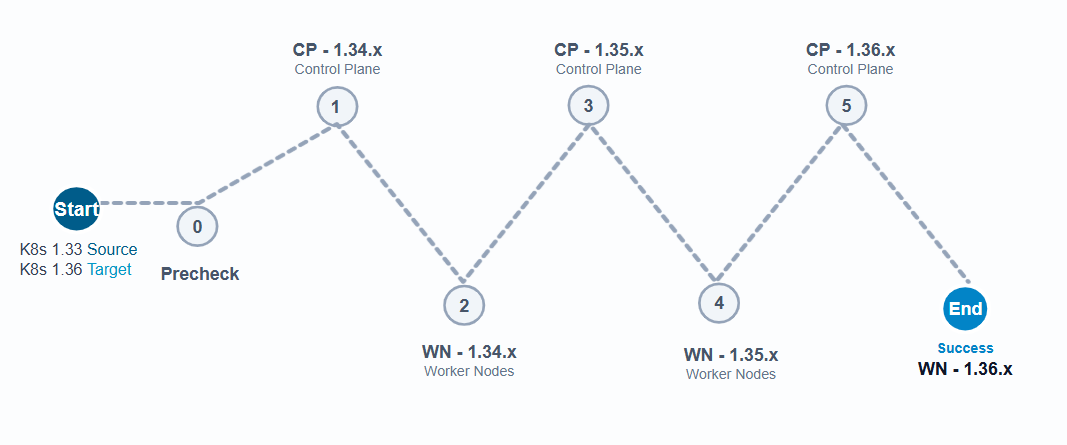
Figure 2: Chained Upgrades in VKS
How It Reduces OpEx and Shrinks Maintenance Windows?
By combining these three features, Telcos and critical infrastructure operators achieve a compounding effect on both time and financial savings. Instead of treating these as isolated improvements, they converge to completely overhaul the maintenance window.
The following table summarizes how these capabilities converge to reduce Operational Expenditure and shrink maintenance windows:
| Feature | Operational Impact | OpEx & Maintenance Window Reduction |
| Fast Deploy | Replaces slow, full-copy VM provisioning with accelerated storage-level cloning. | ~75% Time Reduction: Slashes the time engineers spend waiting for infrastructure to deploy during critical overnight upgrade windows. |
| VKS In-Place Updates | Updates existing worker nodes in-place rather than forcing a destructive rolling update. | Zero Pod Eviction / Lower Churn: Eliminates the need to cordon, drain, and reschedule pods for configuration changes, directly reducing network overhead and engineering supervision. |
| VKS Chained Upgrades | Automates multi-version hops with pre-flight fail-fast compatibility checks. | Substantial Resource Optimization: Condenses multi-step, 8-hour upgrade marathons into single automated workflows. Fail-fast checks prevent mid-upgrade breakages and costly rollback scenarios. |
The Bottom Line: Protecting the Margin
For Telcos and critical infrastructure providers, the margin between profitability and excessive OpEx is often dictated by operational efficiency. Long, manual, and risky upgrade cycles burn operational hours and risk the service-level agreements (SLAs).
With the combination of Fast Deploy, In-Place Updates, and Automated Chained Upgrades, platform engineers are equipped with a next-generation lifecycle engine. By eliminating unnecessary node rebuilds, orchestrating multi-hop upgrades automatically, and provisioning infrastructure at lightning speed, VCF Telco transforms the dreaded maintenance window into a brief, automated, and highly predictable event—safeguarding both your critical network functions and your operational budget.
Ready to Modernize Your Telco Infrastructure?
- Explore the VCF 9.1 Capabilities Deep-Dive
- Discover the VMware vSphere Kubernetes Service (VKS) Release Notes
- Contact your Broadcom account representative for a customized lifecycle modernization assessment.
Discover more from VMware Telco Cloud Blog
Subscribe to get the latest posts sent to your email.