Today, Broadcom announced VMware Cloud Foundation (VCF) 9.1, the next milestone in the evolution of the industry’s most widely deployed private cloud platform.
VCF 9.1 is a focused release with a clear ambition: to be the most cost-effective and secure foundation for production AI, modern applications, and traditional workloads—operated under a single control plane, on infrastructure the enterprise owns and governs.
This release arrives at a moment when the demands on enterprise infrastructure have rarely been higher, or more contradictory. Understanding why VCF 9.1 works the way it does requires a brief look at the forces shaping every IT roadmap in 2026, and at the architectural choices those forces now demand.
Three Forces Reshaping IT in 2026
Three forces are defining and even redefining an IT operating environment for which VCF 9.1 was purposely built.
The first is AI demand, which is now being embedded in many day to day applications and operations. IDC forecasts worldwide AI spending will grow at a 31.9% CAGR through 2029, reaching $1.3 trillion and exceeding 26% of total worldwide IT spending. This is a structural reallocation of the enterprise technology budget toward AI-enabled applications and the platforms that run them. PwC’s 2025 Global AI Jobs Barometer, based on analysis of close to a billion job ads across six continents, finds that productivity growth in industries most exposed to AI has nearly quadrupled since 2022.
The second is geopolitical gravity which compounds AI security issues. Data sovereignty regulations, export controls on accelerators, and fragmented regional compliance regimes have made workload location a board-level question. Default reliance on a public cloud, and a public cloud-only infrastructure is a questionable choice in 2026.
The third is budget compression. AI leaders achieve meaningful cost reductions precisely because they treat infrastructure efficiency as a first-class discipline. The rest of the market is being asked to fund AI ambitions out of flat or shrinking operating budgets.
VMware Cloud Foundation 9.1 at a Glance
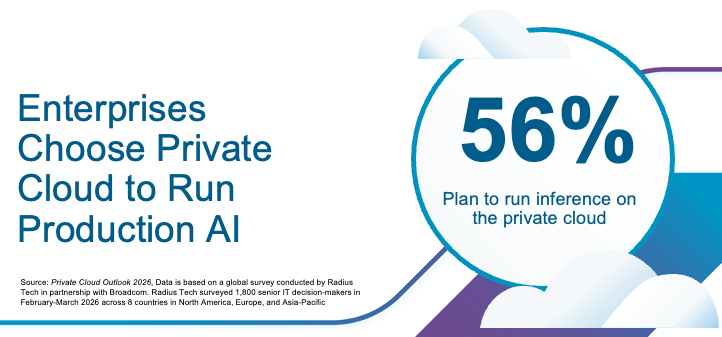
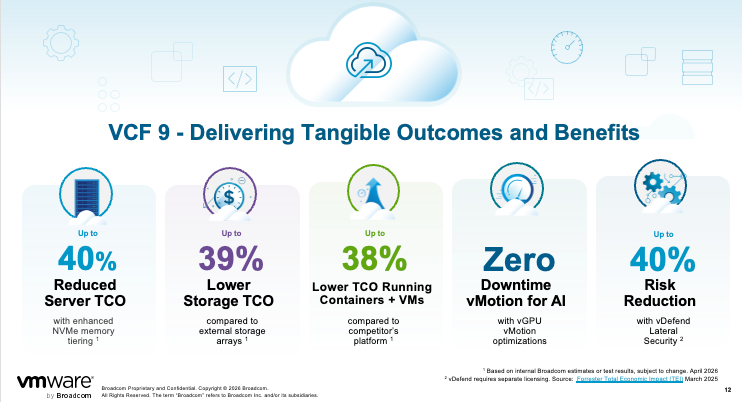
VMware Cloud Foundation 9.1 is engineered to address these market pressures: a private cloud platform designed to run production AI at the lowest cost per workload, under enterprise sovereignty, without compromising security or delivery velocity.
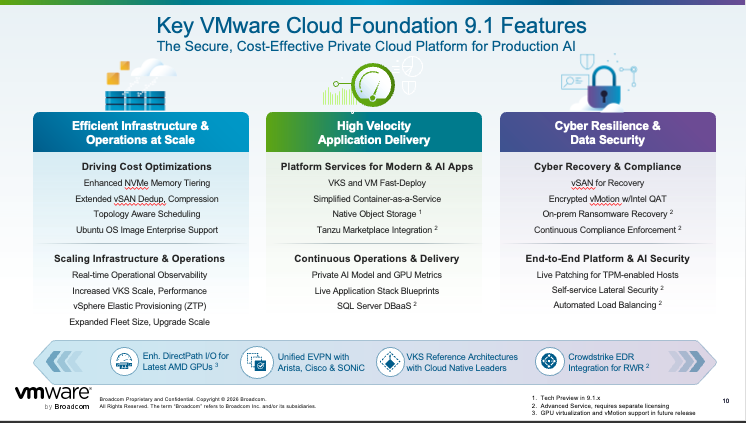
Efficient Infrastructure and Operations at Scale
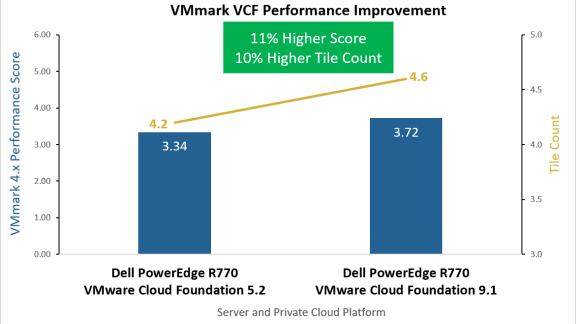
Customers are running denser, more demanding workloads—AI inference, GPU pipelines, large in-memory databases—while being asked to do more with the same infrastructure budget. VCF 9.1 responds on two fronts: drive down cost per workload, and make operating at scale less painful.
To reduce cost, Enhanced NVMe Memory Tiering extends effective memory pools by intelligently tiering DRAM and NVMe—a direct answer to memory-bound AI and database workloads. Extended vSAN Dedup and Compression lowers cost per usable terabyte, Topology Aware Scheduling places workloads with NUMA and accelerator locality in mind, and Ubuntu OS Enterprise Support broadens the workload ecosystem without added overhead.
On the operations side, Real-Time Operational Observability turns telemetry into action, increased VMware vSphere Kubernetes Service (VKS) scale raises the Kubernetes ceiling, vSphere Elastic Provisioning enables zero-touch fleet expansion, and expanded Fleet Size and Upgrade Scale let a single VCF instance govern larger estates with fewer maintenance windows.
Our feature blogs will cover the full 9.1 payload in detail.
| The overall outcome: more workloads per rack, fewer operators per thousand workloads, and a measurable reduction in cost-to-serve. |
High-Velocity Application Delivery
A modern platform in the AI era is tasked to deliver VMs, containers, AI services, and data services with equal fluency. VCF 9.1 closes that gap and delivers this important requirement.
VKS and VM Fast-Deploy materially shortens time-to-running for both Kubernetes and VM workloads. Simplified Container-as-a-Service turns VKS into a true self-service surface for application teams. Native Object Storage (tech preview in version 9.1.x) brings S3-compatible storage natively into the platform Tanzu Marketplace integration provides a curated path to certified middleware and data services, and SQL Server DBaaS elevates the most-deployed enterprise database to a first-class citizen of the private cloud control plane.
For AI specifically, Private AI Model and GPU Metrics expose the telemetry platform and MLOps teams require: utilization, memory pressure, and model-level visibility on the same console as the rest of the estate. Live Application Stack Blueprints enable teams to version and redeploy entire application topologies as code.
| The outcome: one platform and one operating model—from a legacy three-tier application to a RAG pipeline running on the latest AMD GPUs. |
Cyber Resilience and Data Security
In VCF 9.1, resilience is treated as an architectural property. vSAN for Recovery and On-prem Ransomware Recovery provide a sovereign, in-platform path to recover from destructive attacks without dependence on external escrow. Encrypted vMotion with Intel QAT offloads cryptography to dedicated silicon, removing the historical performance tax on end-to-end encryption in motion. Continuous Compliance Enforcement transforms compliance from a quarterly audit exercise into a runtime guarantee.
On platform security, Live Patching for TPM-Enabled Hosts eliminates one of the largest sources of unplanned downtime in large estates. Self-Service Lateral Security and Automated Load Balancing place micro-segmentation and traffic management in application-team hands, governed by central guardrails. The CrowdStrike EDR integration for Ransomware Recovery gives customers additional choice for endpoint detection in the recovery workflow.
| The outcome: recovery, patching, and compliance shift from periodic events on the operations calendar to continuous properties of the platform. This is incredibly important when you are running sensitive data and high-value AI models and need security by design, not by exception. |
Open Platform and Ecosystem Flexibility
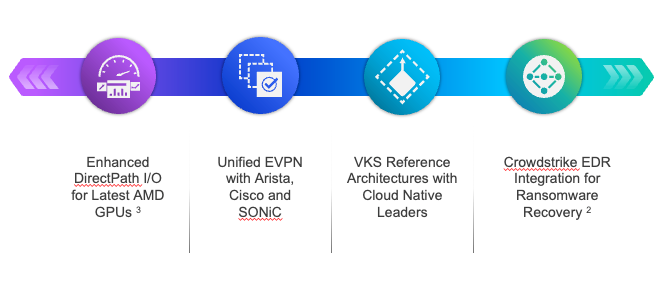
Ecosystem integration is incredibly important in VCF 9.1. It is a transversal design principle. No enterprise of meaningful scale runs a single-vendor estate, therefore, VCF 9.1 is engineered to make the customer’s existing hardware, fabric, and framework choices interoperate under one operating model. Three capabilities in this release make that posture concrete.
Enhanced DirectPath I/O for the latest AMD GPUs extends near-bare-metal accelerator performance to the newest generation of AMD silicon.
Unified EVPN with Arista, Cisco, and SONiC delivers a consistent overlay fabric across the three dominant data center networking stacks—including the open-source option that hyperscalers have legitimized for the enterprise. Network teams get one operating model regardless of which switch vendor sits in which rack, which materially shortens the time required to onboard new sites or absorb acquired estates.
And finally, the new VKS Reference Architectures with cloud-native ISVs give platform teams a validated starting point.
Next Steps
With VCF 9.1, customers on VCF 9.0 can move via a supported in-place upgrade path; the VCF 9.1 Upgrade Guide and compatibility matrix on the Broadcom support portal are the recommended starting points. Customers earlier in the journey should begin with the VCF 9.1 Reference Architecture library for validated AI, container, and traditional workload designs.
To go deeper:
- Watch the replay of the VCF 9.1 Launch Webinar for an end-to-end walkthrough of the three pillars and a live demonstration of Private AI Model and GPU Metrics.
- Request an executive briefing to map VCF 9.1 capabilities to enterprise AI and sovereignty roadmaps.
- Follow the VCF 9.1 technical deep-dive series covering NVMe Memory Tiering, Native Object Storage, On-Prem Ransomware Recovery, and much more.
Discover more from VMware Cloud Foundation (VCF) Blog
Subscribe to get the latest posts sent to your email.