
Thousands of remote sites keep business moving, often without a single systems administrator on site. That gap creates the defining challenge of the distributed edge: heavy hardware sprawl run by a lean team. VMware Cloud Foundation Edge (VCF Edge) is an optimized configuration of VMware Cloud Foundation (VCF) built for edge use cases. It runs traditional VMs, native containers, and edge AI workloads on one consistent platform across thousands of remote locations, with centralized policy and automation doing the heavy lifting.
Following the release of VCF Edge 9.1, we are continuing to build on that foundation by delivering new capabilities for VCF Edge in 9.1.2 for fleet management, application delivery, and security to improve operations. Here’s what’s new in these releases, and what it means for running edge sites.
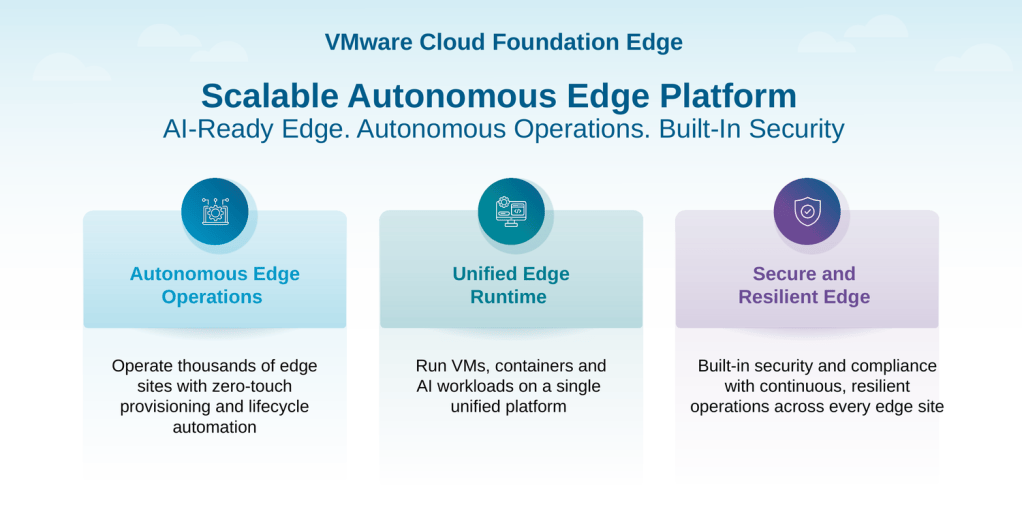
Edge Fleet Operations: AI Diagnostics, Compliance, and Kubernetes Upgrades
Operating thousands of distributed sites requires a single management view. These releases take a step toward that goal.
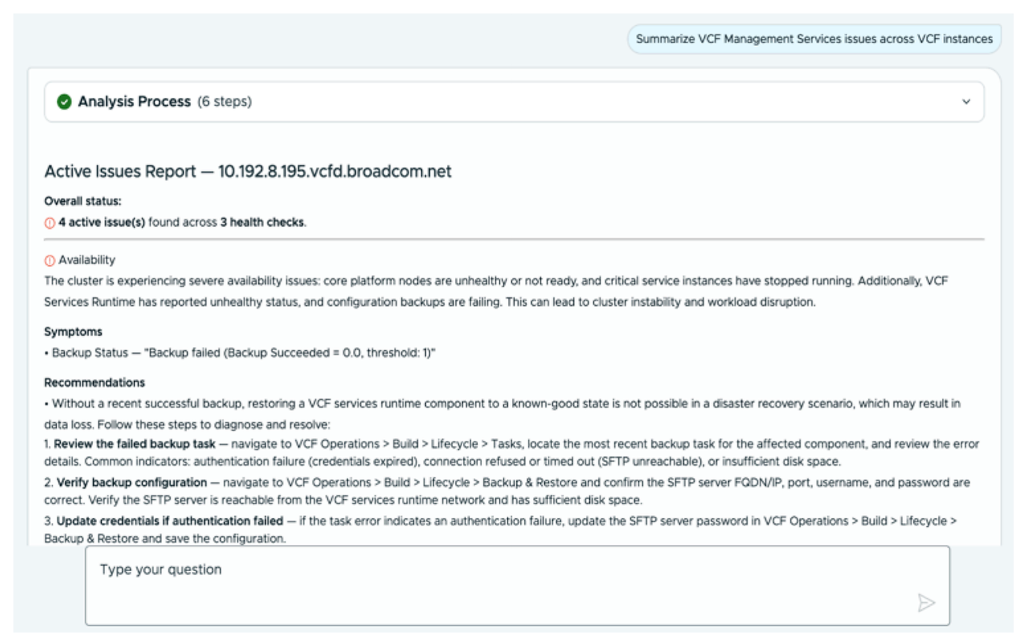
AI-powered diagnostics speed up root-cause analysis. The VCF AI Assistant within VCF Operations, introduced Tech Preview, brings conversational, AI-driven diagnostics. Technicians can ask questions to accelerate root-cause analysis across thousands of edge sites, without needing specialized expertise. Cross-site anomaly detection correlates real-time health signals to catch cluster instability and fleet-wide patterns before they cause downtime, and unified fleet health visibility automatically distinguishes an isolated site failure from a systemic issue. The result, lower mean time to repair (MTTR) reducing late night fire drills for lean IT team.
Compliance at scale, from a single console. VCF Edge now supports fleet-scale compliance and remediation across VCF components, automating ongoing checks against PCI DSS 4.0 and VMware Cloud Foundation security baselines for thousands of remote sites in one view. Distributed operators and retailers can detect configuration drift centrally and pull compliance reports in minutes rather than weeks, reducing manual work for regional staff and store teams.
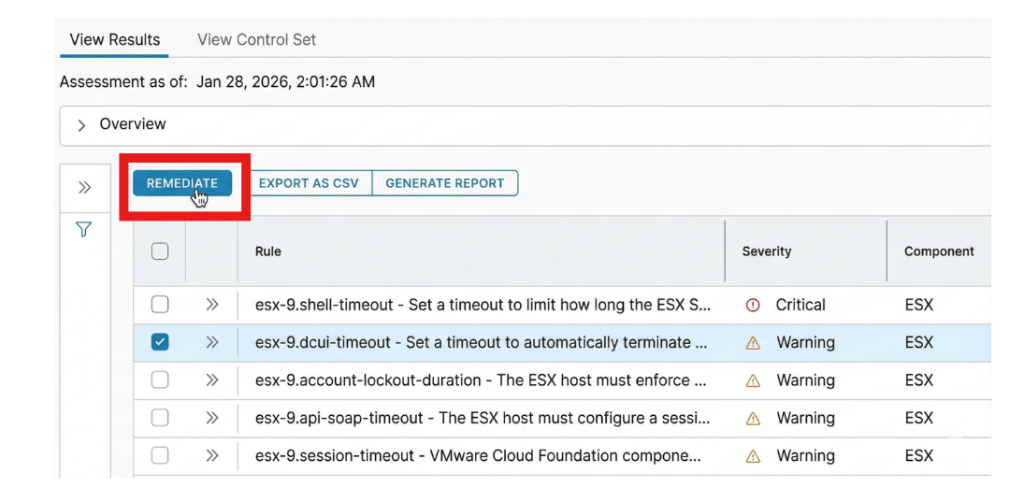
VCF Operations dashboard interface showing a compliance assessment
Chained Kubernetes upgrades give lagging fleets a predictable path. In VMware vSphere Kubernetes Services (VKS) 3.8, automated chained version upgrades orchestrate a cluster from an older Kubernetes version automatically figuring out the intermediate upgrade steps needed to move to the target version, with no manual dependency mapping. The system automatically applies the latest stable patch at each step and keeps add-ons synchronized with the platform version, so fleets that have fallen behind can catch up with a predictable, low-risk path. For sites that are air-gapped or disconnected, the new VKS Upgrade Planner, released via GitHub, identifies the exact stable intermediate patch releases needed to prepare local repositories before an upgrade ever touches production.
Kubernetes and Edge AI at Edge Sites with VKS. VKS Quickstart removes the “empty box” friction that slows Kubernetes adoption at remote sites. Built natively into vCenter, it walks platform teams through a simple three-step workflow to activate the vSphere Supervisor, deploy Harbor, and deploy a VKS cluster, delivering Day 1 readiness for app development without specialized onsite IT or external automation tools. Available in VCF 9.1.2, VKS Quickstart also pre-integrates essential add-ons and a visual UI like Headlamp, allowing application teams to deploy and test edge AI and modern workloads right away.
A harder target for attackers. Platform hardening in VKS 3.8 programmatically disables Secure Shell (SSH) across Kubernetes control plane and worker nodes, closing a common entry point for brute-force attacks and eliminating manual, error-prone OS-level configuration. For edge sites such as retail storefronts, branch offices, and factory floors, or in any environment with limited physical perimeter security, that is a meaningfully smaller attack surface by design.
Edge Security: Confidential Computing and HyperArmor
When hardware runs outside locked cages and without local IT support, attackers look for easy openings, stolen passwords, unpatched hosts, and exposed ports.
Confidential computing protects data in use. Hardware-isolated workloads, supported through AMD Secured Encrypted Virtualization-Secure Nested Paging (SEV-SNP) and Intel Trusted Domain Extension (TDX), encrypt data while it’s actively processing in memory and isolate workloads from the host. Now natively integrated into the VCF Edge platform, confidential computing protects data, so even if an edge device or hypervisor is compromised, sensitive data and regulated workloads stay protected extending zero-trust principles all the way to the edge. VCF Operations identifies which ESX hosts can run confidential VMs and containers, and Quick Boot is supported on hosts with confidential computing active, which helps keep maintenance windows short.
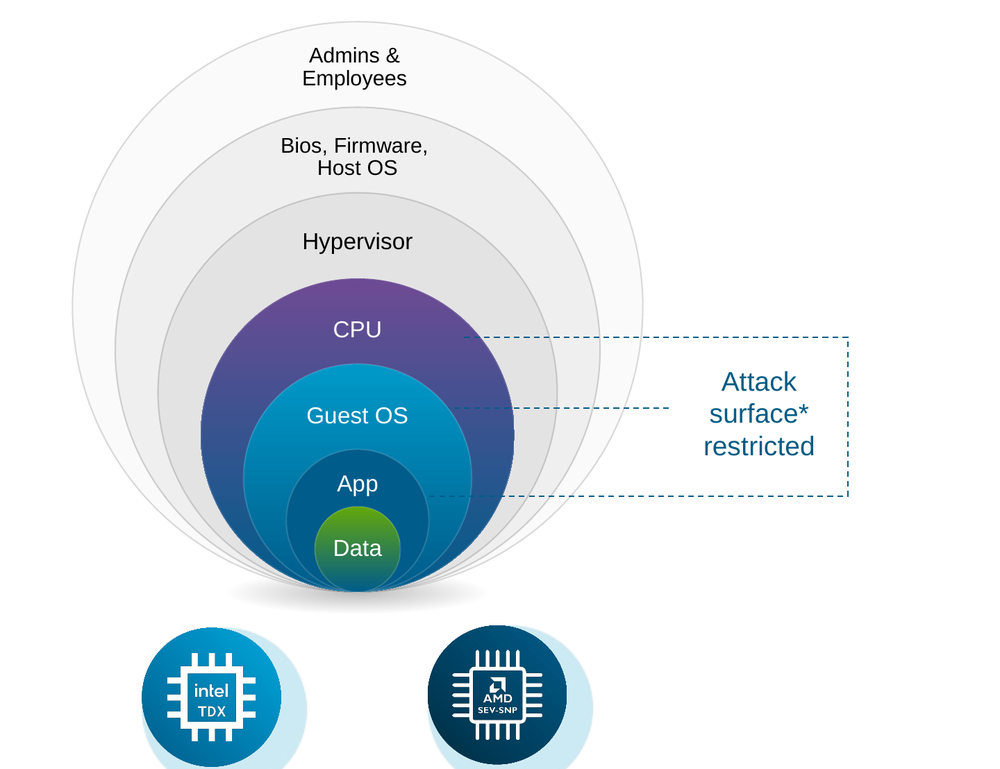
Hardware isolated confidential computing security boundary
Proactive defense at the hypervisor layer. VMware HyperArmor¹ is a new software solution to help further protect the VMware ESX hypervisor component of VCF against sophisticated cyber attacks. It delivers host-layer, real-time virtual patching that mitigates exploit attempts without a host reboot, giving IT teams room to plan and apply permanent patches on their own schedule. HyperArmor also continuously monitors the ESX hypervisor and blocks suspicious behavior, and it adds multi-factor authentication to SSH, so a stolen password alone does not grant access. Together, these help protect business continuity against rapidly increasing threats.
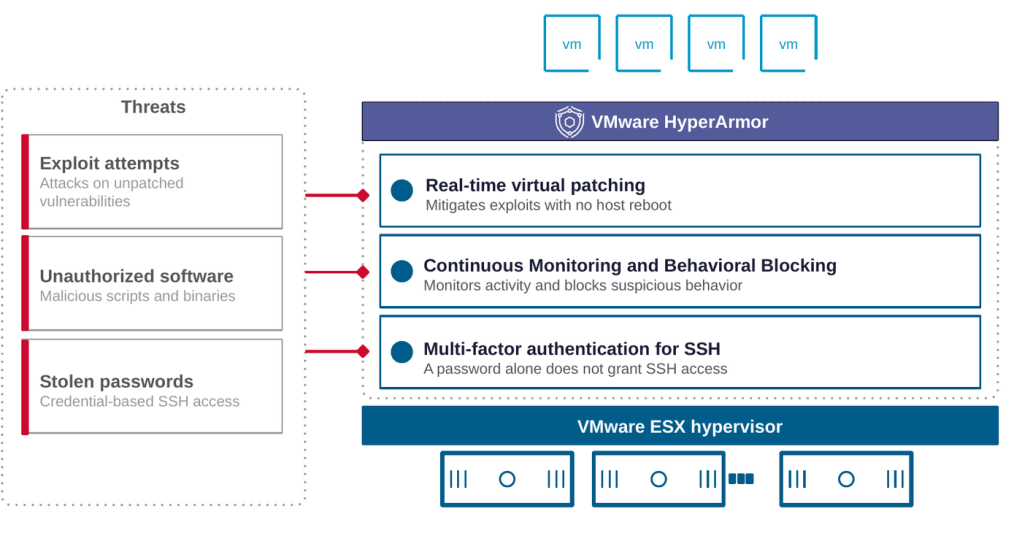
VMware HyperArmor sits between VMs and ESX to provide proactive threat defense.
One Edge Platform for VMs, Containers, and AI at Every Site
With VCF Edge 9.1.2, distributed organizations can manage thousands of remote locations in a single view, deploy modern apps and Edge AI workloads without specialized on site IT, and harden physically exposed infrastructure. Operators run VMs, containers, and AI workloads consistently across one, two, or three-plus node sites, from the core data center to the farthest edge.
Ready to see VCF Edge in action? Explore the resources below or talk to your Broadcom representative.
Helpful Resources:
Release Notes: VMware Cloud Foundation 9.1.2
Website: VMware Cloud Foundation Edge
Resource Page: VMware Cloud Foundation Edge
Blog: Announcing General Availability of VMware Cloud Foundation 9.1.2
Blog: VMware vSphere Kubernetes Services 3.8: Advancing AI and Modern Workloads in Private Cloud
Blog: New Fleet and Infrastructure Operations Capabilities in VCF 9.1.2
Blog: Announcing VMware Cloud Foundation Edge 9.1: A Scalable, Autonomous Edge Platform
Discover more from VMware Cloud Foundation (VCF) Blog
Subscribe to get the latest posts sent to your email.