
For modern enterprise infrastructure, the primary focus has shifted from merely virtualizing compute to mastering unstructured data. With IDC forecasting global storage capacity to exceed 700 zettabytes by 2030, with nearly 80% of it unstructured, enterprise platform teams face an unsustainable paradox: developers and AI models expect the elastic, API-first consumption of public cloud, but data governance, low latency, predictability, and sovereign data residency mandate private infrastructure.
With the release of VMware Cloud Foundation (VCF) 9.1.2, Broadcom bridges this gap. While the storage engine is natively powered by VMware vSAN, the breakthrough for cloud architects and platform engineers lies in how it is operationalized: native S3-compatible object storage delivered through centralized Service Management and consumed via VCF Automation.
Building directly on our companion blog, covering Centralized Service Management and Enterprise GitOps in VCF 9.1.2, this milestone transforms on-premises data architecture from an operations-heavy storage silo into an agile, developer-first cloud service.
Object Storage Fundamentals: Objects, Buckets, and the Universal S3 API
To understand why native private cloud S3 matters, consider the limitations of traditional storage. Block volumes (SAN) and hierarchical file trees (NAS) struggle when scaling to billions of unorganized data elements. Object storage replaces rigid directory hierarchies with a flat, infinitely expandable namespace built on three core pillars:
- The Object: A discrete, self-contained unit comprising raw binary data, rich customizable metadata, and a globally unique identifier.
- The Bucket: A logical, flat container that organizes objects across tenants without nested sub-directories.
- The S3 API: The universal HTTP REST protocol (GET, PUT, DELETE, LIST) that has become the de facto interface for modern software, cloud services, and AI runtimes.
Historically, getting S3 endpoints meant turning to public hyperscalers like AWS S3 or standing up separate third-party appliances and software stacks such as MinIO, SeaweedFS, Dell ObjectScale, or NetApp StorageGRID. While functional, these introduced additional licensing, dedicated hardware requirements, and fragmented operational consoles.
VCF 9.1.2 changes the game: native S3 object storage now runs directly on your existing vSAN Express Storage Architecture (ESA) clusters at no extra software cost, turning your private cloud into a cloud-native service provider.
The Consumption Experience: Multi-Tenant S3 from Provider to Project
Delivering S3 as a private cloud service requires zero-touch developer velocity paired with rigorous provider guardrails. VCF Automation operationalizes this through a clear, multi-tiered consumption workflow:
1. The Provider Admin (Platform Infrastructure)
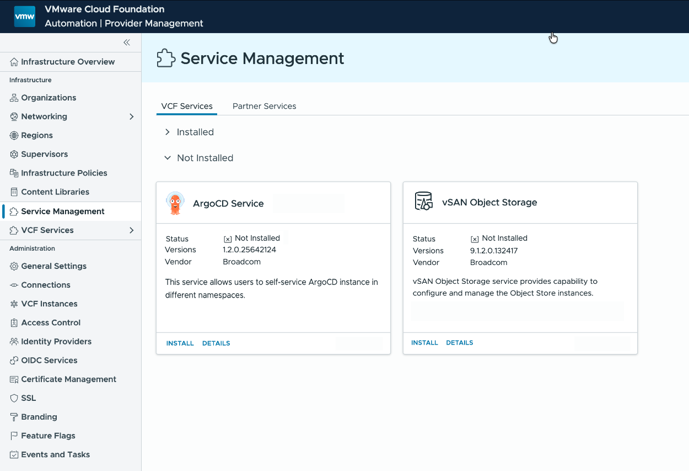
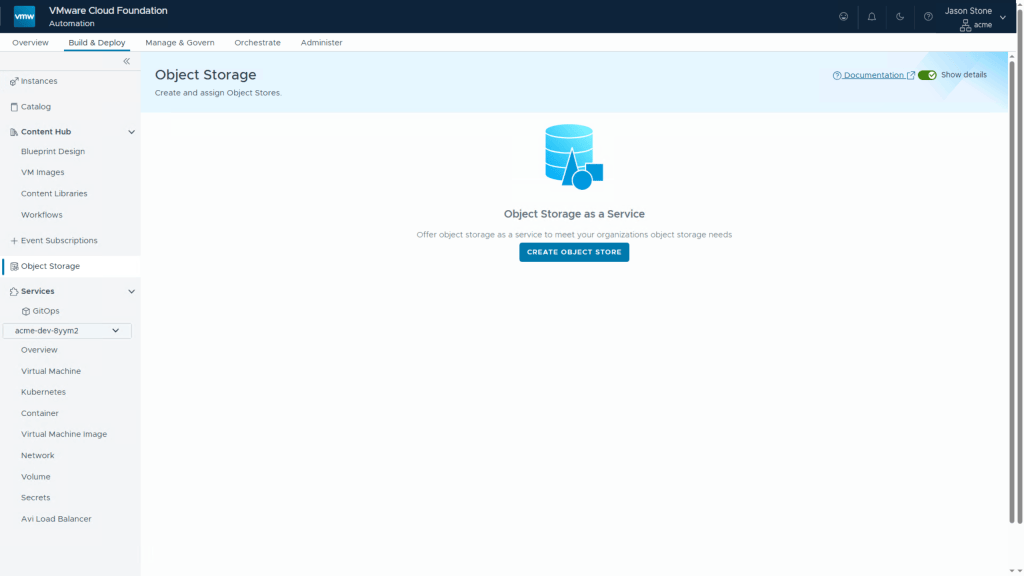
Operating within the VCF Automation Provider Portal, the Provider Admin configures the VMware vSphere Supervisor with the underlying vSAN Cluster in VMware vCenter. Through central Service Management, the admin installs the Object Store service across the regional fleet and assigns compute, zone/region quotas, and vSAN storage capacity to specific tenant organizations.
2. The Tenant/Org Admin (Organization Provisioning & Governance)
Within the VCF Automation Organization Portal, the Org Admin provisions dedicated or shared Object Store instances against their allocated capacity quotas. Crucially, following public cloud security conventions, all buckets are private by default. The Org Admin assigns tenant user access, defines fine-grained IAM and RBAC policies, and issues S3 service accounts and credentials mapped directly to enterprise identities.
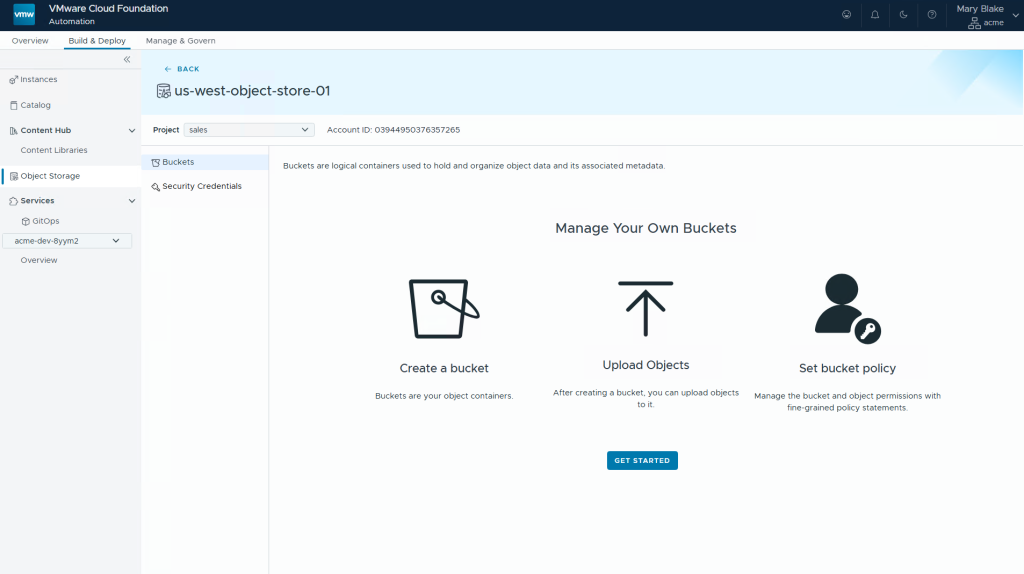
3. The Project User (Application Teams & Data Scientists)
Without submitting IT tickets or waiting days for storage allocations, application developers and platform engineers log into the VCF Automation UI or use automated APIs. They create buckets on demand, manage objects, configure tags, and directly bind their S3 endpoints into application configurations.
Powering Production Use Cases: From Kubernetes Pipelines to Enterprise AI
This self-service model unlocks critical enterprise workloads across two domains:
1. DevOps and Cloud-Native Pipelines
Modern microservices rely heavily on ephemeral, highly available artifact repositories. With native S3 endpoints, automated CI/CD runners like Jenkins can upload build artifacts, binary packages, and container layers directly into self-provisioned buckets.
Furthermore, platform operators running VCF Automation can leverage tools like Velero via Data Protection with VMware vSphere Kubernetes Service (VKS) Cluster Management. Velero points natively to local vSAN S3 buckets as its primary backup target, protecting container application state, namespaces, and persistent volume snapshots with local, wire-speed recovery without sending cluster metadata off-site.
2. Agentic AI and Enterprise Data Lakehouses
Autonomous AI agents require continuous ingestion and high-bandwidth retrieval of enterprise context. Housing unstructured corporate data (e.g., documents, transaction logs, communication archives) in native S3 buckets allows integrated query tools (such as VMware Tanzu Greenplum via PXF) to execute zero-copy analytics directly against Parquet or Iceberg datasets. This supports AI agents querying accurate corporate knowledge bases in real time without massive data movement.
The Sovereignty Imperative: Private Cloud vs. Public Cloud Economics
While public cloud S3 established the interface standard, running large-scale data lakes and AI pipelines in hyperscalers can introduce data egress costs, retrieval fees, and regulatory considerations.
Private S3 on VCF delivers substantial architectural advantages:
- Data Sovereignty and Private AI: Models train and infer directly against corporate intellectual property inside your security perimeter. Sensitive data remains sovereign and strictly isolated, supported by private-by-default buckets and granular IAM and RBAC policies.
- Air-Gapped Resiliency: Regulated industries, financial institutions, and defense environments can operate fully air-gapped, zero-trust cloud data lakes with no external cloud dependencies.
- Predictable TCO: Removing the need for proprietary standalone storage appliances and third-party software licenses lowers total cost of ownership by up to 27% (based on Broadcom internal modeling), leveraging commodity server economics and integrated vSAN licensing.
Accelerate Your Private Cloud Evolution
The general availability of native vSAN S3 Object Storage in VCF 9.1.2 transforms VMware Cloud Foundation into a comprehensive data and automation platform. Block, file, and S3 object storage now share a unified control plane, delivering a public cloud-style consumption experience directly inside your private data center.
Ready to eliminate storage silos and deliver developer-ready S3 buckets on demand? Explore the technical documentation (Administering vSAN Object Storage and Using vSAN Object Storage) to begin consuming S3 services with VCF Automation today.
Learn More
- Blog: Announcing General Availability of vSAN Native S3-Compatible Object Storage
- Blog: Native S3 Compatible Object Storage in VMware vSAN for VCF 9.1
- Blog: Powering VMware Private AI Cloud: Centralized Service Management and Enterprise GitOps in VMware Cloud Foundation 9.1.2
- Blog: Announcing General Availability of VMware Cloud Foundation 9.1.2
- eBook: Your Private Cloud is the New Public Cloud
- eBook: Self-Service Private Cloud for Dummies
- IDC Whitepaper: Self-Service Private Cloud as the Engine for In-House AI and Application Innovation
- Whitepaper: Divided Yet United: Architecting the Multi-Tenant Private AI Cloud
Discover more from VMware Cloud Foundation (VCF) Blog
Subscribe to get the latest posts sent to your email.