
Executive Summary:
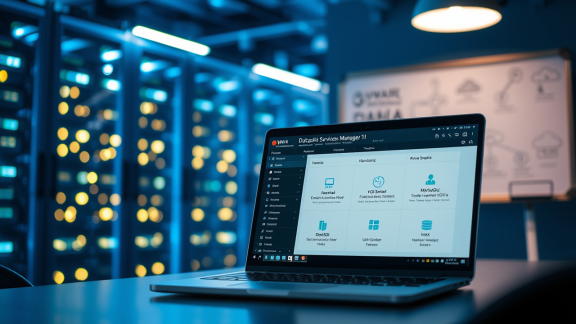
Microsoft SQL Server support is now available with VMware Data Services Manager 9.1, enabling unified management of the top three enterprise databases used with VMware Cloud Foundation.
- Complete DBaaS Platform: Production-ready automation for PostgreSQL (AI-optimized with pgvector), MySQL (instant fast cloning), and SQL Server 2022 (including clusters using always-on availability groups)
- Quantified Business Impact: 90% faster time-to-market, 75% operational efficiency gains, 50%+ cost reduction vs. public cloud DBaaS, 12-18 month ROI 2
- Strategic Platform Alignment: Applications minimize latency to data stores; databases on VCF anchor microservices to VKS supporting delivery of modern applications backed by modern databases
- Cloud Economics Without Compromises: lightning-fast provisioning, automated operations, developer self-service, plus complete control, data sovereignty, and FIPS 140-2 compliance for supported open source databases
Today marks a strategic milestone for organizations modernizing their database infrastructure.
Support for Microsoft SQL Server is now generally available in VMware Data Services Manager 9.1 (DSM). This release expands the enterprise Database-as-a-Service (DBaaS) platform built specifically for VMware Cloud Foundation (VCF). By bringing production-ready automation to SQL Server alongside PostgreSQL and MySQL, DSM 9.1 provides the data foundation necessary for the two most critical initiatives in the modern data center: Private Cloud adoption and AI innovation.
Anchoring the Enterprise Database Stack to Private Cloud
For too long, organizations have been forced to choose between the agility of public cloud DBaaS and the control of on-premises management. This choice has become even more fraught with the rise of AI, where data sovereignty and proximity to compute are non-negotiable.
As a VCF Advanced Service, DSM 9.1 bridges this gap. It integrates into the VCF console to provide a “cloud-like” experience for the databases that power the enterprise:
- Microsoft SQL Server (now GA): Deliver full lifecycle automation for SQL Server 2022. Support mission-critical apps with automated failover (<30 seconds) and integrated backups, all without needing specialized SQL expertise for every routine task.
- PostgreSQL (AI-Optimized): DSM 9.1 supports pgvector, enabling teams to store and query vector embeddings. This allows you to build and run Private AI applications, such as Retrieval-Augmented Generation (RAG) models, entirely within your secure VCF environment.
- MySQL (Fast Cloning): Accelerate development cycles with instant cloning, allowing DevOps teams to spin up test environments in minutes rather than days.
This isn’t just operational automation; it’s strategic infrastructure positioning. Applications are architected to minimize latency to their data stores. Once your databases run on VCF via DSM, your microservices naturally land on VKS to stay close to the data. DSM anchors your entire application stack to private cloud infrastructure with predictable economics and complete control.
DSM 9.1: Key Capabilities and Enhancements
Microsoft SQL Server 2022 Support delivers enterprise-grade reliability across all scenarios:
- Full Microsoft SQL Server 2022 support across all editions (Standard, Enterprise, Developer)
- Windows Authentication via Active Directory integration for identity management
- Automated high availability with failover clustering (< 30 seconds recovery time)
- Comprehensive lifecycle automation: provisioning, patching, backup/restore, scaling
- Production-grade disaster recovery with automated replication and point-in-time recovery
Additional Platform Enhancements
Unified Database Management: Single self-service catalog for database and infrastructure requests via VCF Automation. Infrastructure as Code support through Terraform, GitOps, and CI/CD pipelines. Same APIs across VMs, Kubernetes, and databases.
Enhanced Monitoring & Observability: Unified observability across database and infrastructure metrics with proactive alerting, faster root-cause analysis, and advanced capacity planning analytics. No more context-switching between tools.
MySQL Fast Cloning: Space-efficient clones created in seconds, providing instant on-demand environments for developers and eliminating provisioning bottlenecks.
PostgreSQL with pgvector for AI Workloads: Full enterprise-grade PostgreSQL with native vector database capabilities optimized for modern AI workloads—RAG, semantic search, embeddings. Your private AI foundation needs a data layer you control.
Value Proposition: Automation, Agility, and Integration
DSM 9.1 addresses the database management challenges that don’t scale: manual operations, unpredictable public cloud costs, scarce Kubernetes expertise, and inconsistent tooling across platforms.
Automated Complexity Management
Database teams shouldn’t need to become Kubernetes experts to deliver modern data services. DSM abstracts infrastructure complexity, automating tedious lifecycle tasks: provisioning in under 15 minutes, patching with 99.5% success rates, backups, and scaling. Without automation, these functions normally consume DBA time and introduce human error. Centralized fleet management with policy-based automation ensures consistency while reclaiming strategic focus for database teams.
Developer Agility with Governed Self-Service
The old ticket-based provisioning model creates bottlenecks that slow application delivery. DSM delivers “self-service for developers, governance for IT.” Developers get instant API-driven access to databases through VCF Automation while IT maintains centralized policy control. Single catalog, same APIs across VMs, Kubernetes, and databases. Infrastructure-as-code patterns via Terraform and GitOps integrate seamlessly with DevOps workflows.
Seamless Integration
As a VCF Advanced Service, DSM provides the deepest possible integration with VMware Cloud Foundation infrastructure. This isn’t a bolt-on solution; it’s purpose-built for VCF with unified operations and simplified lifecycle management. DSM is the on-prem RDS replacement. When databases stay on VCF, applications stay on VCF – protecting renewal revenue and anchoring the entire application stack.
Why “Integrated” Matters More Than Ever
DSM 9.1 is an Advanced Service licensed separately from the VCF core, yet its value lies in its deep integration with the platform. In this release, we’ve focused on making the database tier feel like a natural extension of the VCF stack:
- Infrastructure-as-Code: DSM 9.1 works seamlessly with VCF Automation and Terraform, allowing databases to be provisioned as part of a larger application stack.
- VCF Console Integration: Administrators can manage database fleets from the same interface they use for VMs and containers, reducing “console fatigue.”
- Policy-Based Governance: Infrastructure teams can set guardrails (storage tiers, backup frequency, versions) and then hand off self-service access to developers.
Economics That Matter
Data is the “gravity” of the private cloud. By automating the data tier on VCF, our customers are seeing transformative results: 1
- 90% faster time-to-market for applications through elimination of database provisioning bottlenecks
- 75% operational efficiency gains allowing DBAs to focus on strategic optimization instead of routine tasks
- 50%+ cost reduction compared to public cloud database services (AWS RDS, Azure SQL Database, Google Cloud SQL)
- 12-18 month ROI for organizations migrating databases from public cloud to DSM
Strategic Control Without Compromises
You get the operational simplicity of managed database services—instant provisioning, automated operations, developer self-service—without surrendering control, data sovereignty, or cost predictability. Your databases run on infrastructure you own, governed by policies you define, protected by security controls you implement.
For regulated industries (healthcare, government, financial services), FIPS 140-2 compliance certification for PostgreSQL and MySQL addresses stringent security requirements. For organizations with data sovereignty requirements, data never leaves your infrastructure. For cost-conscious teams, predictable infrastructure costs replace consumption-based billing that escalates unpredictably.
Solving Real Database Management Challenges
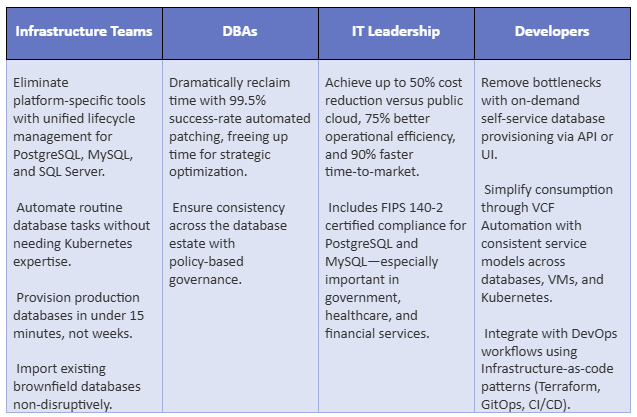
The challenges facing database teams are well-documented. Manual database operations don’t scale. Public cloud costs spiral unpredictably. Kubernetes expertise is scarce and expensive. Governance gaps create security risks. Different tooling for different database platforms multiplies operational complexity. DSM 9.1 addresses these challenges directly: 1
Professional Services and Getting Started
Beyond platform capabilities, we offer structured professional services through partner AxelCore to help organizations maximize their VCF and DSM investment. Whether you need a proof-of-value engagement to demonstrate DSM’s impact on your specific workloads, or you’re looking to transform commercial databases (Oracle, SQL Server) to open-source alternatives (PostgreSQL, MySQL), these proven methodologies can deliver 70-90% licensing cost reduction.1 The engagements leverage 80%+ automated migration tooling, can be funded through existing ELAs, and provide a clear path to replatforming with minimal risk.
The Bottom Line
The three databases that power most enterprise applications – PostgreSQL (with AI-ready pgvector), MySQL (with fast cloning), and Microsoft SQL Server – are now available through VMware Data Services Manager’s unified platform and built to work with VCF.
Whether you are looking to reclaim time from manual maintenance or building the next generation of AI-powered applications, DSM 9.1 provides the automation, security, and performance required for the modern enterprise.
That’s VMware Data Services Manager 9.1.
Production-ready. Enterprise-proven.
Sources: 1 VMware internal and telemetry reports 2 Broadcom IT case study outcomes
Learn More:
- VMware Data Services Manager Product Page
- Video – What’s New in VMware Data Services Manager 9.1
- Schedule a Technical Consultation
- Explore AxelCore Database Migration Services
Discover more from VMware Cloud Foundation (VCF) Blog
Subscribe to get the latest posts sent to your email.