
At the VMware Cloud Foundation 9.1 Live Briefing this week, VMware and Arista Networks showcased how the companies are working together to enhance interoperability between application environments and the network, promoting cloud-like simplicity through a unified network fabric. This approach will accelerate customer deployments through a common architectural approach for both virtualized and physical workloads while preserving existing network investments. Customers will benefit from modern VPC networking, enhanced network performance, lower TCO, and consistent end-to-end networking and operations across their private cloud.
This post recaps recent networking simplifications in VMware Cloud Foundation (VCF) and presents an overview of how Arista and Broadcom collaboration will make connecting and securing workloads faster and easier than ever before.
VCF Networking – a march towards simplicity and operational agility
As application environments get larger and more complex, there’s a need to simplify how workloads are deployed, connected, and secured. The network architecture in VMware Cloud Foundation has evolved significantly to simplify the operating model for networking and virtualization teams. VPCs and Transit Gateways were introduced to deliver distributed connectivity and self-service networking. New automation and operational workflows made it easier to integrate VCF workloads and networking into brownfield environments while minimizing disruption. Direct host to fabric connectivity reduced the infrastructure footprint and increased compute density.
We’re now defining the next evolution of networking in the private cloud with the Unified Network Fabric strategy. The work underway between Arista and Broadcom is a significant step in this direction.
How VMware-Arista Networks interoperability works
Bringing together VCF and Arista Universal Cloud Network (UCN) will create a unified fabric that bridges modern application environments with high-performance physical infrastructure. This section outlines how both environments will connect seamlessly — across the control plane and data plane — to deliver consistent architecture and simplified operations across domains.
In our illustration, VM (192.168.1.10) inside a VPC in VMware Cloud Foundation connects to the Arista Leaf Switch (Leaf-1) through a Transit Gateway. Similarly, a Remote Server (172.16.2.20) outside VCF connects into the network via another Arista Leaf Switch (Leaf-2).
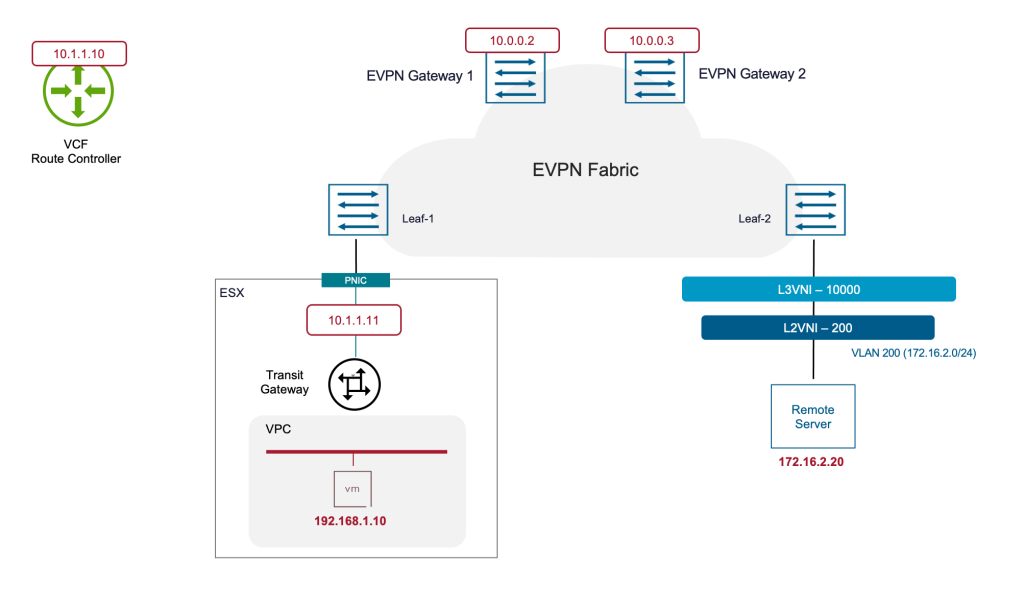
Step 1: Establish Common Control Plane
The interoperability is initiated through control plane alignment between the VCF and non-VCF environments. The VCF Route Controller (RC) peers directly with the Arista EVPN Gateway using the industry-standard MP-BGP EVPN protocol.
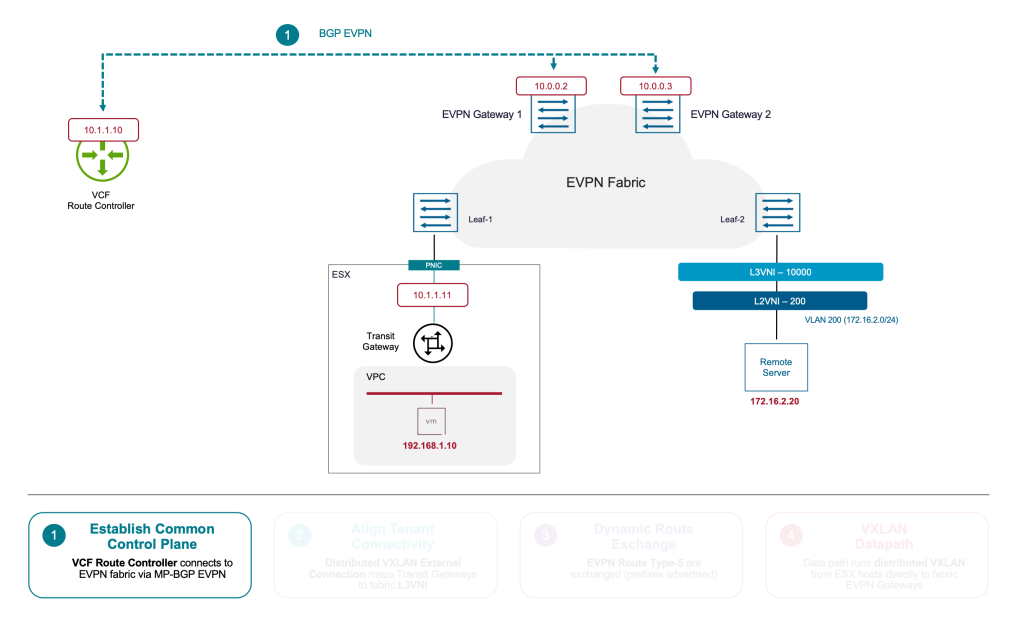
This setup allows each side to advertise and learn workload routes dynamically — ensuring that VCF and non-VCF workloads coexist in one cohesive routing domain.
Step 2: Align Tenant Connectivity
In an EVPN-VXLAN fabric, every tenant or VRF operates within its own Layer-3 VNI. IP connectivity to the VRF to facilitate inter-subnet routing is advertised using a EVPN type-5 route.
At the VCF end, the Transit Gateway (TGW) plays a similar role, providing routed connectivity between VPCs and external networks. By mapping each VCF Transit Gateway to the corresponding L3VNI in the fabric (L3VNI-10000), the two environments share a common tenant routing framework.
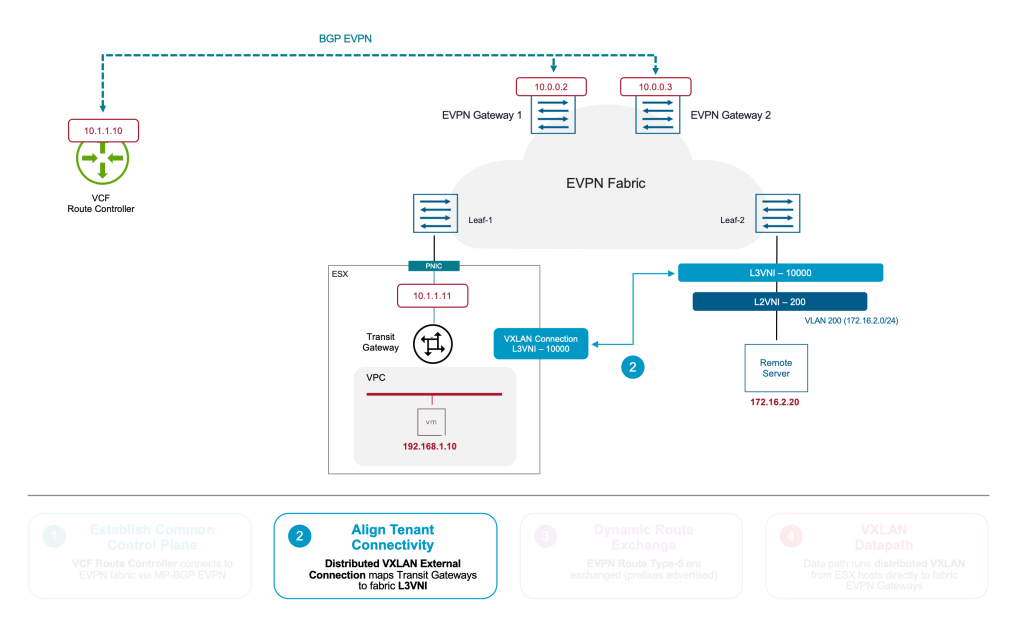
This 1:1 mapping ensures isolation, scalability, and operational simplicity. Tenants gain full connectivity across VCF and the EVPN fabric without sacrificing segmentation or policy control.
Step 3: Dynamic Route Exchange
Once control plane and tenant associations are in place, EVPN Route-Type 5 routes are exchanged automatically.
From VCF to the EVPN fabric: The Route Controller advertises per-workload /32 prefixes (192.168.1.10/32), identifying each workload and its ESX host TEP location (tunnel endpoint). These routes can be optionally summarized at the EVPN Gateway to optimize the fabric’s routing tables.

From the EVPN fabric to VCF: The EVPN Gateway advertises subnet prefixes or a default route per VRF for non-VCF workloads, providing visibility and reachability back into VCF. The VCF Route Controller programs the VPC Transit Gateway with a default route to the EVPN Gateways.
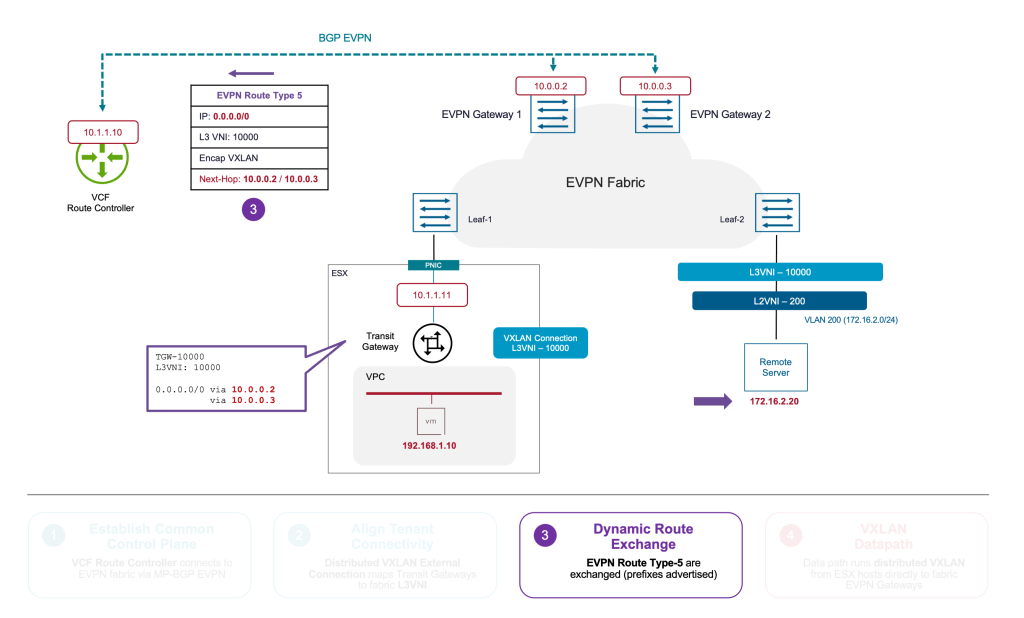
This dynamic, standards-based route exchange removes the need for static and manual configurations and enables cloud-scale mobility across domains.
Step 4: Establish End-to-End VXLAN Datapath
In the data plane, traffic flows over VXLAN encapsulation, extending Layer-3 reachability across the two systems.
- VCF workloads forward traffic through their ESXi TEP towards the Arista EVPN Gateways.
- The EVPN Gateway routes packets through the appropriate L3VNI and towards the destination VTEP (leaf switch) in the EVPN fabric.
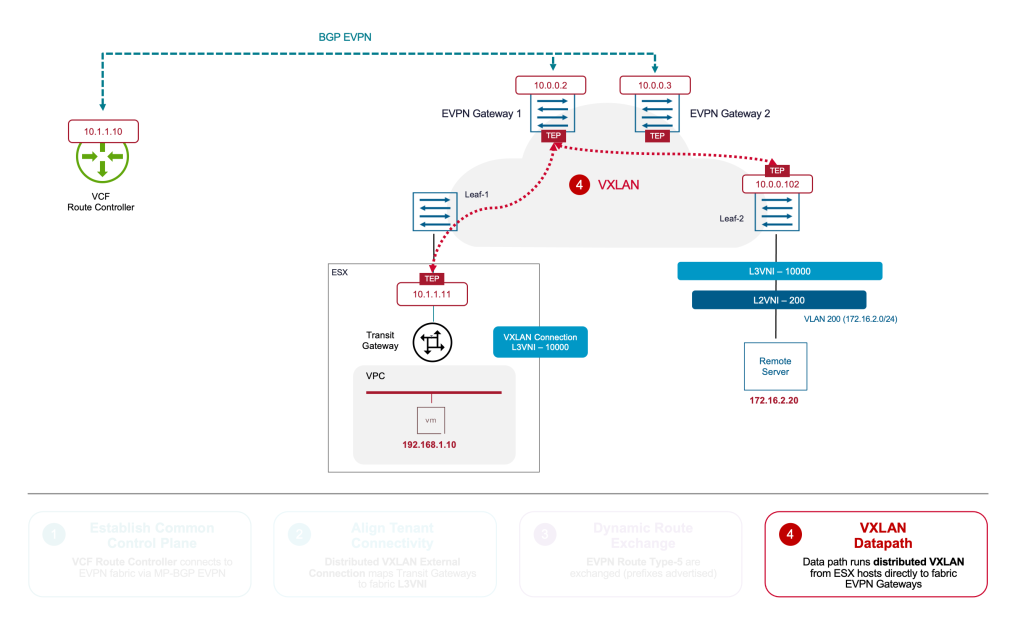
This symmetric model ensures consistent routing behavior — no matter where the workload resides — and delivers line-rate forwarding between VCF, EVPN fabric, and external endpoints.
The Outcome
The VCF-Arista Networks integration will create a unified, intelligent network fabric that spans the virtual and physical domains. By combining the VCF multi-tenant VPC networking with Arista’s EVPN-VXLAN architecture:
- Networking teams will gain unified routing and visibility across virtual and physical workloads, simplified multi-tenant operations with consistent policies, and standards-based interoperability with no proprietary dependencies. EVPN-VXLAN provides a common underlying connectivity, simplifying network management, visibility, and troubleshooting. Arista CloudVision complements VCF Operations, providing a unified ‘single pane of glass’ for automating network deployments, offering end-to-end visibility, monitoring real-time telemetry, and managing change controls.
- Virtualization teams will gain simpler connectivity for their VCF workloads, better scaling for the workload domain, and lower compute and operational costs due to not needing edge node infrastructure.
The result is a modern, scalable hybrid network that brings cloud agility and data-center performance into a single, seamless experience.
We are excited to continue working with Arista Networks to extend the interoperability even further. Across deep visibility, telemetry, automation, and operations, we are committed to helping customers optimize the network architecture, simplify design and configuration, and lower infrastructure and operational costs.
Acknowledgements
Written by Varun Santosh and Andre Bernardes Vasquez. Special thanks to Shyam Kota and Alex Nichol from Arista Networks for their contributions to this topic.
Discover more from VMware Cloud Foundation (VCF) Blog
Subscribe to get the latest posts sent to your email.