
Deploying and operating telco and AI/ML workloads requires an industry focused carrier-grade software infrastructure, from the private cloud platform layer and guest operating system, that are hardened and tested to meet the specific workloads requirements: hardware compatibility across diverse compute platforms, long-term security maintenance, kernel modules for packet processing and low-latency workloads, as well as compliance with telecom and AI data security standards.
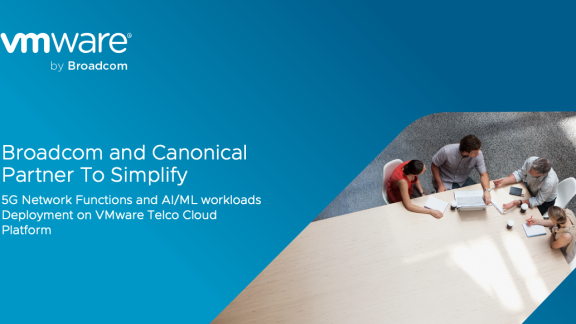
Broadcom and Canonical have expanded their partnership to deliver Ubuntu to run network functions and AI/ML workloads on VMware Telco Cloud Platform, a private cloud platform built on VMware Cloud Foundation, for Telcos. This will provide network operators with an operating system and private cloud platform combination designed to meet operational and compliance requirements.
A Unified Solution for Customers
VMware Telco Cloud is a platform for deploying and managing virtualized and cloud-native network functions as well as AI/ML workloads.
Canonical’s focus is to enable all capabilities that silicon partners deliver for CPUs, GPUs, SmartNICs, and other accelerators. As such, Ubuntu provides out-of-the-box kernel and driver support for major silicon vendors such as Intel, AMD, NVIDIA, Qualcomm, NXP, Ampere and Rivos, along with the long-term maintenance lifecycle required for production deployments.
Through this partnership, Ubuntu will be integrated as a validated and optimized OS option for cloud-native network functions (CNFs) workload clusters as part of VMware Telco Cloud 9. Operators will be able to deploy network functions on a pre-integrated platform that Broadcom and Canonical will validate with the major Network Equipment Providers (NEPs).
Operators running network workloads on Telco Cloud Platform with Ubuntu will be able to access a range of benefits, including :
- Faster time to deployment: Ubuntu is one of the most widely-used Linux operating systems. Through the partnership, Ubuntu is pre-validated in ecosystem labs and against VMware Telco Cloud Platform components, enabling operators to deploy network functions on a jointly validated OS and platform combination. In addition to giving access to hardware-specific optimizations for networking, storage and AI, the pre-validation will reduce the time spent on functional and performance testing, integration and shorten validation cycles for NEPs and operators.
- Reduced lifecycle management overhead: VMware Telco Cloud Platform will offer better long-term security maintenance. This will enable operators to stay on validated kernel versions and receive security updates without requiring frequent platform upgrades. Customers will benefit from reduced operational overhead of upgrades and revalidation cycles.
- Network function performance on supported configurations: Enhanced platform awareness (EPA) features like kernel modules for DPDK, low-latency, real-time, and RDMA workloads are fully enabled in Ubuntu, removing the need for operators to maintain custom, unsupported kernels across long lifecycles.
- Simplified GPU deployment in air-gapped environments: Ubuntu images with pre-compiled virtualized GPU drivers will reduce dependency on external repositories and internet access during deployment and run-time. This will remove the need for on-node driver compilation, reducing deployment time, start-up delays and wasted resource consumption. This is useful for secure telco sites that operate without direct internet access.
- AI and ML workloads on the same platform: operators will be able to run their AI and ML workflow software stack of choice (e.g. TensorFlow, PyTorch, MLflow and Kubeflow etc.) to build their own AI-powered software (such as network management,analytics etc.) alongside network functions without introducing a separate OS, micro-services and networking environment.
- Strengthened compliance: Canonical supports FIPS 140-3, NIST 800-53, PCI DSS, DISA STIG as part of the Ubuntu Security Guide (USG). Through its vulnerability management offering, Canonical also simplifies compliance with the UK NCSC Telecom Security Act, ENISA guidelines under the EECC, and the EU Cyber Resilience Act. Canonical adheres to GDPR and other applicable data protection laws, and holds ISO 27001, ISO/SAE 21434 and IEC 62443-4-1 certifications.
These benefits will enable VMware Telco Cloud Platform customers and partners to enter a new era of cloud native innovation, acceleration and AI, whilst enhancing their operational, security and compliance positions.
Additional resources
- Learn more about Canonical’s solutions for the telecommunications industry
- Read more about the partnership between Canonical and Broadcom
- For VMware Telco Cloud Platform Documentation, please visit here
- For VMware Cloud Foundation product page, please visit here
Discover more from VMware Telco Cloud Blog
Subscribe to get the latest posts sent to your email.