
Picture this: Your application teams pushed 30 updates last quarter. Your agents are reasoning in milliseconds. Your on-call rotation has never been quieter. And somewhere, a platform engineer is still manually configuring connection strings and writing a wall of YAML for a Postgres instance in Region X.
That last part is the problem. As application development has accelerated and organizations push into new use-cases that leverage generative and agentic AI, the platform itself has to evolve. The tools and workflows that have historically served you well, may start to reveal some strain at scale, such as when you have a fleet of autonomous agents that need governed access to data services in real-time. For platform teams, the service layer in many environments has not kept up. When you manage data services per instance, every new region added to your estate adds a proportional slice of operational toil. You don’t notice it at first. By the time you do, that toil has quietly become a ceiling on how fast your organization can move.
Scaling services for the agentic era
When we announced the release of VMware Tanzu Platform 10.4, we described the goal as further collapsing the distance between idea and production. One of the most direct ways we’re doing that in this release is by treating service fleet management as a first-class operational discipline, not an afterthought for platform teams to solve on their own.
With Tanzu Platform, platform engineers can now manage massive fleets of data and messaging services with centralized lifecycle operations—backup, restore, and automated updates and upgrades—directly from the Tanzu Hub interface. What used to require per-instance work across dozens of foundations can now be handled using fleet management. You define the policy once, and the platform enforces it.
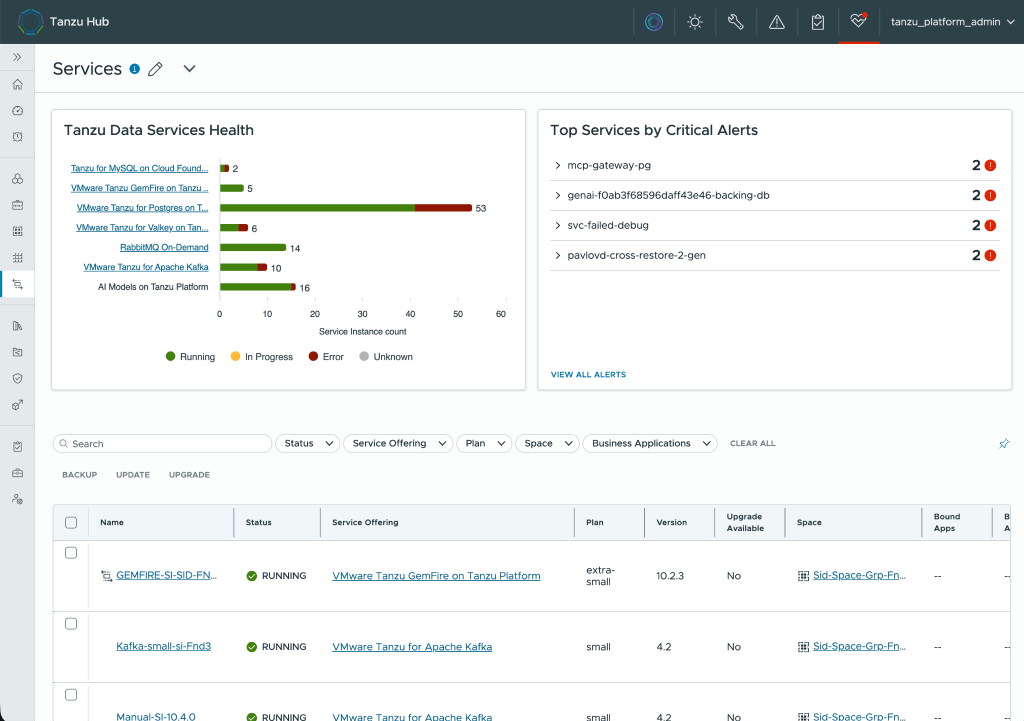
The new services dashboard in Tanzu Hub as part of Tanzu Platform 10.4 shown here enables platform teams to get a more complete view of services deployed across the fleet and manage backup, update, and upgrade operations at scale.
If you’ve been operating three or four environments, this might feel incremental. But with dozens of foundations spanning global regions, it isn’t. The difference is the contrast between a platform team that focuses on strategic governance and one that is occupied by the day-to-day instance management.
Services without borders: VMware vSphere Kubernetes Service joins the platform
One of the quieter but more consequential additions in the Tanzu Platform 10.4 release is the extension of Tanzu Platform’s service binding model to applications running on VMware vSphere Kubernetes Service (VKS).
Previously, if you had an application running on VKS and wanted to connect it to a database managed by Tanzu Platform, you were doing the manual plumbing: connection strings and secrets management, all handled by platform teams.
With Tanzu Platform 10.4, VKS-hosted applications are treated as first-class consumers of platform services. A developer with apps hosted on VKS can browse the Tanzu Platform marketplace, instantiate the service they need, and initiate a bind. The platform injects credentials and configuration directly into the VKS namespace, establishing a secure encrypted channel between the app and the data. No manual steps. No hand-rolled secrets. No ticket necessary. The same governed path that Tanzu Platform application teams have relied on since Day 1 is now available across the broader VMware Cloud Foundation estate.
The practical message for platform engineers: Regardless of where an application lives on your private cloud, the path to services and content, such as databases, caching or messaging, is now the same. Simply discover through the marketplace, create a service instance, and bind the service to the application.
Governing application services at scale
In Tanzu Platform 10.4, service management capabilities close the operation gap between how organizations govern their applications and how they govern the services those applications depend on.
For application workloads, Tanzu Platform has long supported the “three R’s” of platform security—repave, repair/restage, and rotate—as an automated, continuous security practice. CVE in a buildpack? The platform can force a fleetwide restage across the organization in minutes. These capabilities directly facilitate efficient patching of application workloads, ensuring security updates are applied seamlessly across the entire fleet.
The same programmatic discipline now extends to the service layer. When a critical vulnerability surfaces in your database fleet, platform engineers aren’t triaging instance by instance. They’re applying updates from a centralized plane and letting the platform do the heavy lifting. The window between detection and remediation shrinks, not because the team worked faster, but because the work itself was already automated.
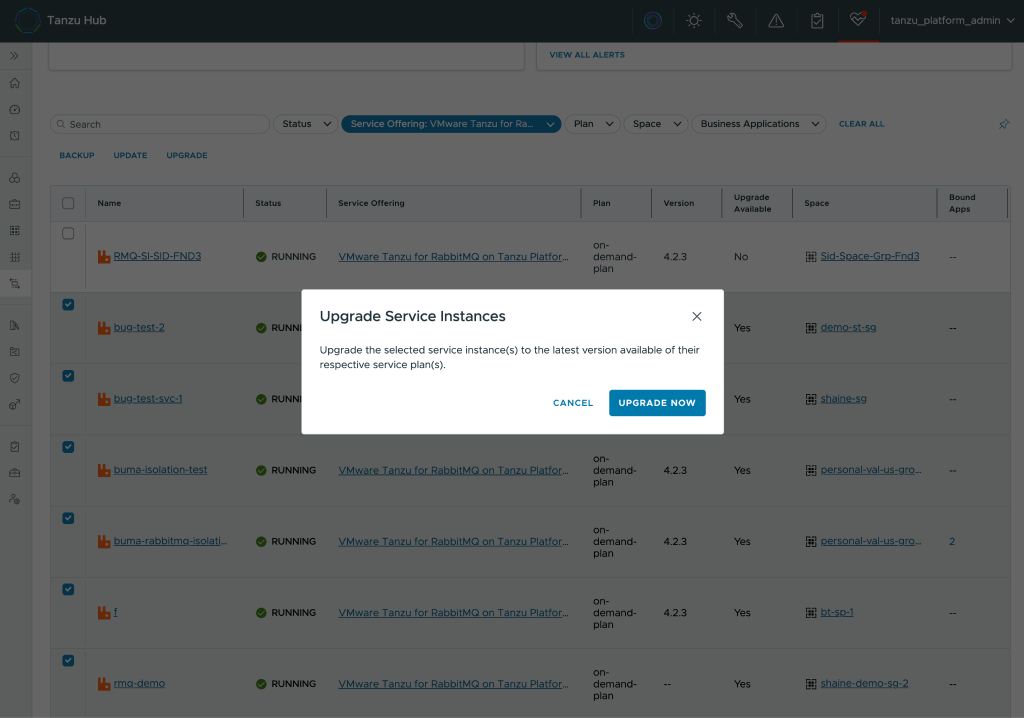
This screenshot of Tanzu Hub shows a fleet of upgrade-eligible Tanzu RabbitMQ instances, with this operation to be performed at scale.
For enterprises managing AI-centric workloads alongside traditional applications, this matters in a specific way. The same rigorous governance that protects a mission-critical Postgres instance can now be applied to the high-performance caching and messaging services that agents depend on. The platform doesn’t have to distinguish between traditional and AI infrastructure; it governs the estate.
This lifecycle management is critical for AI success, as agents rely on consistent, reliable data to make accurate decisions. By automating underlying service operations, we ensure that the data layer is as dependable and performant as the models themselves.
The service layer, fully accounted for
The shift in Tanzu Platform 10.4 is ultimately about accountability. It enables teams to make sure that every part of your private cloud estate, not just the application layer, operates under the same governance standards you’ve built for the rest of your platform.
When your application can scale globally in seconds but your data services are still managed foundation by foundation, you haven’t built a platform. You’ve built a faster approximation of one. Enterprise-scale service management in Tanzu Platform 10.4 closes this gap.
To explore the full release, start with the Tanzu Platform 10.4 release notes and documentation, or visit the Tanzu Platform product page to learn more and connect with our team.