

The enterprise threat landscape is changing fast, as attackers now use frontier AI to discover vulnerabilities and exploit them at machine speed. To stay ahead of these threats, organizations need multi-layer security with advanced threat prevention in their private cloud. For their most sensitive workloads, organizations in defense, healthcare, financial services, and critical infrastructure often require complete isolation and rely on air-gapped environments. Organizations deploying AI agents are also opting for air-gapped environments. By severing all internet and public cloud connectivity, an air-gapped deployment model provides a boundary of absolute digital isolation, eliminating the primary attack vectors used by attackers.
However, air-gapped private cloud platforms are not immune to attacks. Security risks persist through malicious or negligent insider activity, infected software patches, and removable hardware like USB storage devices. Because of this, isolated networks require the same multi-layer cyber defense as internet-connected systems.
Isolation has its own challenges. Many advanced security capabilities, such as malware prevention service, IDPS, zero-day attack mitigation, and behavioral analytics, rely on intelligence that is updated over the internet. Without internet access, the effectiveness of these security capabilities is significantly reduced. For years, organizations have been forced into dangerous trade-offs: sacrifice modern, advanced threat prevention to maintain strict data isolation, or connect to the cloud and expose sensitive assets to external threats.
The VMware vDefend air-gapped deployment model addresses this challenge. With VMware vDefend 9.1.1 and Security Services Platform (SSP) 5.2, organizations no longer have to deal with these security trade-offs. Organizations can now deploy the full suite of vDefend capabilities, including lateral segmentation and advanced threat prevention, while maintaining an isolated deployment model.
Security Services Platform Connected and Disconnected Modes
The VMware vDefend Security Services Platform (vDefend SSP) serves as a high-performance, scale-out data lake and management platform designed to deploy and scale vDefend security services across VCF private clouds. Organizations can deploy SSP in two distinct modes depending on their security needs: Connected Mode and Disconnected Mode.
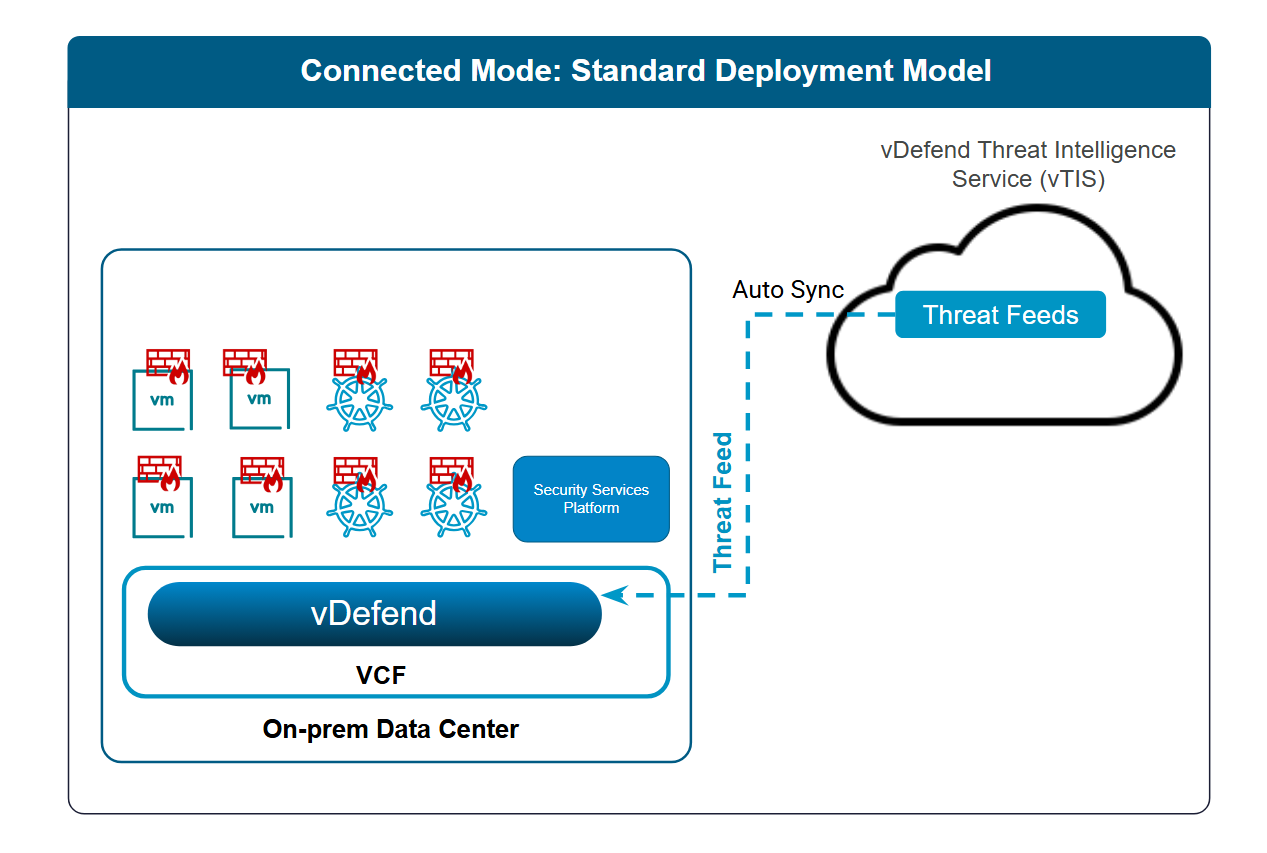
- Connected Mode: This is the standard deployment model for vDefend. In this model, the SSP maintains direct internet access to the vDefend Threat Intelligence Service (vTIS), VMware’s cloud-delivered threat intelligence engine that aggregates, correlates, and updates global threat indicators, behavioral models, and signatures. With auto-sync enabled, the platform regularly pulls real-time updates without administrative intervention.
- Disconnected Mode: Designed for strictly air-gapped environments, this mode completely cuts off the SSP from external networks and vTIS. Instead of relying on automated threat intelligence feeds, security teams maintain full sovereign control through a controlled, offline update workflow.
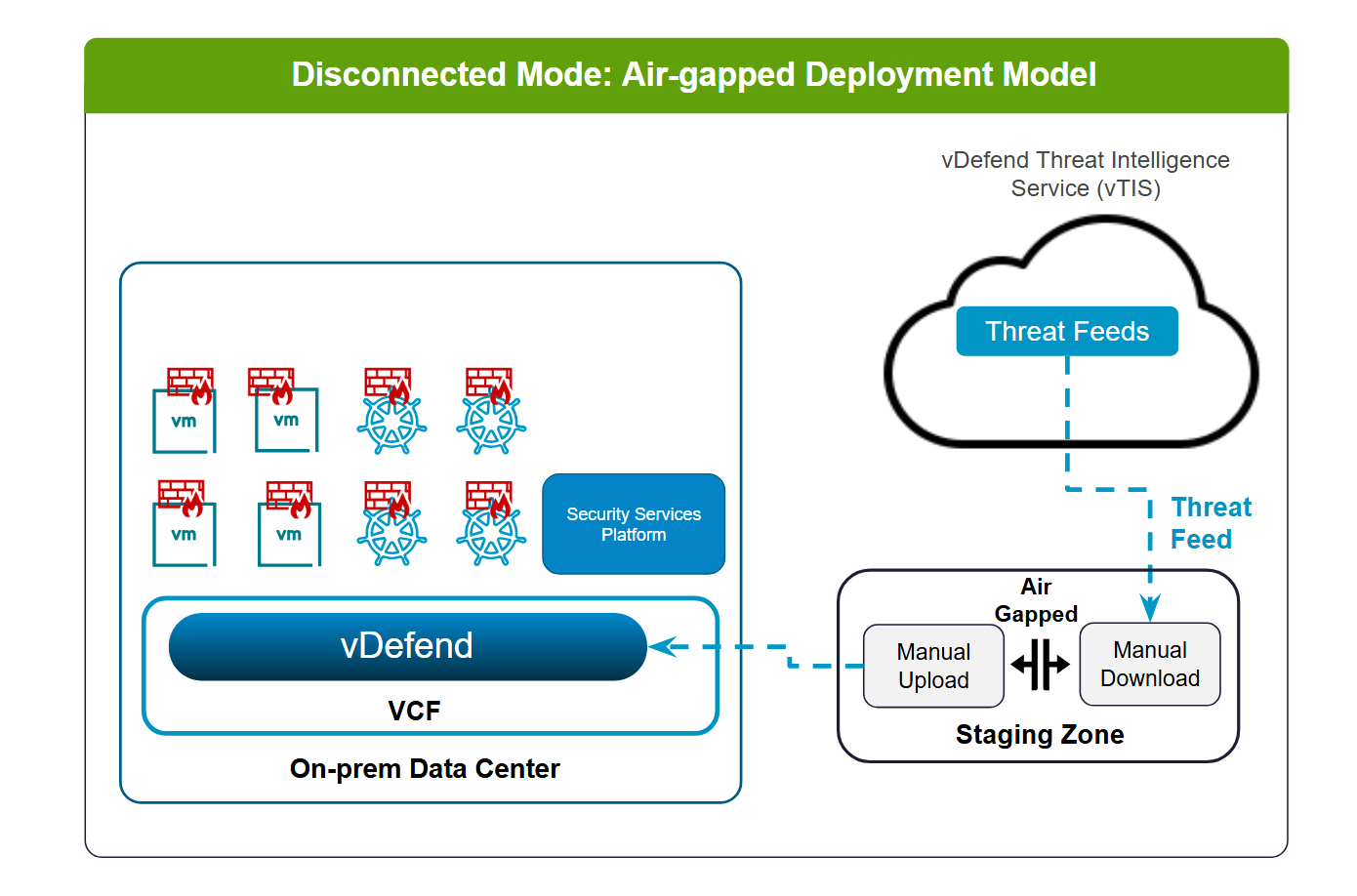
In air-gapped deployment models, the complete suite of vDefend capabilities runs directly inside the private cloud. The sections below explain how Threat Intelligence, IDPS Signature Management, and Malware Prevention, which previously relied on internet updates, operate without cloud connectivity.
Keeping Threat Intelligence Current Without an Internet Connection
Defending against rapidly evolving threat vectors requires up-to-date intelligence, traditionally one of the hardest operational challenges for isolated environments. AI makes this challenge more urgent. Attackers now find and weaponize new vulnerabilities much faster, so intelligence that is days or weeks old leaves isolated networks exposed. vDefend for air-gapped environments simplifies this by consolidating all security feeds into a single, comprehensive Threat Intelligence Bundle that covers every vDefend capability.
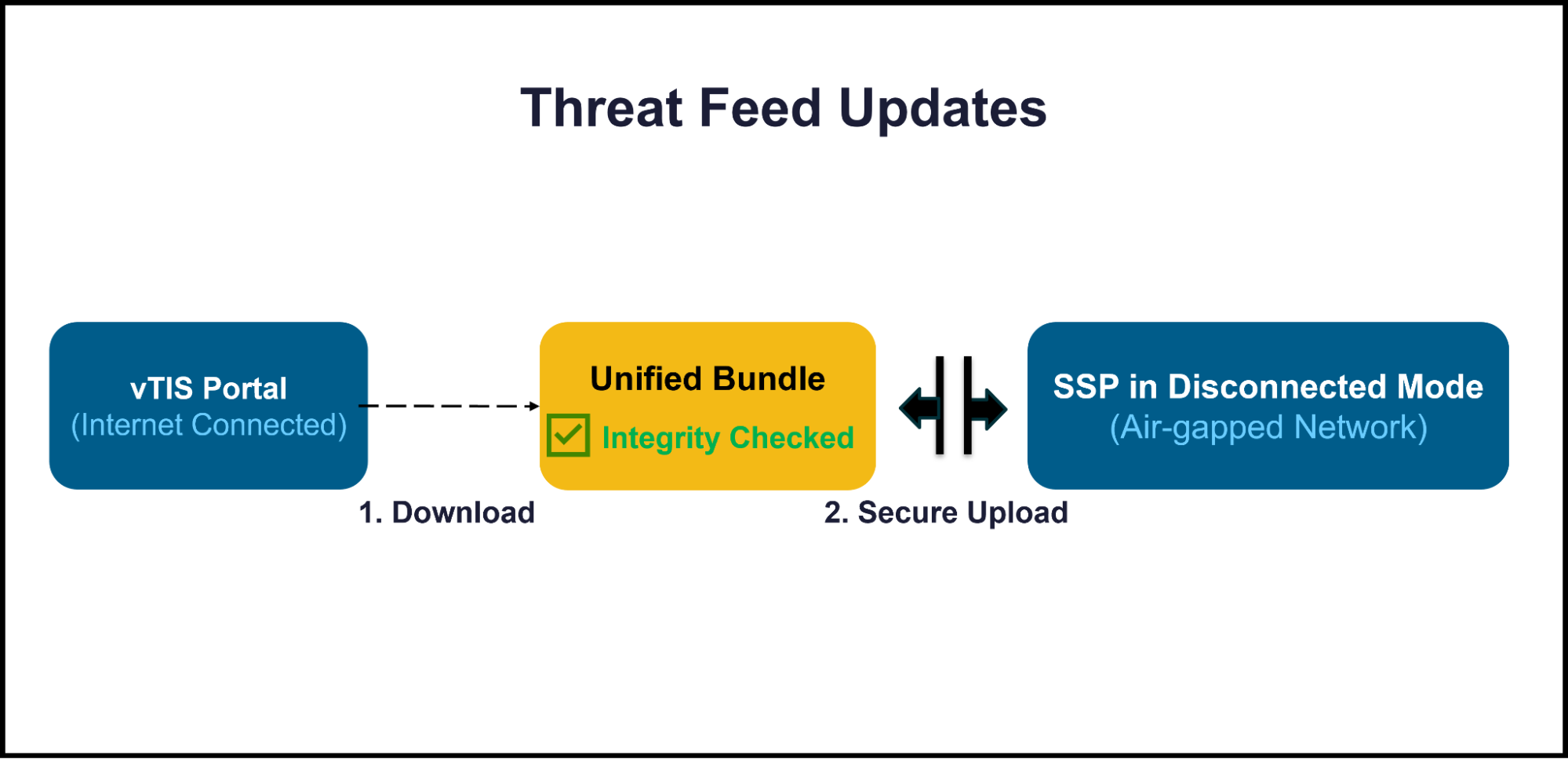
- A Single, Unified Threat Payload: Rather than managing fragmented, feature-specific updates, administrators receive a single bundle containing threat intelligence across all vDefend capabilities, including IDPS signatures, MPS models and signatures, NDR metadata, Geo/Malicious IP reputations, and URL feeds. That means one download and verification workflow.
- Secure, Verifiable Retrieval: Security teams download the consolidated threat bundle from the vDefend Threat Intelligence Service (vTIS) portal using either the UI or public APIs. Built-in integrity checks let teams verify the bundle before uploading it into the isolated environment, mitigating supply chain risks across the air-gapped boundary.
- Up-to-Date Offline Protection: vTIS refreshes these unified bundles every 24 hours, and security teams import them on their own schedule. This helps isolated networks maintain a sharp, up-to-date defensive posture against global attack vectors without compromising perimeter isolation.

Streamlined IDPS Signature Management
While the Threat Intelligence Bundle covers every capability, IDPS signatures require extra control because they directly affect how live traffic is inspected. Security teams require signature set versioning and a fast way to roll back if a new signature set affects internal traffic. Maintaining control over security policies in a disconnected environment requires precise, localized management tools. vDefend in an air-gapped deployment model provides full IDPS signature management directly through the localized SSP portal, offering complete, granular control over signature sets without requiring manual intervention.
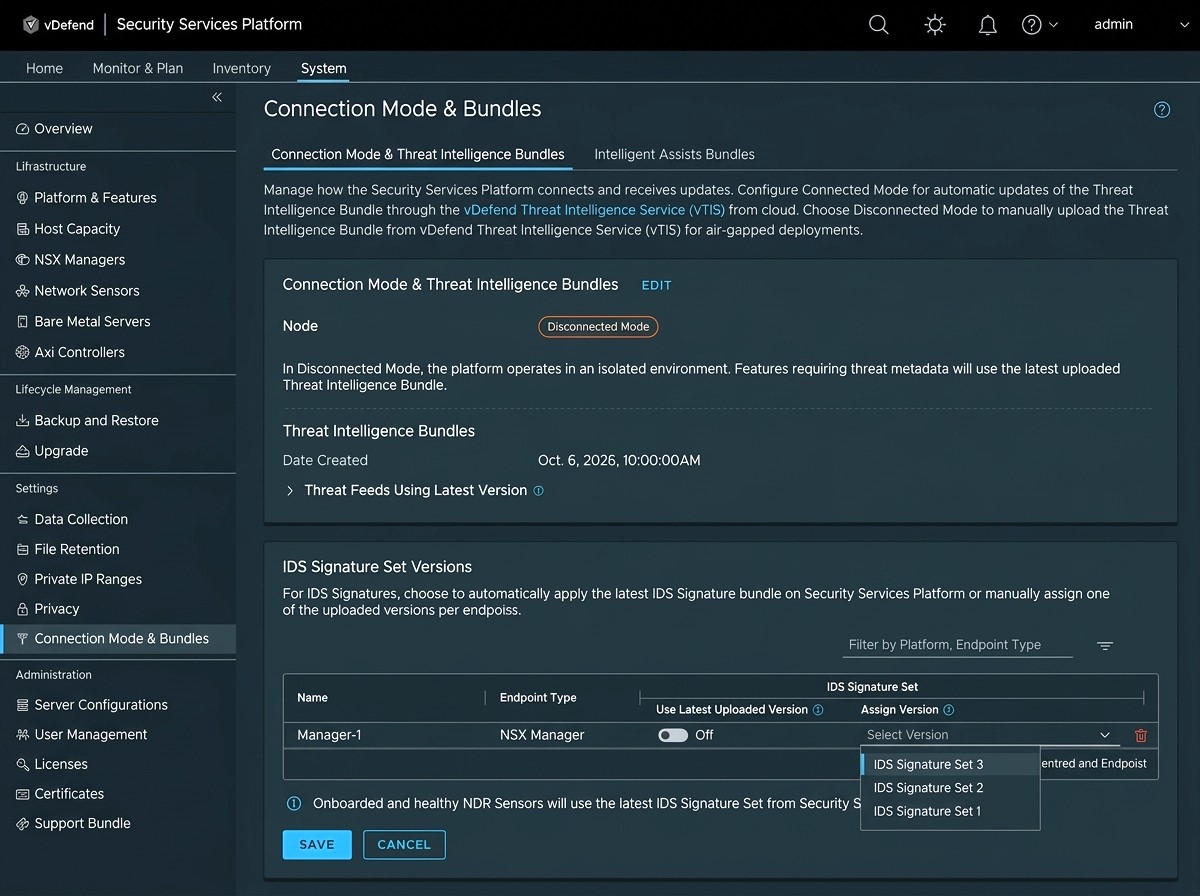
- Centralized Bundle Management: Administrators can upload, view, and manage downloaded IDPS signature bundles directly within the isolated SSP interface.
- Version Control: The platform stores up to 5 distinct IDPS signature bundles simultaneously, providing offline environments with a built-in safety net and an update history.
- Precise Deployment Control & Rollback: Security teams select exactly which signature bundle is active for NSX Manager inspection. If an update unexpectedly affects internal traffic, operators can perform a one-click rollback to a stable bundle without requiring new downloads or extending exposure windows.
Bringing Malware Prevention Fully On-Premises
For highly sensitive environments, routing suspicious files to a cloud sandbox for analysis has always been a non-starter, as it conflicts directly with the data privacy and sovereignty mandates these organizations operate under. With Security Services Platform (SSP) 5.2, vDefend for air-gapped environments removes that conflict by running the entire malware prevention pipeline directly within your private cloud, with no dependency on external connectivity.
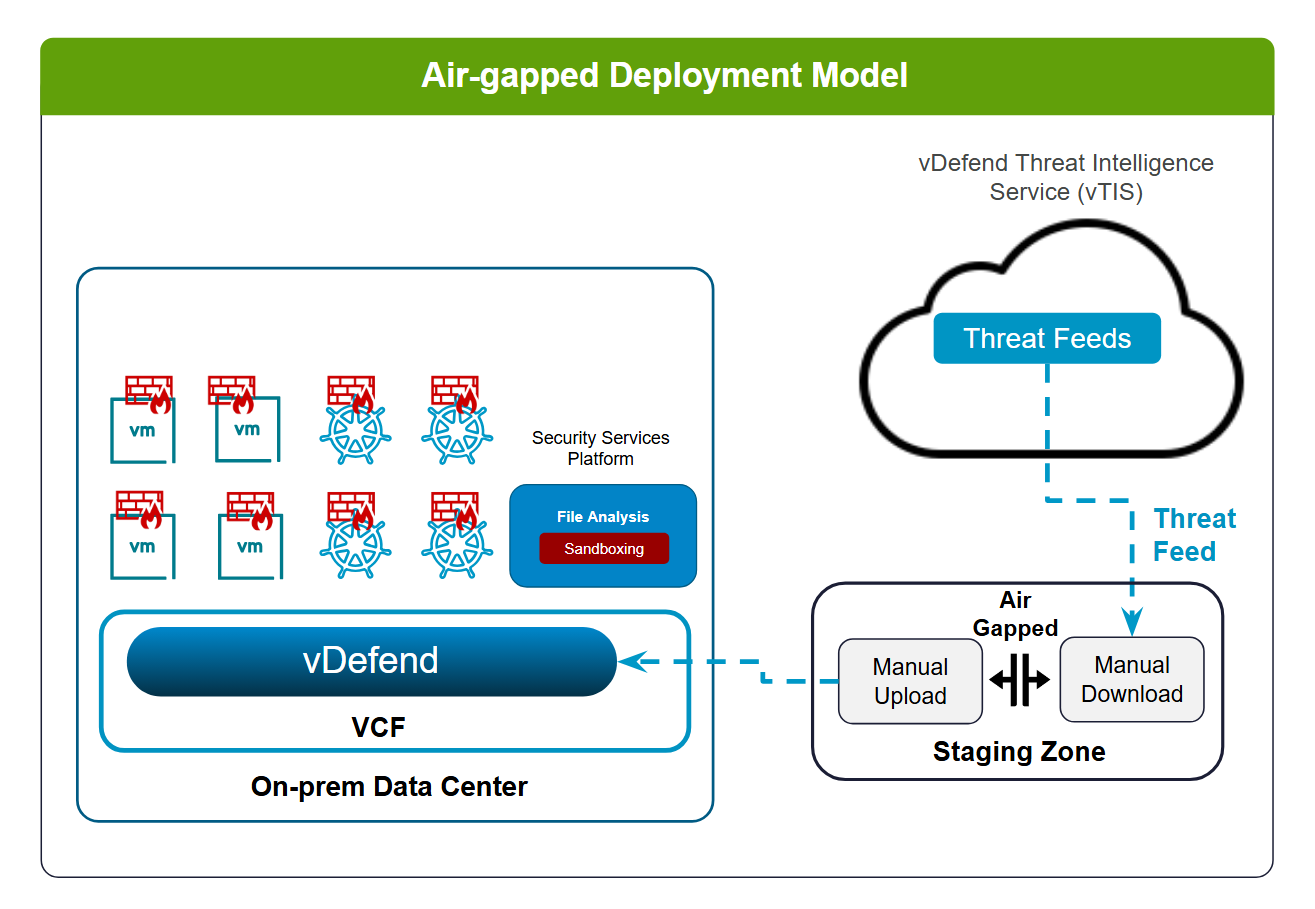
- Hypervisor-Native Inline Inspection: The Malware Prevention Service (MPS) performs multi-layered inline inspection directly at the hypervisor layer, combining rapid hash/cache lookups, deep static analysis, and antivirus feeds to block known threats instantly without outbound connectivity.
- On-Premises Dynamic Sandboxing for Zero-Day Threats: When unknown or evasive artifacts require behavioral evaluation, vDefend detonates them locally within isolated Sandbox instances running directly on ESXi hosts inside your private cloud. This enables fast, zero-day-capable detection without ever exposing file payloads beyond your perimeter.
- Uncompromised Data Sovereignty: File payloads, threat metadata, and operational telemetry remain strictly contained within the enterprise boundary, providing a defensible answer for auditors who require proof of complete data isolation.
Putting It Together: The Air-Gapped Workflow
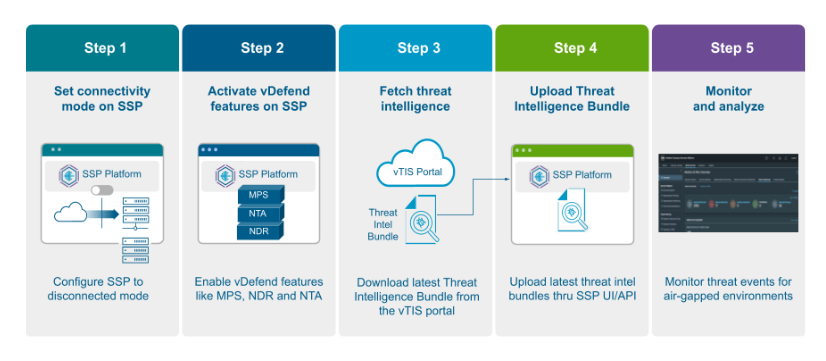
In summary, vDefend follows a structured operational process in an air-gapped deployment model:
Step 1: Set Connectivity Mode on SSP: Access the SSP (Self-Service Portal) platform and configure SSP network connectivity settings to disconnected mode.
Step 2: Activate vDefend Features on SSP: Enable vDefend features on SSP including MPS (Malware Prevention Service), NDR (Network Detection and Response), and NTA (Network Traffic Analysis). On initial deployment, the platform includes a default threat intelligence feed to establish an immediate security baseline.
Step 3: Fetch Threat Intelligence: To maintain defenses against emerging zero-day threats and evolving attack vectors, teams manually download the latest Threat Intelligence Bundle from the internet-facing vTIS portal in a staging zone. The bundle is scanned, verified, and transferred across the air-gapped perimeter following standard internal security protocols.
Step 4: Upload Threat Intelligence Bundle: Administrators upload the verified payload into the isolated SSP console via the UI or API, instantly distributing the latest threat feeds, including IDPS signatures, MPS models and signatures, NDR metadata, Geo/Malicious IP reputations, and URL feeds, across the environment.
Step 5: Monitor and Analyze: Monitor security telemetry and threat events directly within the air-gapped environment using local dashboards and analytics to investigate and respond to incidents without outbound connectivity.
What This Means for Organizations
This approach supports the following business goals for enterprises:
- Data sovereignty and residency: Network traffic, application data, and sensitive files stay inside the local data center. Advanced security services such as malware sandboxing, IDPS, and NDR are all handled locally.
- Threat containment: Air-gapped environments effectively neutralize internet-based command-and-control (C2) frameworks. Combining this with vDefend’s comprehensive multi-layer security helps detect threats and restrict their lateral propagation.
- Regulatory compliance: Government agencies, defense contractors, utility operators, and financial institutions face strict isolation rules. A fully self-contained advanced security stack helps them meet these regulatory mandates.
- Continuous threat prevention: The vDefend air-gapped deployment model removes the dependency to connect to the internet, enabling security teams to keep IDPS signatures and threat intelligence current through secure offline updates.
Conclusion
As AI-driven threats continue to grow, effective defense requires multi-layered protection, including zero-trust lateral security and advanced threat prevention. VMware vDefend delivers its complete suite of security capabilities for organizations with sensitive workloads operating in air-gapped environments.
Learn more:
- VMware vDefend
- Introducing the Frontier AI Security Readiness Program
- VMware vDefend IDPS: Securing Private Cloud Workloads in the Age of Frontier AI
- VMware vDefend Advances Multi-Layer Lateral Security, Deployment Automation and Performance for the Frontier AI Era
- Virtual Patching: Guarding Against a Tsunami of AI-discovered Exploits with vDefend and Avi