
Securing the control plane that your Kubernetes strategy depends on.
As enterprise containerization accelerates on VMware Cloud Foundation (VCF), the vSphere Supervisor becomes the central focal point of both operation and platform risk. Securing tenant applications alone is insufficient – organizations must safeguard the infrastructure and control plane beneath them. VMware vDefend delivers a multi-layered, VCF private cloud-native security stack, extending zero-trust defense from control plane management interfaces down to individual virtual machines and container workloads.
Kubernetes is central to how modern enterprise applications are delivered. On VCF, the vSphere Supervisor makes this possible by serving as the management control plane that converts developer requests into running vSphere Kubernetes Service (VKS) clusters, Virtual Machines (VMs), and containers at business speed. However, that speed carries a concentration of risk. Sitting directly between core virtualization infrastructure and managed workloads, a potential compromise of the Supervisor can expose both the control plane and workloads simultaneously. As a high-value enterprise asset, it requires dedicated infrastructure-level protection.
This post outlines why Supervisor control plane protection is critical and how vDefend delivers zero-trust security across the Supervisor, native Services, vSphere Namespaces, and VKS clusters, referencing detailed architectural blueprints. Importantly, the design patterns covered in this blog are completely Container Network Interface (CNI) agnostic.
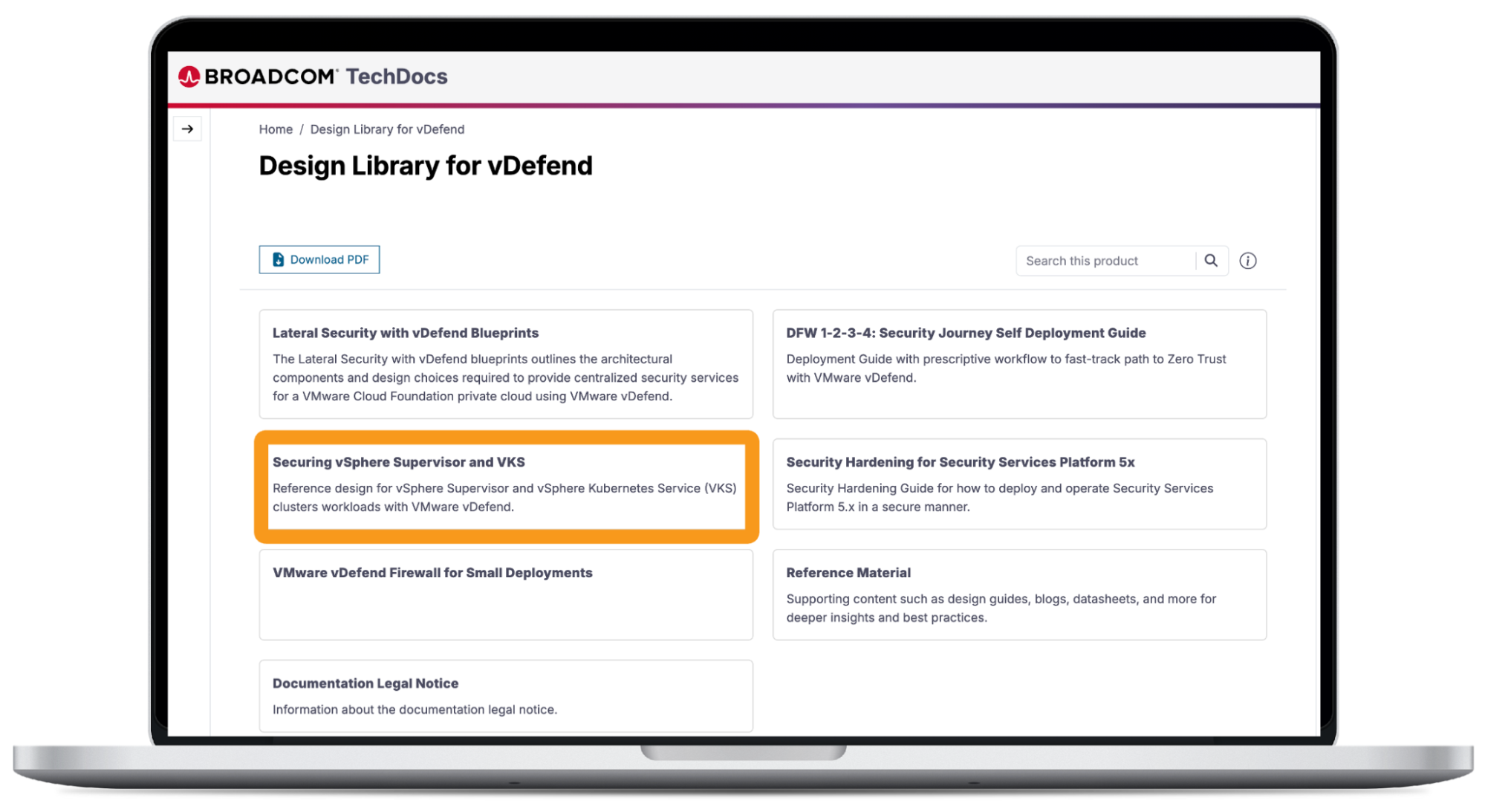
Detailed architectural materials live in the Design Library for vDefend.
Furthermore, the complete design guide expands on this foundation by providing blueprints specifically tailored to securing containerized workloads within VKS clusters running Antrea CNI.
Why does it matter
The Supervisor is a high-value asset in the VCF private cloud
While security focus typically centers on guest applications, the Supervisor requires priority protection for four strategic reasons:
- Gateway to Infrastructure: The Supervisor Control Plane VMs connect directly to vCenter, ESX hosts, NSX Manager, and other VCF management components. An attacker who gains control of these VMs can move laterally across the VCF management plane.
- Platform-Wide Impact: vSphere namespaces, VKS clusters, VMs, and containers are provisioned and managed via the Supervisor. A breach here is a multi-tenant, platform-wide event, not a single-application incident.
- Exposed by Design: Although the Supervisor API possesses built-in authentication and authorization capabilities, it remains exposed at the network level because it accepts incoming connections by default to accommodate developers, CI/CD pipelines, automated tools, and downstream clusters.
- Intersection of Trust Boundaries: Management traffic, workload traffic, platform services, and VKS clusters API calls converge at the Supervisor. Each connection path represents a trust boundary requiring strict governance. The Supervisor requires infrastructure-level protection that application teams cannot accidentally disable or modify.
The Infrastructure Provisioned by the Supervisor is permissive by default
The Supervisor provisions VPCs, vSphere Namespaces, VKS clusters, VMs, and vSphere Pods on demand. Operational teams frequently assume that structural separation implies network security – it does not:
- Logical boundaries are not security barriers: Virtual infrastructure network segmentation establishes logical boundaries, but it does not inherently block communication. Without explicit firewall enforcement, workloads in different namespaces remain fully reachable across the network.
- Intra-VPC east-west traffic goes unchecked: Traffic flowing between workloads within the same VPC is routed in a distributed manner and never traverses a VPC perimeter gateway. A single compromised workload can easily serve as a pivot point to adjacent systems, significantly expanding the blast radius of a breach.
- Network address translation (NAT) obscures source identity: VPC Gateways and Load Balancers apply source NAT (SNAT), stripping the original client IP. As a result, the source identity is lost, leaving firewall enforcement points at the destination unable to reliably verify the origin, but only L4/L7 services. Access control must be enforced at the appropriate policy layer before translation occurs.
- Unmonitored open access creates compliance blind spots: Lacking explicit zero-trust policies, the Supervisor Control Plane VMs, platform services, and provisioned workloads accept far more incoming connections than intended—with no audit log recording allowed or denied traffic.
A perimeter firewall alone cannot eliminate these internal exposures because it has zero visibility into east-west traffic moving between workloads inside the platform. Closing these gaps requires two complementary, infrastructure-native security controls operating under a strict Zero-Trust (“permit only what is required”) posture.
vDefend Security Framework for Supervisor and VKS
Supervisor Control Plane Protection
The Challenge: The Supervisor control plane links VCF management components with endpoints that users and automation entities consume to deliver applications. Without a proper security segmentation, a compromised workload could probe the control plane interfaces and pivot into underlying infrastructure management components.
The Solution: vDefend distributed firewall (DFW) can segment and secure the Supervisor’s two primary networks independently:
- Management Network: Restricts traffic communicating with vCenter, ESX hosts, NSX Manager, and VCF management services to explicitly documented paths.
- Workload Network: Governs access to the Supervisor API and supporting infrastructure for vSphere Namespaces, VKS clusters, and VMs. Unapproved traffic is blocked and logged.
Key Outcomes:
- Reduced Attack Surface: Restricts network access strictly to required operational connections.
- Proactive Threat Detection: Denied connection logs provide immediate audit telemetry to detect and investigate potential threats.
- Scalable Policy Enforcement: Firewall rules automatically track control plane components during scaling-out or vMotion activities.
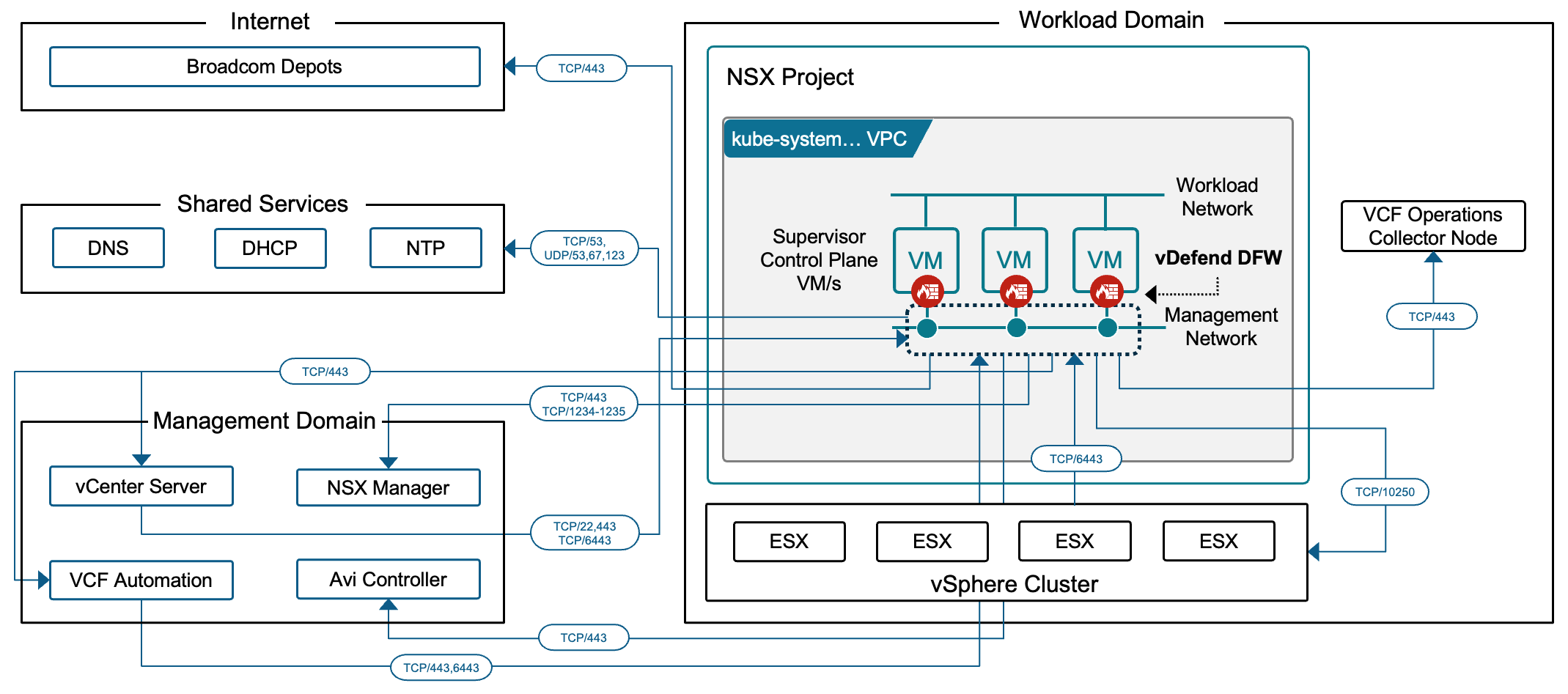
Design Blueprint: Secure the Supervisor Control Plane | Supervisor Management Network | Supervisor Workload Network | Secure VKS cluster control plane
Supervisor Services Security
The Challenge: System services inside the Supervisor automate platform lifecycle management, resource provisioning, keep configuration consistent, collect operational metrics, and more. They enable self-service and often hold broad privileges. A possibly compromised service creates a high-impact vector.
The Solution: Least-privilege Distributed Firewall (DFW) rules are applied to each Supervisor Service. Only authorized components requiring access can communicate with a specific service—and vice versa—while all other inbound and outbound traffic is blocked and logged. The design pattern directly accounts for VPC load balancing and NAT transformations to ensure security policies are enforced exactly as intended.
Key Outcomes:
- Supervisor Services Containment: Prevents initial compromise of one service from escalating into lateral movement across others.
- Operational Transparency: Provides clear visibility into expected vs. anomalous services communication.
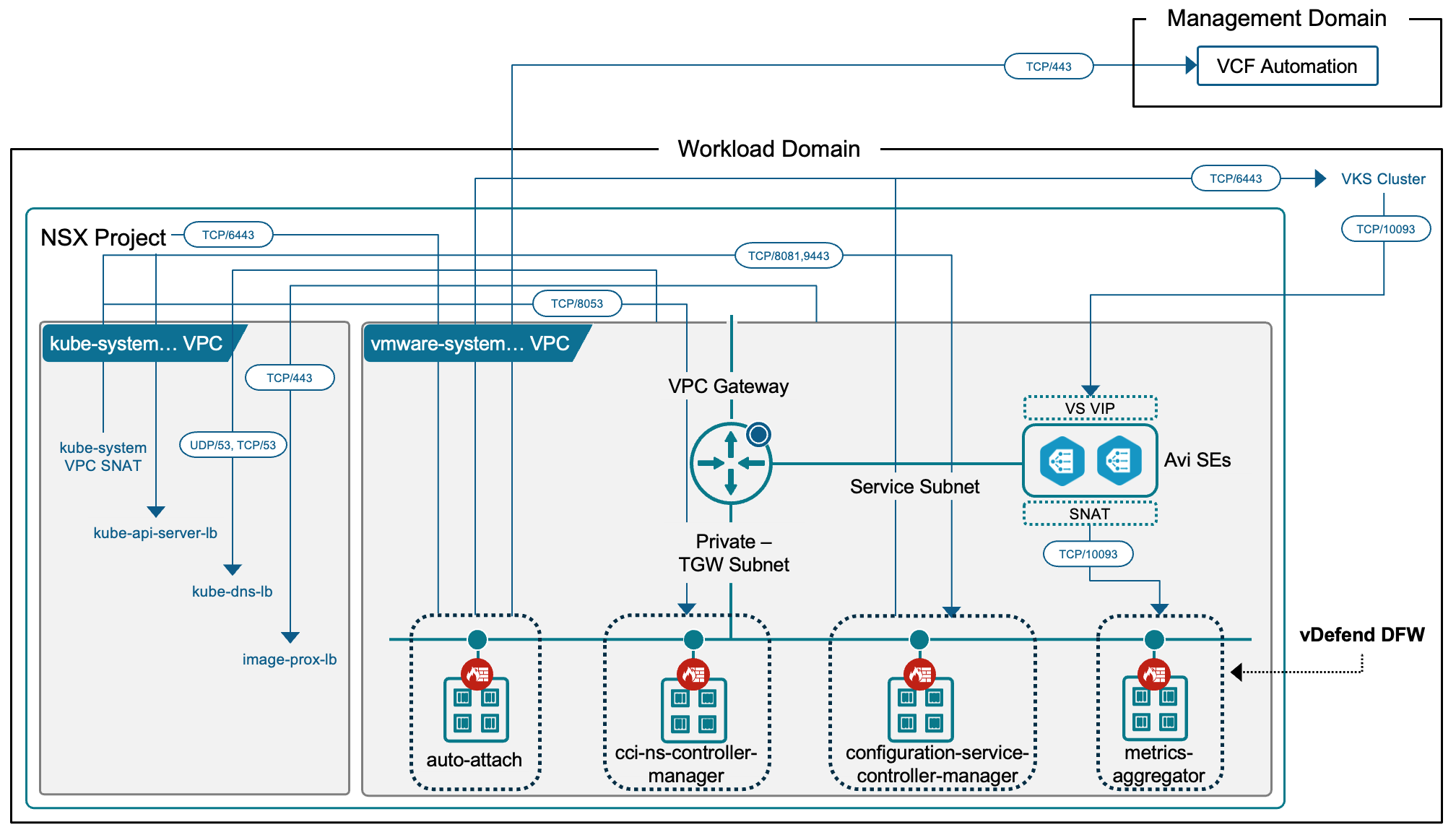
Design Blueprint: Secure Supervisor Services
Supervisor API Access Protection
The Challenge: By default, the Supervisor and VKS Clusters API are reachable from any source by platform administrators, developers, and automation tools. These Kubernetes API server communications are just as critical, and they must remain protected against external probing or accidental disruption during administrative operations.
The Solution: API access is restricted to authorized sources – such as administrative jump hosts and trusted management systems – and enforced upstream using Transit Gateway or VPC Gateway firewall policies. Enforcing policies before traffic reaches the Load Balancer Virtual Service ensures inspection occurs before SNAT to obscure the original client identity. Where possible, this is implemented centrally at the Transit Gateway to provide a single, auditable point of governance. Clusters retain their required operational access, while all unauthorized traffic is blocked and logged.
Key Outcomes:
- Prevention at the front door: Unauthorized API requests are blocked before reaching platform endpoints.
- Centralized governance: One policy point is simpler to audit and operate than many.
- Security that preserves agility: Critical control plane paths stay reliable, and application teams keep their pace.
- Accountability: Logged denials record who attempted to reach the Supervisor API, and when.
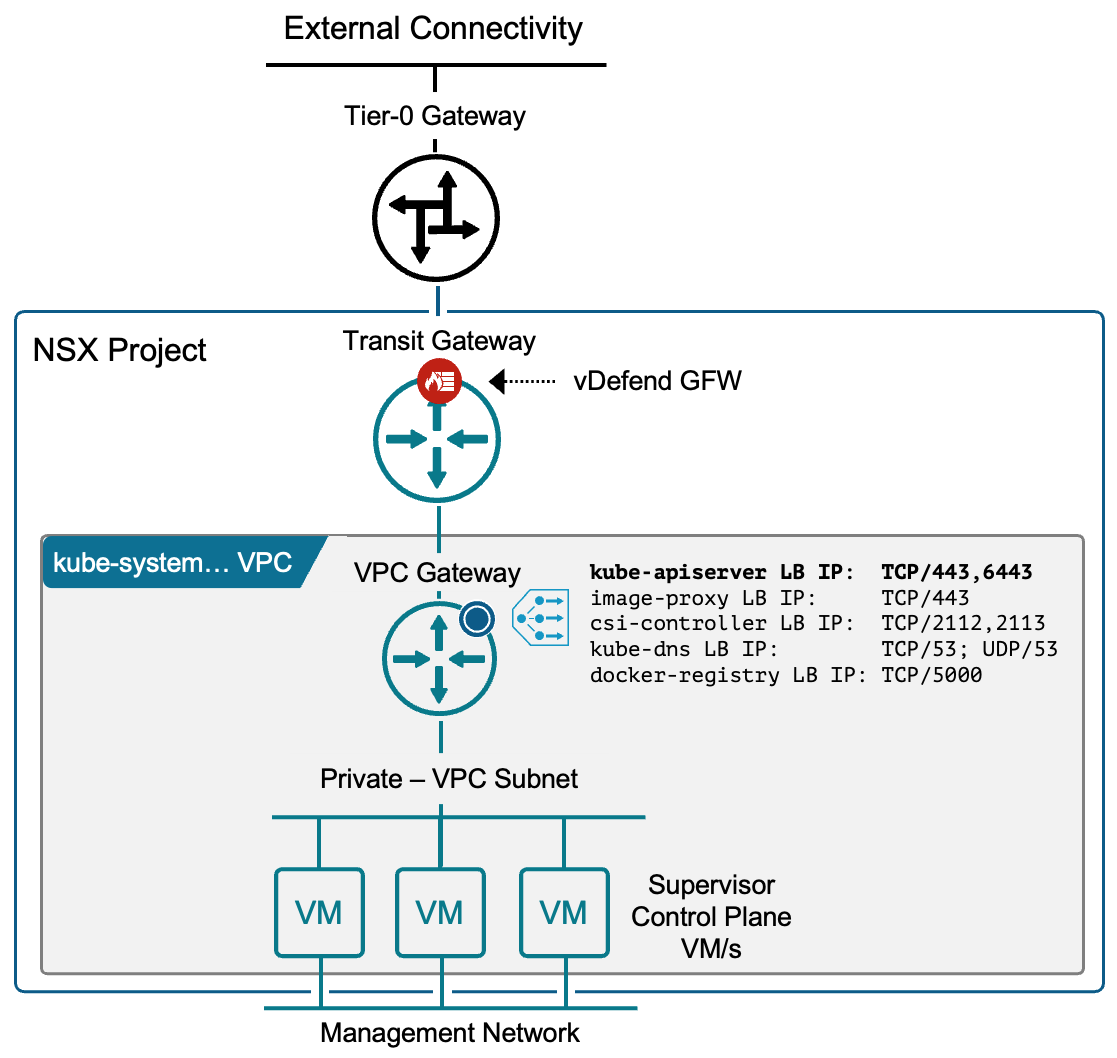
Design Blueprint: Protect Supervisor API
vSphere Namespaces Isolation
The Challenge: vSphere Namespaces separate customer applications, projects, tenants, departments, or environments. Network subnets segmentation and standard IP routing do not provide security isolation on their own; workloads in different namespaces can communicate unless blocked by firewall policy.
The Solution: Dedicated DFW policies are applied to each vSphere Namespace. Intra-namespace traffic flows unrestricted, while inter-namespace communication is blocked by default unless a service is explicitly published. This design pattern operates seamlessly whether namespaces share a single VPC or are deployed in distinct VPCs, accounting for private subnet SNAT behavior and ensuring authorized services remain reachable without compromising isolation.
Key Outcomes:
- Blast Radius Containment: A breach in a development namespace cannot pivot into production.
- Verifiable Multi-Tenancy: Separation between business units or environments is enforced via strict firewall segmentation, not just by convention.
- Intended access preserved: Isolation does not interrupt applications that are meant to be exposed.
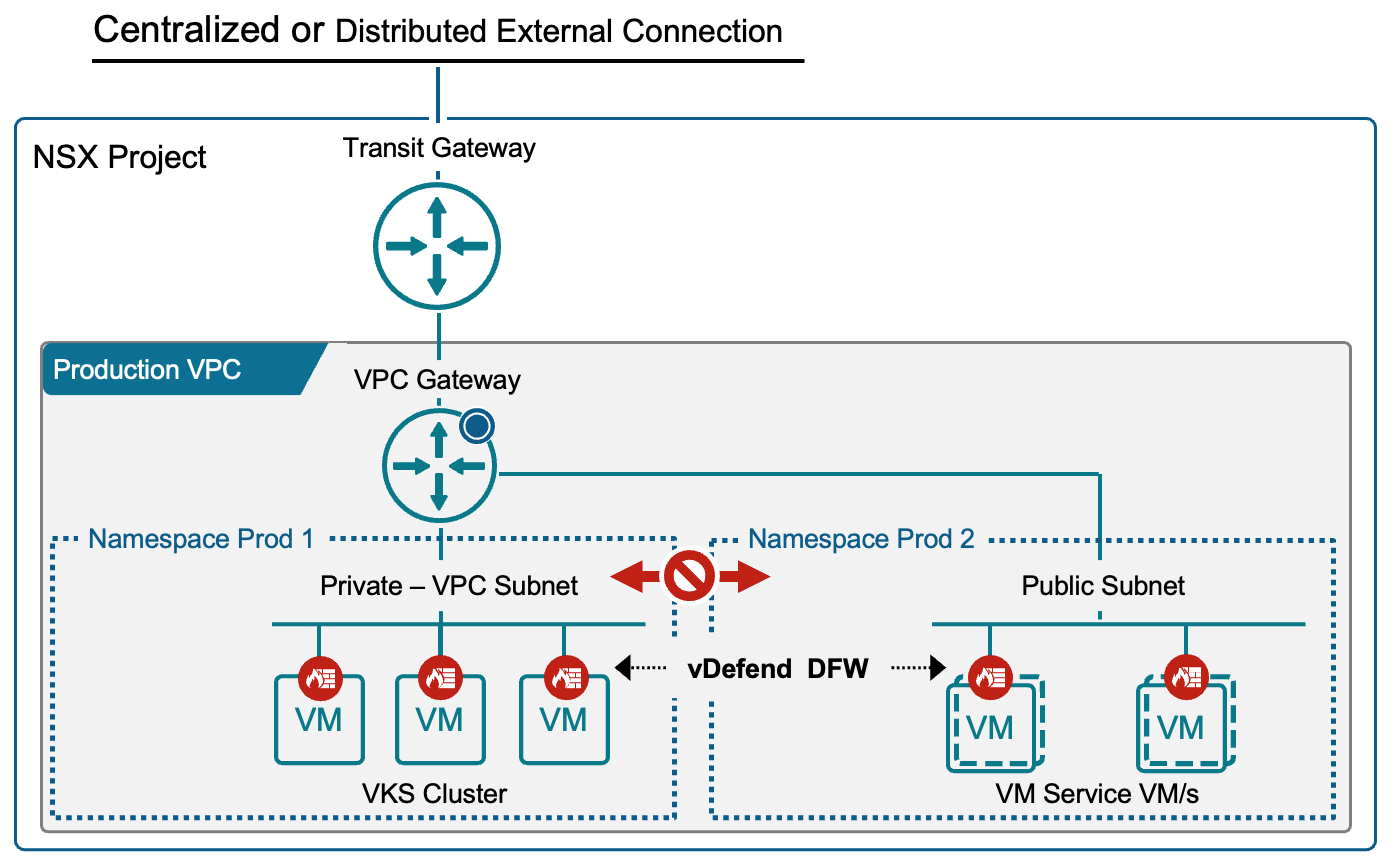
Design Blueprint: vSphere Namespace Isolation
VKS Clusters Isolations
The Challenge: A single vSphere namespace can host multiple VKS clusters, VMs, containers, and data services. Traffic inside a VPC flows unrestricted by default: workloads attached across different VPC subnets (such as Private-VPC, Private-TGW, or Public) can communicate freely without traversing or being inspected by the VPC Gateway firewall. A misconfiguration, privilege escalation, or malicious workload can become a foothold, allowing lateral movement between adjacent workloads.
The Solution: DFW segmentation is enforced at the cluster boundary to individual VKS Nodes (VMs). The policies are built on the vDefend platform’s tagging and grouping model, so provider and tenant administrators can manage them with familiar tools. External ingress passes strictly through load balancers on approved ports.
Key Outcomes:
- Zero-Trust: Prevents lateral movement between adjacent VKS clusters
- Unified Operations: A single policy pane governs VKS clusters, VMs and containers, using a familiar toolset.
- Security Posture Governance: Infrastructure-level enforcement complements Kubernetes-native controls and can’t be switched off by an application team by accident.
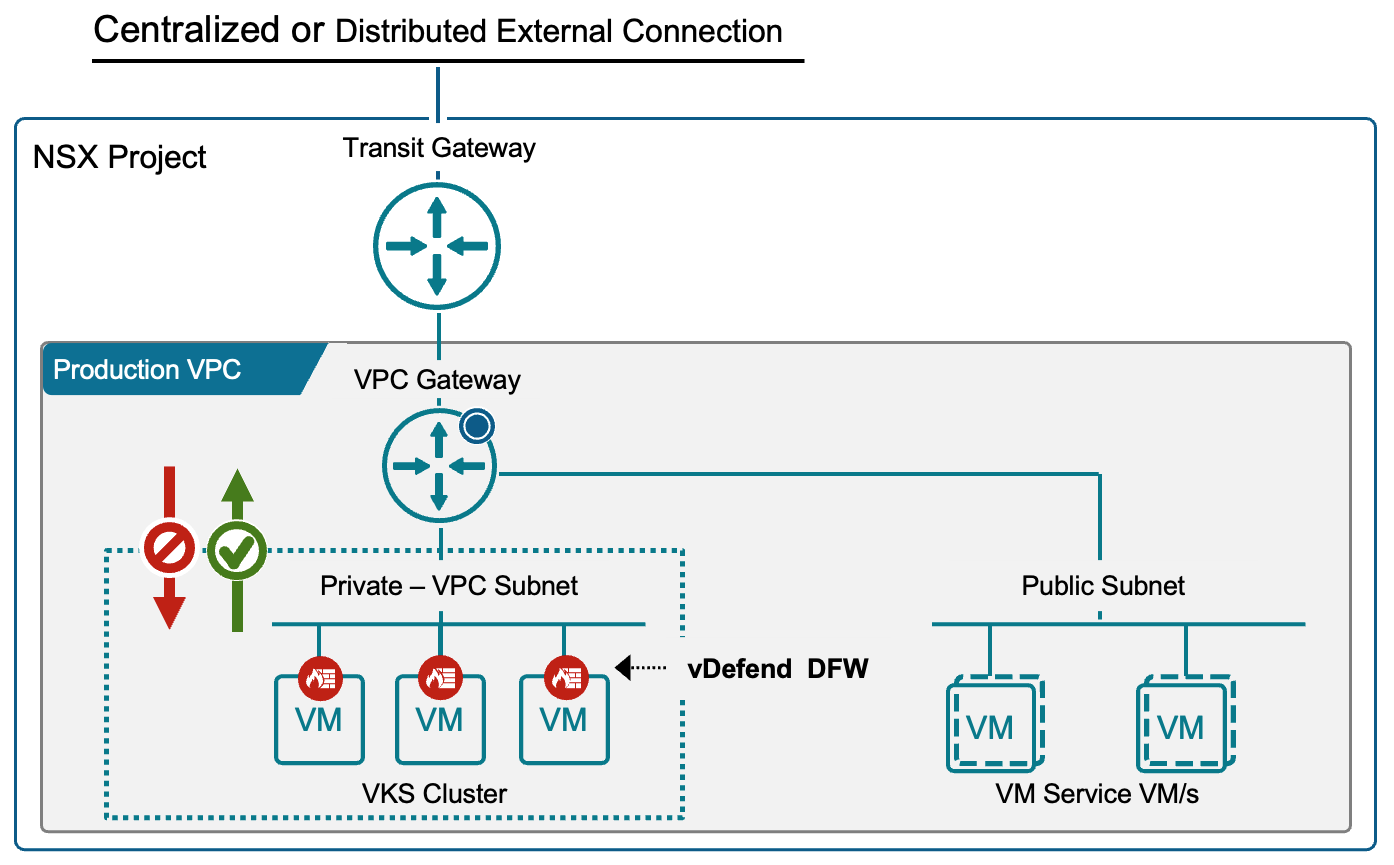
Design Blueprint: Secure resources within a vSphere Namespace
Conclusion
The vSphere Supervisor and vSphere Kubernetes Service are now core of the VCF private cloud infrastructure. Securing the applications running on top while leaving the control plane exposed is a risk modern platforms cannot afford.
Delivered natively within VMware Cloud Foundation, vDefend integrates both DFW and GFW solutions to protect the Supervisor control plane and its dynamically provisioned workloads.
Your teams don’t need to design this from scratch. The vDefend Design Library provides the groups, rules, and rationale for each layer, so you can start with the area of greatest concern and build outward.