VMware Cloud Foundation (VCF) 9.1.2 brings native S3-compatible object storage to vSAN. Block, file, and object are all a part of the vSAN component of VMware Cloud Foundation, so infrastructure teams can use their existing investments in vSAN to support cloud-native apps and AI workloads with S3-compatible object storage. The capability ships with the VCF license, runs on the vSAN hardware customers already own, and gives developers self-service bucket provisioning with multi-tenancy from day one through VCF Automation.
IT leaders consolidating their storage footprint get a third storage type as an integrated platform feature instead of another silo to manage. For IT decision makers, that means one less appliance to procure, power, and operate. For administrators, it means one management plane instead of two or three.
Why On-Premises Object Storage is Now a Requirement
Since the vast majority of data created today is unstructured, file and object storage will see robust demand growth going forward. Cloud-native applications and AI projects, both experiencing significant growth, are large users of object storage. Broadcom is seeing increasing adoption of cloud-native applications and AI projects in customers’ VCF-based private clouds for security, compliance, control and cost reasons.
Demand for object storage isn’t limited to the public cloud. The market for on-premises object storage is growing quickly, reflecting the strong demand for on-premises AI workloads.
VCF 9.1.2 Delivers Foundational Object Storage Capabilities
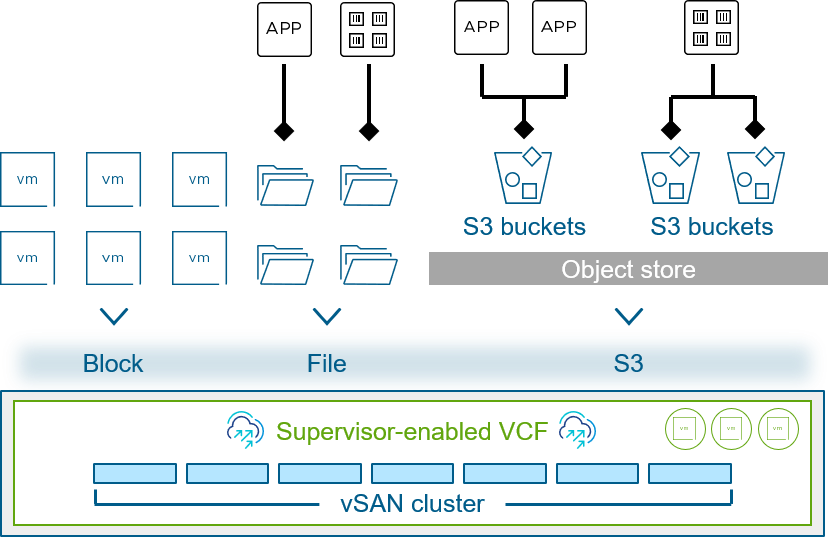
In VCF 9.1.2, vSAN introduces general availability of native S3-compatible object storage. It is the third storage type, alongside block and file, built directly into vSAN.
Because it runs natively in vSAN, the S3-compatible object storage inherits the scalability of any vSAN cluster. Teams scale up by adding capacity to existing hosts, or scale out by adding hosts, all without disruption.
Self-service multi-tenancy of vSAN native S3-compatible object storage through VCF Automation or vSphere Supervisor gives customers logical and physical isolation of buckets, with project-level isolation from day one. IT administrators can set access controls and quotas on buckets. The storage integrates with VCF features designed for multi-tenancy, including VPCs for networking isolation and VCF Automation constructs.
vSAN’s native object storage is secure. Because it is fully integrated, it takes advantage of the full stack of security capabilities of VCF. For instance, vSAN’s native object storage uses vSAN’s software-based encryption for data-at-rest and data-in-transit. It integrates with VCF features designed for security, such as VPCs for networking isolation.
A core set of S3 APIs is available at general availability for bucket and object operations, with an extensive roadmap to rapidly expand capabilities. Deployment and management run through the VCF Automation management plane, keeping operations simple for administrators.
vSAN S3-compatible object storage is easy to deploy, manage and consume, as it runs through the VCF Automation management plane.
Unlike competing object storage products that require separate purchases, separate management tooling and third-party automation software, vSAN native S3-compatible object storage is included with VCF licenses at no additional cost and is fully integrated with VMware Cloud Foundation for simplicity of deployment, scaling, management and consumption. Customers also save on operational costs by simplifying storage management onto a single platform.
Compared to cloud-based object storage, an on-premises approach can cost significantly less over time. Cloud providers charge for egress at nearly four times the storage rate itself. They also charge for API calls that compound with usage. For workloads that move data frequently, like AI training pipelines, these charges can push real-world cloud spend two to five times higher than raw storage rates.
Key Use Cases of vSAN Native Object Storage
In this release, vSAN native S3-compatible object storage is best suited to applications that manage their own data protection and versioning, such as build artifact repositories, Kubernetes backups, and Agentic AI.
DevOps. With VCF Automation, vSAN delivers S3 buckets-as-a-service for Kubernetes-orchestrated applications with self-provisioning and tenant isolation, reducing requirements for third-party tooling. We see two key use cases for vSAN native S3-compatible object storage in devops practices.
- S3 Bucket-as-a-Build-Artifact Repository: Because vSAN’s native object storage is S3-compatible, it integrates with the most popular CI/CD tools on the market today used in DevOps. vSAN provisions storage faster than on-premises options, and it can scale incrementally, lowering your up-front storage costs. The net benefit is lower cost object storage that is already integrated with the infrastructure and applications you use today.
- S3 Bucket-as-a-Kubernetes and Database Backup Repository: vSAN native object storage can be used easily for VMware vSphere Kubernetes Service (VKS) and Data Services Manager (DSM) backup of data and persistent volumes without the need for third party tools.
Agentic AI: Agentic AI does not rely on a single data type, and it requires multiple storage protocols. vSAN provides block, file and S3-compatible object storage for agentic AI workloads on the same infrastructure with the same tool set. The raw, unstructured data is stored on vSAN object storage, then applications such as Tanzu Greenplum process and vectorize the data. Vector embeddings are stored on block storage, which deliver the performance required for instant similarity searches. Agentic AI models can be stored on vSAN native file shares, resulting in a high-performance AI engine all stored locally on VMware vSAN in VCF.
vSAN ESA delivers high-performance object storage that can meet the demands of agentic AI workloads by leveraging NVMe-based TLC. vSAN’s native S3-compatible object storage uses a proprietary zero-copy protocol developed internally that minimizes data processing through the storage stack, reducing I/O queuing and CPU overhead for fast performance. Object storage inherits vSAN’s native availability features, including fault domains and stretched clusters, so rack or site failures are handled without a separate protection layer . Finally, vSAN’s native snapshots allow teams to efficiently test their AI agents with cloned datasets without duplicating storage capacity or impacting production performance.
Learn More
- Take the next step and dive deep into vSAN native S3-compatible object storage at Tech Docs, Administering vSAN Object Storage and Using vSAN Object Storage.
- Learn more about running an AI Data Lakehouse on VMware vSAN with Tanzu Greenplum.
- Read this blog on vSAN native S3-compatible object storage’s integration with VCF Automation.
- To learn more about VMware vSAN, visit our website.
Discover more from VMware Cloud Foundation (VCF) Blog
Subscribe to get the latest posts sent to your email.