
In today’s fast-evolving IT landscape, enterprise IT organizations face a fundamental operational dilemma. On one side, VMware vSphere and infrastructure administrators require strict control, compliance, security, and multi-tenant resource governance. On the other side, developers and DevOps engineers need agility, rapid self-service provisioning, and native API-driven infrastructure to accelerate application delivery.
When these two priorities collide, operational friction is inevitable. Infrastructure teams become overwhelmed by endless ticket queues for cluster provisioning and network changes, while development teams, frustrated by delays, turn to shadow IT or deploy siloed external management clusters. This fragmentation not only slows down innovation but also introduces significant security vulnerabilities, operational overhead, and cost inefficiencies.
In our recent webinar, Activating VKS Supervisor to Support Kubernetes, we demonstrated how activating the control plan, referred to as the vSphere Supervisor, in VMware Cloud Foundation (VCF) 9.1 directly resolves this modern app dilemma.
VMware vSphere Kubernetes Service (VKS) is the Kubernetes runtime built natively in VCF. With CNCF-certified Kubernetes, VKS enables platform engineers to deploy, manage, and scale Kubernetes clusters while leveraging a comprehensive set of cloud services in VCF, as well as all conformant third-party services.
Bridging the Gap: What is the vSphere Supervisor?
Enterprise platform teams face a persistent operational tension: developers need rapid, self-service Kubernetes APIs, while infrastructure teams must enforce centralized governance, security, and resource compliance.
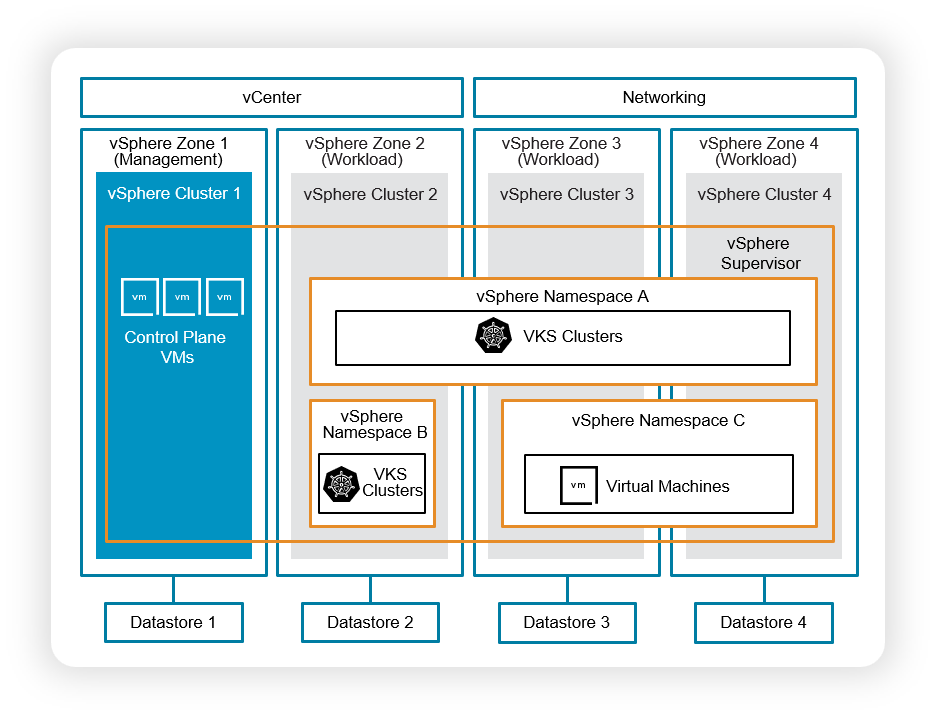
The vSphere Supervisor resolves this friction by delivering true developer self-service backed by enterprise-grade administrative control, all running directly on your existing vSphere infrastructure. Instead of building and maintaining complex, siloed management clusters on top of vSphere, Supervisor integrates a native Kubernetes control plane directly into VMware ESXi and vSphere, converting hypervisors into native Kubernetes endpoints.
This architecture establishes a shared, multi-tenant platform where both infrastructure admins and developers operate harmoniously:
- For vSphere Admins: Control and compliance are preserved through vSphere Namespaces. Admins define resource boundaries (CPU, memory, storage quotas), assign role-based access control (RBAC), and maintain full operational visibility via the vSphere Client and VMware Cloud Foundation Operations.
- For DevOps Engineers: The platform presents a standard Kubernetes API endpoint. Engineers can consume declarative YAML manifests through kubectl and Helm to provision workload clusters (VKS clusters), virtual machines (via the VM Service), and containerized workloads directly within assigned vSphere Namespaces.

In VCF 9.1, decoupled lifecycle management allows platform teams to patch and upgrade Kubernetes versions independently of underlying platform updates. Combined with major VKS engine optimizations, the platform delivers up to 70% faster cluster deployments, up to 75% faster upgrades, and scales up to 500 clusters per control plane instance.
vSphere Supervisor Architecture and High Availability
The vSphere Supervisor architecture is designed to deliver enterprise-grade resilience by embedding a native, high-availability Kubernetes control plane directly into the vSphere hypervisor layer. The vSphere Supervisor control plane consists of three active Kubernetes control plane virtual machines (VMs) deployed across ESX hosts or multi-zone vSphere clusters, enabling continuous quorum and zero single points of failure. These control plane VMs collaborate directly with vCenter and ESX to manage workload lifecycles, resource allocations, and state reconciliation across the environment. Under the hood, storage and compute primitives are tightly coupled to help ensure high availability. The control plane placement algorithm dynamically handles VM placement across fault domains, while transient data is managed via Ephemeral Disks that automatically clean up upon pod termination. Additionally, container image disks are cached directly on individual ESX hosts, bypassing registry download latency to enable near-instantaneous pod creation and recovery during host failover events.
Storage Topologies and Policy Management
Stateful, cloud-native applications require robust persistent storage handling. The vSphere Supervisor seamlessly connects Kubernetes persistent volume requests with vSphere storage primitives through Cloud Native Storage (CNS) and the native vSphere Container Storage Interface (CSI) driver.
When a developer submits a Kubernetes PersistentVolumeClaim (PVC), the CNS-CSI driver interfaces directly with vCenter to translate the claim into a First Class Disk (FCD) on the underlying storage. Admins enforce governance by assigning storage policies (e.g., Gold, Silver) and capacity caps directly to vSphere Namespaces.
The vSphere Supervisor supports three distinct storage topologies tailored to specific workload requirements:
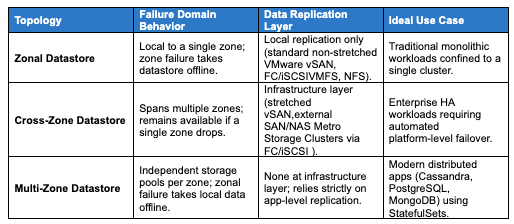
While hyperconverged vSAN is commonly highlighted, traditional external storage arrays (Fibre Channel, iSCSI, and NFS) map directly into these same topologies. Standard external SAN/NAS datastores provisioned to a single vSphere cluster function as Zonal Datastores. In multi-zone deployments, customers utilizing third-party array replication, such as FC/iSCSI Metro Storage Clusters can achieve Cross-Zone Datastore availability without requiring a native vSAN Stretched Cluster.
Beyond persistent storage, vSphere Supervisor manages Control Plane Disks, Ephemeral Disks (automatically destroyed at pod teardown), and Container Image Caching directly on ESX hosts to enable near-instantaneous pod boot speeds.
vSphere Supervisor Networking and Load Balancing
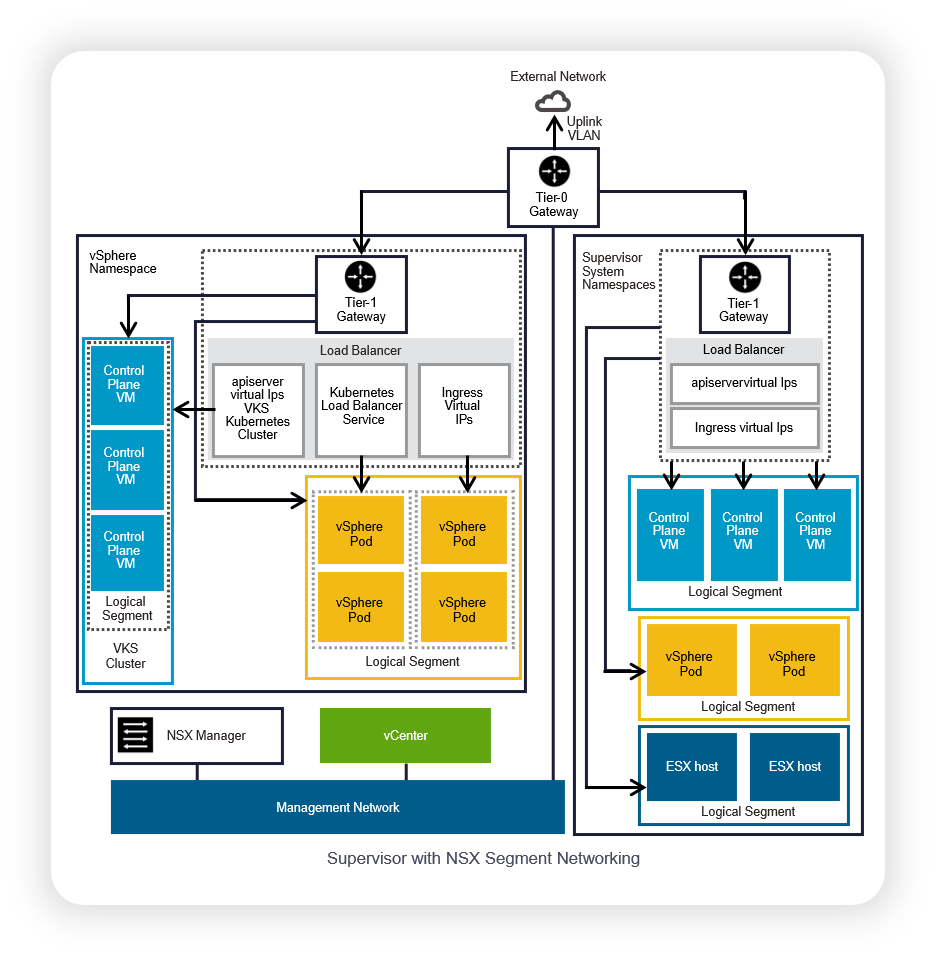
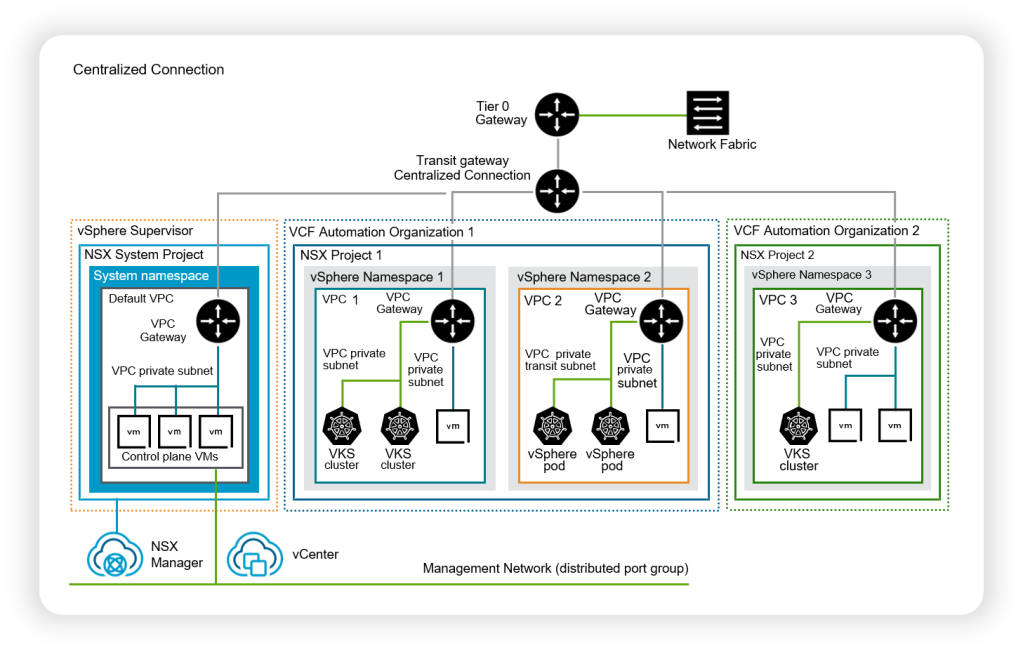
Networking and load balancing within vSphere Supervisor are engineered around a decoupled, highly scalable Virtual Private Cloud (VPC) model implemented through VMware NSX System Projects and Centralized Transit Gateways. Each vSphere Namespace operates within its own dedicated NSX VPC, complete with private subnets and VPC Gateways that isolate tenant workloads and eliminate IP address conflicts, even across teams using overlapping CIDR blocks. Traffic routing across namespaces, management networks, and external services is managed via Tier-0 and Tier-1 Transit Gateways, helping ensure secure, high-throughput network fabric transit. For load balancing and traffic ingress, vSphere Supervisor seamlessly integrates with VMware Avi Load Balancer. This integration automates the provisioning and lifecycle management of virtual IP addresses (VIPs), Kubernetes API endpoint load balancers, and L4/L7 ingress controllers, providing fine-grained traffic management, zero-touch network automation, and deep security isolation without requiring manual networking intervention.
Modern Networking: NSX VPCs and Transit Gateways
Networking across multi-tenant container platforms has traditionally caused significant friction, often resulting in IP address exhaustion, firewall routing complexities, and security risks.
The vSphere Supervisor solves this by pairing NSX Virtual Private Clouds (VPCs) with adaptable transit gateway designs in NSX System Projects. Although our webinar demo highlighted a Centralized Transit Gateway implementation, vSphere Supervisor fully supports Distributed Transit Gateways as well, allowing you to choose the connectivity model that best fits your environment.
Key capabilities of this networking framework include:
- Isolated VPCs per Namespace: Every vSphere Namespace is isolated inside its own NSX VPC, complete with private subnets and dedicated VPC Gateways.
- Zero IP Conflicts and Decoupled Routing: Decoupled routing across VPCs allows separate development teams to use overlapping IP ranges without network collisions.
- Linear Scalability: Centralized Transit Gateways handle high-throughput, cross-namespace, and external transit routing securely via Tier-0/Tier-1 gateways.
- Integrated Load Balancing: Avi Load Balancer automates ingress controller traffic routing and Kubernetes API load balancing seamlessly.
Step-by-Step Activation and Demo Workflow
During the demonstration portion of our webinar, we walked through the complete end-to-end deployment lifecycle from both administrative and developer perspectives.
Day-2 Observability: Full telemetry, performance metrics, and logs flow directly into centralized VCF Operations for proactive monitoring and lifecycle operations.
Prerequisites and Activation Trigger: Before triggering the Supervisor activation, ensure the core prerequisites are met: an active VCF Workload Domain with vSphere HA and DRS enabled, an NSX or vSphere Distributed Switch network configuration with assigned IP pools, a supported load balancer, a dedicated vSphere storage policy, and a Subscribed Content Library. Activation can then be initiated during Workload Domain creation in VCF Operations or post-deployment directly in vCenter under Supervisor Management -> Get Started, where the wizard validates compute zones, storage policies, content libraries, and load balancing configurations before provisioning.
Namespace and RBAC Configuration: The VI Admin creates a vSphere Namespace, assigns storage policies and resource quotas, and grants developer access rights.
Declarative Provisioning: The DevOps engineer authenticates to the vSphere Supervisor control plane via kubectl and applies a YAML manifest to request a new VKS cluster. vSphere Supervisor automatically provisions control plane and worker nodes.
Dual-Perspective Visibility: The VI Admin monitors infrastructure health and VM objects inside vSphere/VCF Operations, while the developer manages pods, services, and deployments using kubectl.
Hybrid App Deployment: Teams deploy multi-tier applications combining virtual machines (via the VM Service API) and containerized workloads using Helm charts.
Conclusion and What’s Next
Activating vSphere Supervisor transforms traditional enterprise virtualization into a powerful, multi-tenant cloud platform. By providing developers with native Kubernetes self-service while giving IT administrators total resource and governance control, VKS accelerates modern application delivery without increasing operational risk.
To experience the full walkthrough step-by-step, make sure to check out the full webinar recording.
Ready to Get Hands-On?
- Hands-on Labs: Try our Hands-on Lab with Kubernetes.
- Official Documentation: Check out these resources.
- Learning Courses: Log in to Learning@Broadcom via the Broadcom Support Portal, under the “Education Portal,” to access the following VKS courses.
Need assistance with your VKS projects? Contact your Broadcom Account Manager to learn how VCF Professional Services and Partners like TeraSky can help advance your initiatives.
Discover more from VMware Cloud Foundation (VCF) Blog
Subscribe to get the latest posts sent to your email.