
We’re pleased to share that GartnerⓇ has named Broadcom (VMware) a Leader in both the 2026 Magic QuadrantTM for Distributed Hybrid Infrastructure, and the 2026 Magic Quadrant for Server Virtualization Platforms. We are also recognized in the 2026 Gartner Critical Capabilities for Server Virtualization Platforms. In the Critical Capabilities rankings for Server Virtualization Platforms, Broadcom (VMware) ranked #1 in all six use cases: Private Cloud, Testing & Development, Legacy Application Support, Disaster Recovery, Edge, and AI. We believe these rankings reflect the breadth and depth of VMware technology and specifically VMware Cloud Foundation (VCF) as a unified private cloud platform that consolidates compute, storage, networking, AI, Kubernetes, and security into a single, integrated stack.
The vast VCF installed base and deep integrations with hardware partners and independent software vendors (ISVs) help ensure compatibility for complex IT environments across many sovereign territories. For organizations in regulated industries that require ISV certification, this ecosystem provides a safe, proven option.
Strong VCF 9 Adoption
VCF’s strength as a fully integrated private cloud platform is also being demonstrated through rapid adoption of VCF across many industry verticals. This adoption is highlighted by customers looking to rapidly deploy distributed infrastructure with consistent operations across on-premises, edge and public cloud environments, natively supporting VMs, containers and AI workloads. License portability provides the ability for customers to repurpose license entitlements purchased on-premises into public cloud deployments. Built on the proven ESX hypervisor, VCF delivers a comprehensive virtualization stack that serves customers of all sizes, from small businesses to Global 500 enterprises in highly regulated verticals such as banking, healthcare, and government. In particular, customers are deploying VCF to help them with their challenges to manage costs, run production AI at scale, and securely operate their environments.
Cost Savings Through Technology Innovation
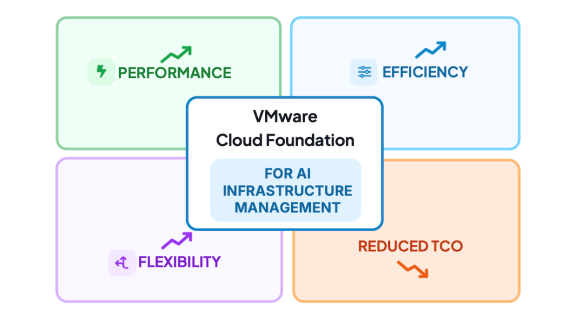
To drive down costs, infrastructure and operations leaders focus on a few key vectors. At the core, it is making infrastructure more efficient through technology innovation, such as delivering dramatic compute and storage savings via NVMe memory tiering, storage compression, and global deduplication. By migrating workloads from public clouds to on-premises private AI clouds, customers can eliminate AI “tokenomics” concerns while maintaining complete security and control. Finally, governed model choice within VCF provides the flexibility to run small language models on CPUs and for open-weight or LLM workloads that need GPUs, vGPUs let you virtualize these powerful engines across multiple users and teams, further lowering overall costs.
AI-Native Infrastructure, Built In
VCF’s AI integration is a key differentiator, offering deep integration of Private AI Services, GPU virtualization and an Agent Builder service built directly into the platform, allowing organizations to build and run sovereign AI natively on familiar infrastructure. Enterprises can take advantage of a consistent operational platform to maximize efficiency for existing and AI workloads. Rather than deploying AI on separate, unfamiliar infrastructure, teams can leverage the same tools, governance, and security model they already use for traditional workloads. This includes retrieval-augmented generation (RAG) and fine-tuning capabilities built directly into VCF.
Broadcom recently announced general availability of VCF 9.1 which delivers additional enhancements and capabilities that accelerate adoption and consumption of private cloud solutions. Also, at the most recent VMware Explore 2026, Broadcom announced key capabilities leveraging VCF 9.1, VMware AI Factory and how VCF is delivering industry-leading AI models to the Private AI Cloud.
Securing the Enterprise Ecosystem
As frontier AI models accelerate the threat landscape, VCF secures operations from hypervisor to agent, protecting infrastructure, models, and agent workflows without slowing innovation. Hardware-enforced confidential computing (Intel TDX and AMD SEV-SNP) encrypts data in use, closing the last unprotected attack surface that encryption at rest and in transit potentially leaves exposed. Secure MCP-based agentic AI workflows enforce a unified security model across infrastructure, AI models, and agent access patterns, reducing compliance and data leakage risks. Continuous compliance enforcement automatically validates and remediates configuration drift across the fleet, keeping organizations audit-ready under DORA, NIS2, and PCI-DSS 4.0. And by preventing lateral attacks across AI and traditional workloads, VCF with VMware vDefend distributed firewalls and intrusion detection and response reduces the operational complexity and security tool sprawl that attackers exploit, without platform sprawl.
What’s Next
As we look ahead, the VCF team is laser-focused on deepening AI integration, expanding data services maturity, and continuing to improve the customer experience across commercial and support interactions. VCF 9.1 is available now, and we’ll continue our cadence of incremental enhancements designed to keep your private cloud at the forefront of the AI era.
If you’re already running VCF, take the next step on your private journey by evaluating the Frontier AI Security Readiness Center, Private Cloud Modernization Program, Upgrade Planning Tool and VCF Adoption Path. If you’re evaluating VCF, there’s never been a better time to see what a unified, AI-native private cloud platform can do for your organization. Talk to your Broadcom account team about how VCF 9 can accelerate your private cloud strategy.
This accomplishment would not be possible without the ongoing trust and relationships with our customers, partners and the broader VMUG community that continues to challenge us every day to keep innovating and improving the VCF product and experience.
Resources:
Gartner, Inc, Magic Quadrant for Distributed Hybrid Infrastructure, Julia Palmer, Elaine Zhang, Adrian Wong, Daniel Bowers, 7 September 2026
Gartner, Inc, Magic Quadrant for Server Virtualization Platforms, Tony Harvey, Daniel Bowers, Paul Delory, Tony Iams, Owen Marino, 14 September 2026
Gartner, Inc, Critical Capabilities for Server Virtualization Platforms, Tony Iams, Daniel Bowers, Tony Harvey, Paul Delory, 14 September 2026
Gartner and Magic Quadrant are trademarks of Gartner, Inc. and/or its affiliates. Gartner does not endorse any company, vendor, product or service depicted in its publications, and does not advise technology users to select only those vendors with the highest ratings or other designation. Gartner publications consist of the opinions of Gartner’s business and technology insights organization and should not be construed as statements of fact. Gartner disclaims all warranties, expressed or implied, with respect to this publication, including any warranties of merchantability or fitness for a particular purpose.
Discover more from VMware Cloud Foundation (VCF) Blog
Subscribe to get the latest posts sent to your email.