
Rigid, hardware-bound PCs on legacy factory floors have long acted as a bottleneck for the electric vehicle transition. To eliminate these infrastructure constraints without risking costly downtime, Audi developed its Edge Cloud 4 Production (EC4P) architecture, built on VMware Cloud Foundation (VCF) at the Edge.
By deploying an on-premises private edge cloud, Audi completely decouples automation control logic from physical machinery. This software-defined approach does more than streamline active production; as highlighted in Audi’s recent announcement on scaling up AI deployment in production, it turns siloed shop-floor data into an AI-ready pipeline for predictive analytics.
To evaluate the industry-wide significance of this framework, ARC Advisory Group, a leading independent research and advisory firm for manufacturing automation, has published an in-depth technical white paper on Audi’s EC4P. Additionally, a companion series of three ARC View reports and webcasts explores each phase of Audi’s modernization journey in detail:
The Cultural Shift (IT/OT Convergence)
- The Action: Audi built cross-functional, three-shift teams to seamlessly merge enterprise IT software practices directly into an “always-on” operational technology (OT) availability mindset on the shop floor.
- The DevOps Edge: Has begun to apply using Continuous Delivery (CI/CD) pipelines to continuously validate virtualized workloads in pre-production staging environments, eliminating traditional deployment friction.
Read the Full Analysis: ARC View Part 1: Vorsprung through Culture – Inside Audi’s Software-Driven Factory. Discover how Audi aligned its organizational structure and culture to successfully scale its software defined framework
Redefining Technical Boundaries
- The Network: Audi partnered with Broadcom and Cisco to engineer a real-time-capable “industrial virtual switch” powered by VMware Cloud Foundation networking (NSX). This advanced architecture achieves the ultra-low, sub-millisecond network latency required to handle deterministic PROFINET traffic while leveraging Parallel Redundancy Protocol (PRP) for instant, seamless failover.
- Host Tuning and Security: Enabled microsecond-level deterministic performance via hardware tuning, including exclusive CPU core pinning and strict NUMA memory allocation.
Read the Full Analysis: ARC View Part 2: Determinism at Scale – Audi’s KPIs & Technical Limits. Dive deep into the hardware configurations, performance metrics, and network tuning required for microsecond level deterministic control.
Proven Business Value vs. Future Scalability
To evaluate the operational readiness of the platform, the research highlights what is delivering immediate value today versus the future roadmap limits validated by ARC Advisory Group:
Phase 1: Immediate ROI in Live Production (Deployed)
- Infrastructure Consolidation: Virtualizing legacy assets like IPCs and Human-Machine Interface (HMI) devices onto centralized server clusters has eliminated physical hardware sprawl across assembly lines.
- Drastic OpEx Reduction: Localized hardware maintenance costs have dropped, and software upgrade deployment times have been slashed from over 20 minutes per device to just a few minutes across hundreds of stations simultaneously using a single “golden image” framework.
- Zero-Downtime Resilience: Powered by VMware vSAN stretched clusters within VMware Cloud Foundation, manufacturing state data is synchronously replicated across dual data centersIf an entire site fails, an automated failover triggers minimizing potential factory line outages from days to mere minutes.
Phase 2: The Real-Time Scaling Roadmap (Validated Limits)
- The Safety Milestone: Audi partnered with Siemens to deploy the world’s first TÜV-certified virtual failsafe PLC (Simatic S7-1517VF), proving critical human safety workloads can run entirely in software without dedicated local safety hardware.
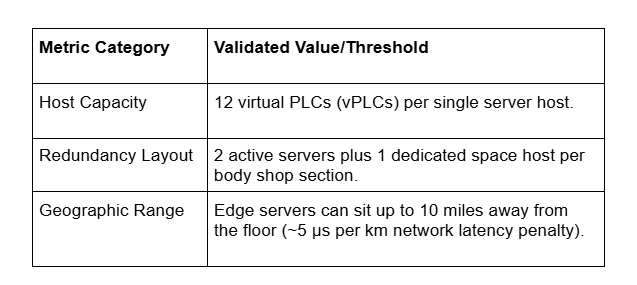
- Validated Scalability Metrics:
Read the full analysis: ARC View Part 3: Operating a Software-Defined Factory – How Audi Runs Virtualized Production. Explore the real-world operational performance metrics, scaling thresholds, and economic impact validated by ARC Advisory Group.
Behind the Blueprint: The Role of VMware Cloud Foundation Edge
Sustainable modernization demands a platform that delivers consistency across infrastructure, applications, and factory operations, not a collection of separate tools stitched together. This holistic capability is what drove Audi’s choice of VMware Cloud Foundation at the Edge as the core infrastructure platform for Edge Computing 4 Production (EC4P).
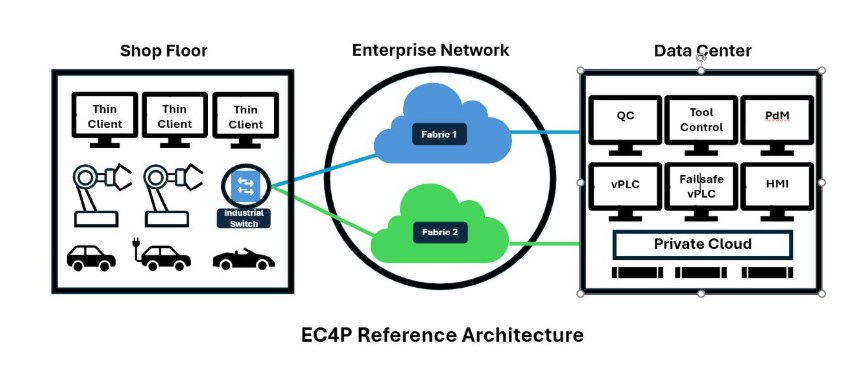
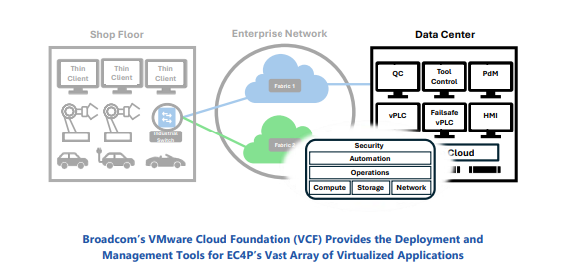
VMware Cloud Foundation is the complete platform that brings compute (vSphere), storage (vSAN), networking (NSX), Kubernetes, security, and lifecycle management under a consistent operating model. The VCF platform helps organizations simplify day to day edge operations, standardize infrastructure across factories and edge locations, and drastically improve security and governance.
“Our motto is software, not hardware. VMware Cloud Foundation underpins our EC4P project, virtualizing our production environment with an on-premises infrastructure platform.”
— Sven Müller,Project Lead, Edge Cloud 4 Production, Audi
“With VMware Cloud Foundation, we have an all-in-one solution that we can use for various use cases and applications…VMware Cloud Foundation enables us to centralize these systems and move away from a distributed approach towards more streamlined processes. By focusing on the ‘golden image,’ we can install once and then roll out to the hundreds of stations we operate in production.”
— Christopher Kolb, Domain Architect for the EC4P project, Audi
The Core Takeaway
The software-defined factory is no longer an experimental lab concept; it has been running in live series production since July 2023 at Audi’s Böllinger Höfe plant to manufacture the electric Audi e-tron GT. As detailed in the original Audi Press Release, this deployment marked the first time a car manufacturer used a centralized server solution to redeploy shop-floor computing power. By unifying IT/OT engineering cultures under the automated framework of VMware Cloud Foundation, Audi has proved that global manufacturing can achieve cloud agility without sacrificing microsecond reliability, corporate security, or human safety.
Explore the Complete Audi and VMware Cloud Foundation Edge Blueprint
Get access to the full documentation, technical architecture, and official announcements detailing this smart manufacturing deployment.
Deep-Dive Analysts Report:
- Analyst Report: Read the core ARC Advisory White Paper Building Audi’s EC4P Platform for Shop Floor Virtualization to explore the comprehensive analysis, overarching industry drivers, and operational findings.
- Business Case: Read the VMware and Audi Case Study for the high-level business case, corporate outcomes, and executive summary.
Multimedia & Visual Walkthroughs:
- Factory Floor Infographic: Explore the visual map of operational and business outcomes.
- Audi Smart Manufacturing Video: Watch the walkthrough of the EC4P platform running at Böllinger Höfe plant.
- Break It Down: Audi broke the “can’t virtualization” assumption
Technical Partner Ecosystem Webcast:
- Broadcom: How Broadcom Supports Audi’s EC4P Virtualization Platform
- Siemens Integration: Siemens & Audi Joint Webcast on Virtualized PLCs
- Cisco Networking: Cisco and Audi Joint Webcast on Edge Connectivity
Official Announcements and Perspectives:
Audi Press Release: Audi Scales up Deployment of Artificial Intelligence in Production
Broadcom News: Driving New Levels of Manufacturing Efficiency with VMware Cloud Foundation
VCF Edge Blog: Building an AI Ready Factory: How Software Defined Production is Transforming Manufacturing
Discover more from VMware Cloud Foundation (VCF) Blog
Subscribe to get the latest posts sent to your email.