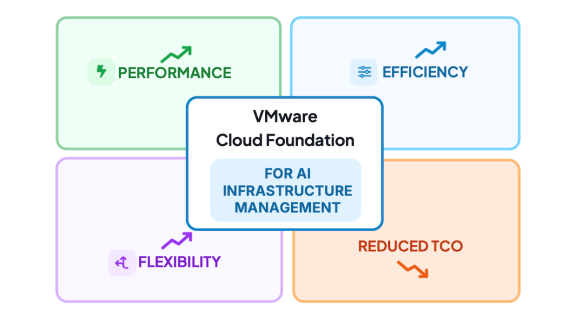

VMware Cloud Foundation (VCF) has evolved significantly with each release. VCF 9.1 will build on the comprehensive capabilities established in VCF 9.0, delivering an enhanced consumption experience for a self-service private cloud with VCF.
Based on a Broadcom customer survey conducted in March 2026 evaluating VCF 9, organizations using VCF Automation achieved two critical improvements: first, they cut the time from request to a ready-to-use application environment by 49%, and second, they reduced manual effort per application lifecycle—spanning provisioning, updates, patches, and configuration changes—by an additional 49%. VCF 9.1 will advance this foundation with enhanced automation capabilities designed to help you accelerate application innovation further, reduce costs, and scale governance and compliance across your enterprise. Let’s explore three key ways VCF 9.1 will transform how organizations deliver and consume private cloud services.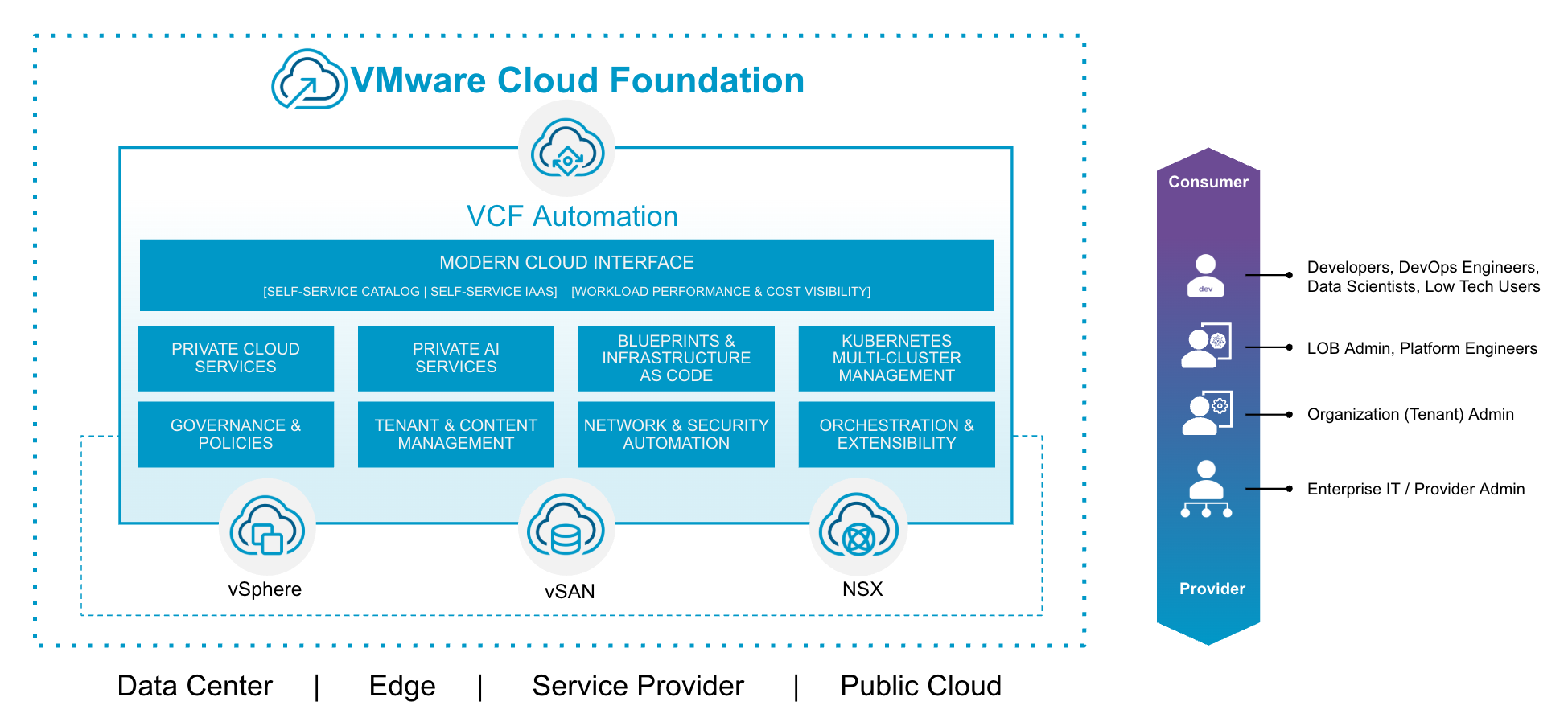
VCF Automation 9.1 Automation Overview
1. Fast-Track Deployment with Enhanced Services
Container as a Service
VCF 9.1 will accelerate container deployment by clearly delineating three distinct runtime options—VM Service, Container Service, and VMware vSphere Kubernetes Service (VKS) —enabling you to select the right runtime for your workload without unnecessary complexity.
VCF Automation will provide Container Service access with complete lifecycle management. Deploy, configure, monitor, upgrade, and delete containers directly through the interface—no kubectl commands, no YAML files, no Kubernetes API expertise required. Containers will be first-class runtimes alongside VMs and VKS clusters.
This simplified container runtime will provide agility without the operational complexity of Kubernetes infrastructure. It will execute directly on ESX without cluster overhead, providing workload isolation and resource efficiency with a managed, serverless-like experience. The VCF platform will fully automate scheduling, isolation, performance optimization, and upgrades. When your application architecture evolves, the UI will generate consistent YAML that enables a smooth transition to VKS clusters—a gentle on-ramp from simple container deployments to full Kubernetes capabilities.
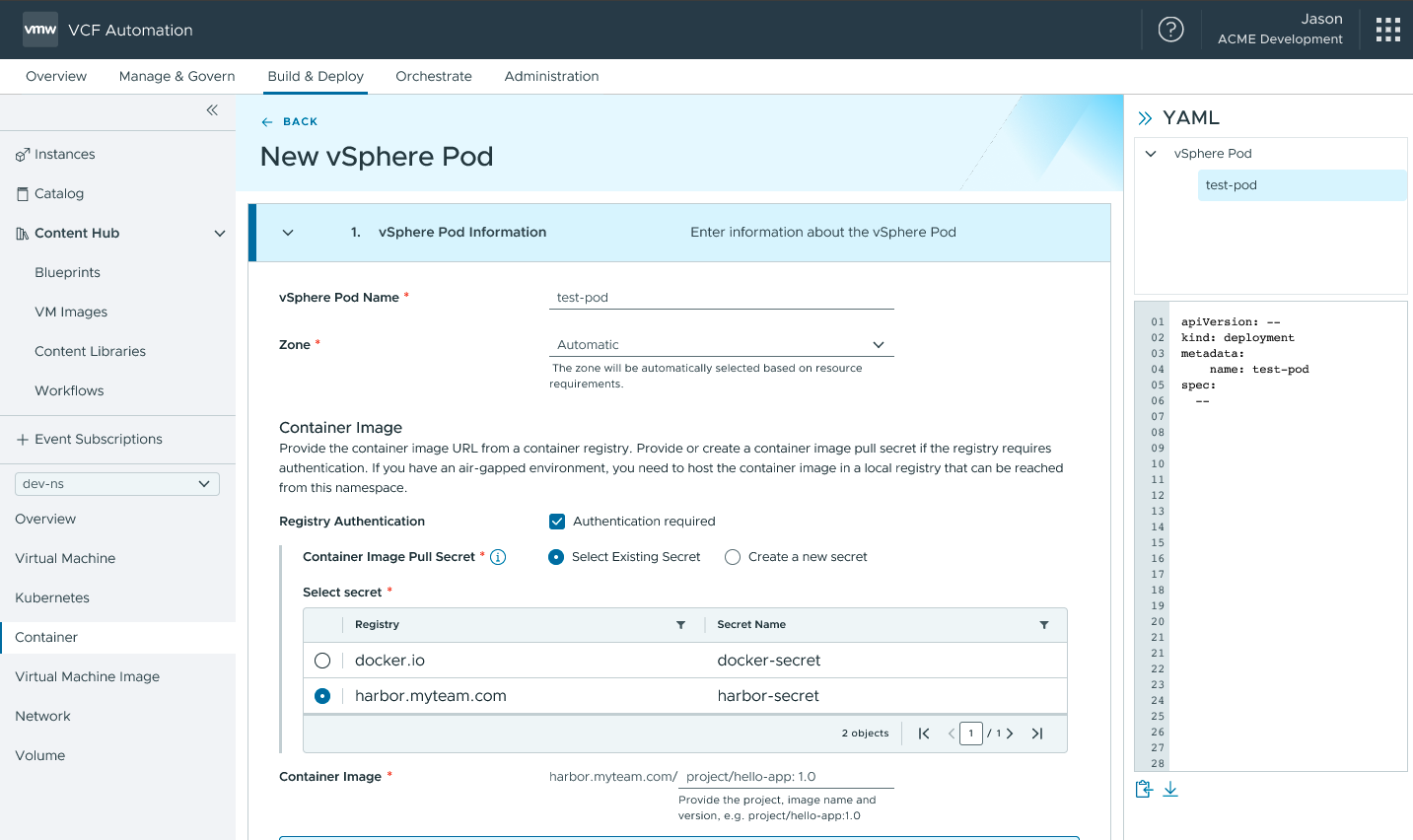
VCF Automation: Container Service Deployment Interface
Fast Deploy for VKS and VMs
VCF 9.1 will introduce Fast Deploy capabilities that dramatically accelerate VM and VKS cluster provisioning. The feature will be automatically enabled post-upgrade for any VM provisioned from a blueprint, requiring no UI configuration. Operating seamlessly via YAML, it will accelerate all VM-based lifecycle operations, including VM Service deployments and VKS cluster bring-up.
Fast Deploy will operate in two modes optimized for different scenarios. Linked-Mode will use a linked-clone delta-disk chain approach to enable instant VM power-on while the full disk will complete asynchronously in the backend, reducing both deployment time and storage consumption. Direct-Mode will accelerate provisioning based on VM image size and concurrent operations, delivering faster deployment at scale while maintaining full disk integrity from the start. VKS cluster deployments will accelerate significantly—from 37 minutes to 11 minutes, a 69%1 improvement.
Cluster upgrades will complete 75%1 faster at 1.7 hours versus 6.9 hours, saving over 5 hours per upgrade cycle. Application teams will be able to leverage Fast Deploy to spin up development environments on-demand, scale workloads dynamically, rapidly create test environments that mirror production, and deploy multi-tier applications with speed.
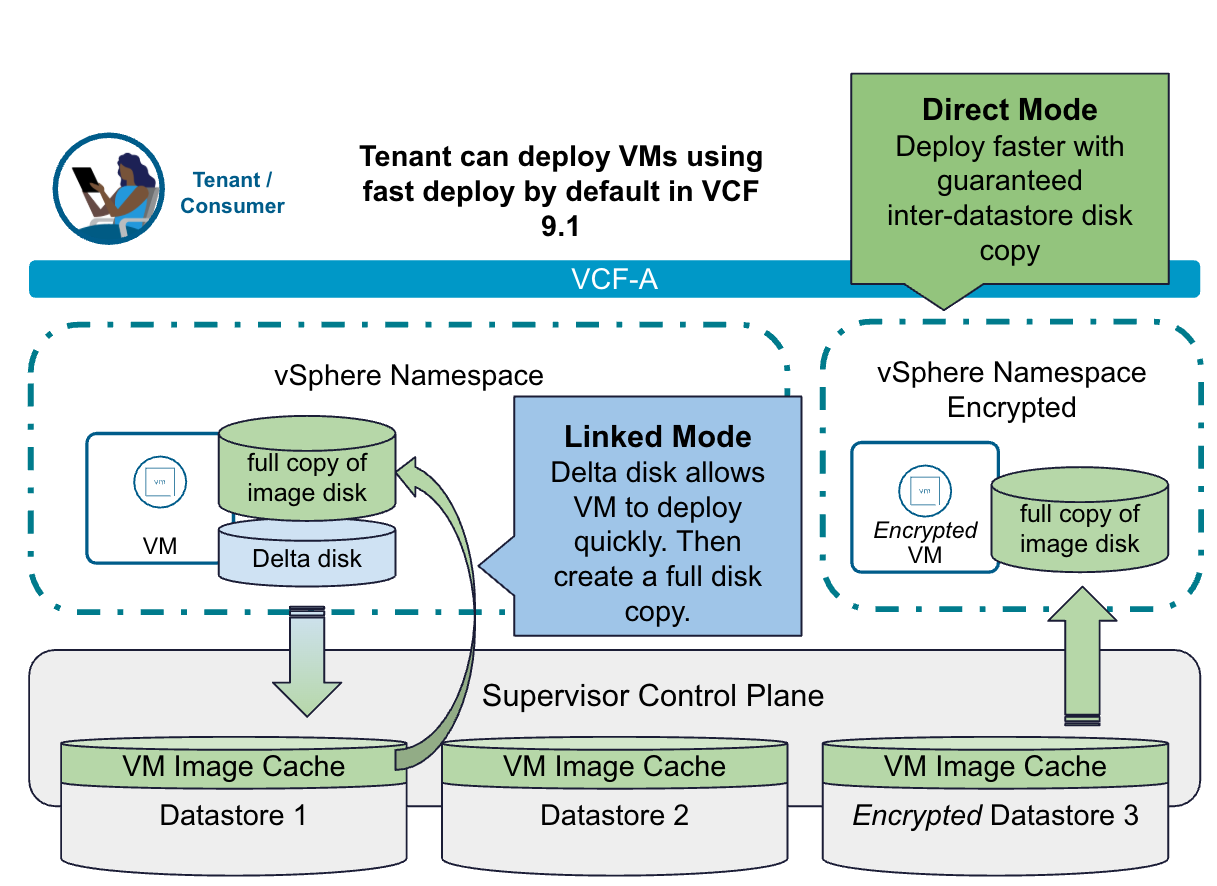
VCF Automation: Fast Deploy Workflow
Centralized Service Management and New Pre-Bundled Services
Managing extensible services across your private cloud will be centralized and simplified. VCF 9.1 will introduce an enhanced service management that leverages a regional Harbor instance to simplify the deployment and lifecycle management of services across the platform. The Service Manager will retrieve and display service content directly from this registry, enabling more services to be onboarded and published to tenants.
Ten services will be pre-bundled with the release and automatically synced as part of the platform’s baseline configuration. These services will be presented as individual tiles in the UI, including Harbor, VMware Data Services Manager, Secret Store Service, VKS cluster management Auto-Attach Service, and Encryption Management (BYOK), among others.
This centralized approach will deliver faster access to platform capabilities with services available by default and immediately usable in the UI. It will enable accelerated adoption across every region while streamlining operations through centralized updates and reduced manual administrative work, leading to consistent environments.
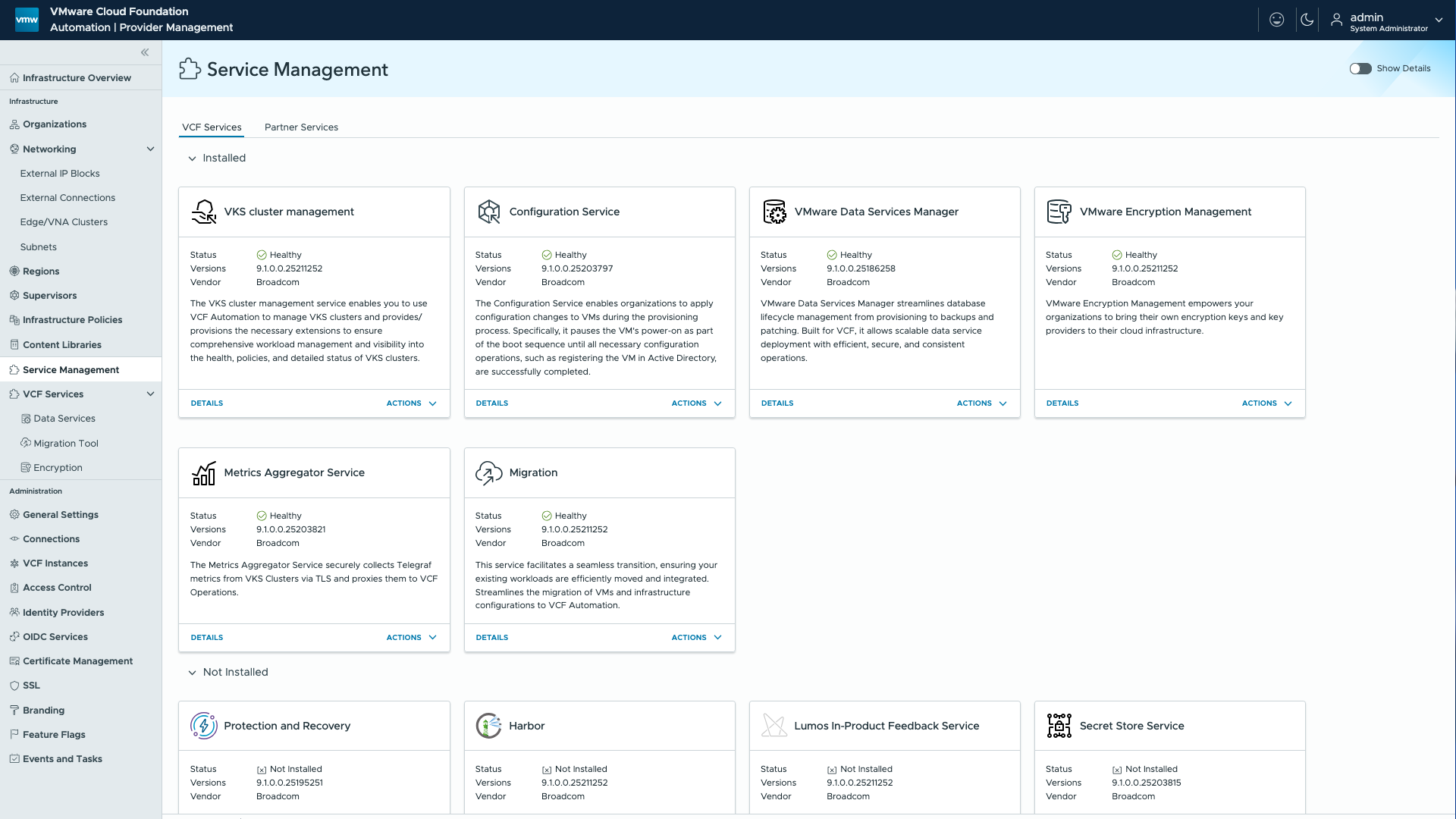
VCF Automation: Services Management Interface
Additional Capabilities
Enhanced Day-2 VM Lifecycle Management
With VCF 9.1, consumers will be able to independently modify CPU, memory, storage, and network configurations post-deployment with expanded capabilities including network mutability, snapshots, and VM Groups. This will eliminate administrative bottlenecks and reduce service request cycles from days to minutes.
Networking Enhancements
Enhanced IP Management for Providers and Tenants
Tenants will be able to independently pre-allocate and manage IP addresses with support for multiple CIDRs and Infoblox integration. This will support complex network configurations like one-to-one NAT without workload dependencies.
Flexible Transit Gateways for Complex Routing Topologies
VCF 9.1 will enable multiple external connections and multiple Transit Gateways per tenant with isolated VPN, static route, and custom NAT configurations. This will deliver flexible multi-site routing with precise traffic management without external routing equipment.
Self-Service Networking and Security for Tenants
Self-service networking will be available with VCF 9.1 and will provide direct data center access, private network exposure, VPN deployment, and Gateway Firewalls. This will increase tenant empowerment and enable independent network security management.
Shared Subnets and VLAN Extensions
VCF 9.1 will introduce organization-level subnets and VLAN extensions with direct Layer 2 connectivity. This will enable complex network architectures including multi-NIC VMs and direct physical fabric connectivity to tenant workloads.
Existing VLAN Connectivity via Distributed Transit Gateways
VCF 9.1 will introduce Distributed Transit Gateways that connect VPCs directly from ESXi hosts using only a VLAN ID, eliminating Edge Clusters and dynamic routing. This will simplify operations for legacy VLAN environments and enable direct communication between VCF and non-NSX VMs.
Streamlined Firewalls and Automated Inter-VPC Security
VCF 9.1 will enable Zero Trust deployment with automated micro-segmentation, firewall rules, and compliance tags using vDefend. This will deliver automated security from Day 1, eliminating manual configuration and enabling consistent policy enforcement.
For more details, please read the release notes.
2. Enhanced App and Workload Lifecycle Management
App Stack Formation
VCF 9.1 will introduce the ability to enable the app stack formation use case, which represents a new way of doing blueprinting. This will allow users to capture a running topology—including a group of VMs, their network configuration, and disks—into a single blueprint. This capability will transform live application environments into reusable templates, enabling the immediate, identical, and scalable delivery of services.
Rather than rebuilding environments from scratch, platform engineers will be able to capture running VMs along with their network configurations (VPCs, subnets), storage disks (PVCs), Guest OS settings, and inter-VM dependencies. Users will be able to define startup and shutdown sequences for VMs within the stack, ensuring multi-tier applications boot in the correct order.
This will group multi-tier applications into a single, portable OVF/OVA package, eliminating environment drift between Dev, Test, and Prod. It will manage entire application stacks as one unit, streamlining start/stop and snapshot operations while supporting defined power-on sequencing. Providers will be able to offer pre-built application stacks via catalogs, fostering self-service for tenants and accelerating time-to-market for new services.
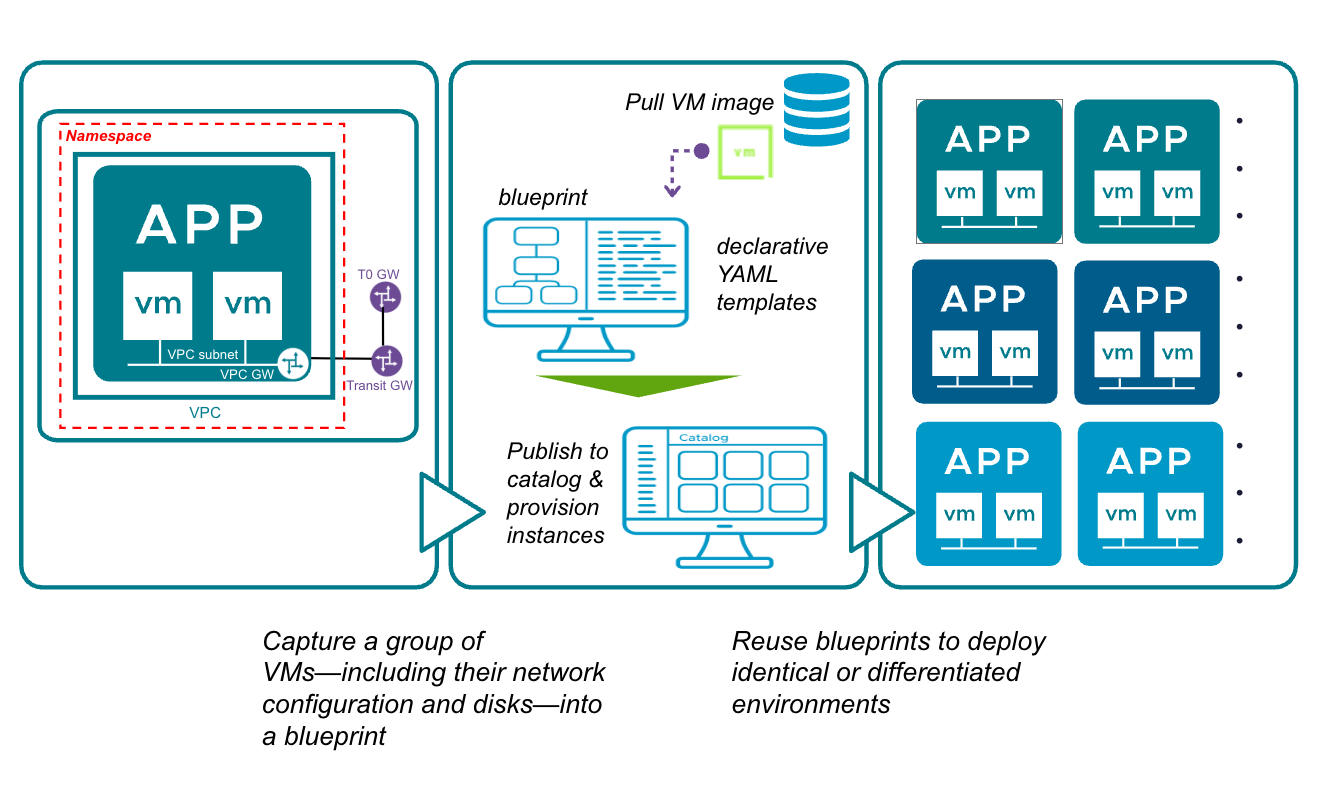
VCF Automation: App Stack Formation Workflow
Automation of Canonical Ubuntu OS Image Delivery
VCF 9.1 will introduce native integration with Canonical’s content libraries, delivering VCF-optimized Ubuntu OS LTS images. These images will include packages such as VM drivers and tools required to successfully deploy and run on VCF, and will be included with the base VCF license for customers with active subscriptions.
The interface will provide effortless discovery and selection of Ubuntu OS images directly within the VCF Automation interface, eliminating the need for users to navigate external sites to find and import these images. Enterprise IT Admins will be able to subscribe to Canonical-maintained content libraries and automatically synchronize official Ubuntu images (e.g., 24.04 LTS) directly into the environment, populating the VM Images without manual uploads.
This will deliver stable deployments, enhanced security, and operational efficiency made possible by efficient patch management for critical and high vulnerabilities. Broadcom will incorporate latest patches into full images and make them available via the solution catalog, ensuring automated delivery of official, verified content. Customers will experience streamlined OS image availability while accessing trusted Ubuntu OS images through a secure, native connection.
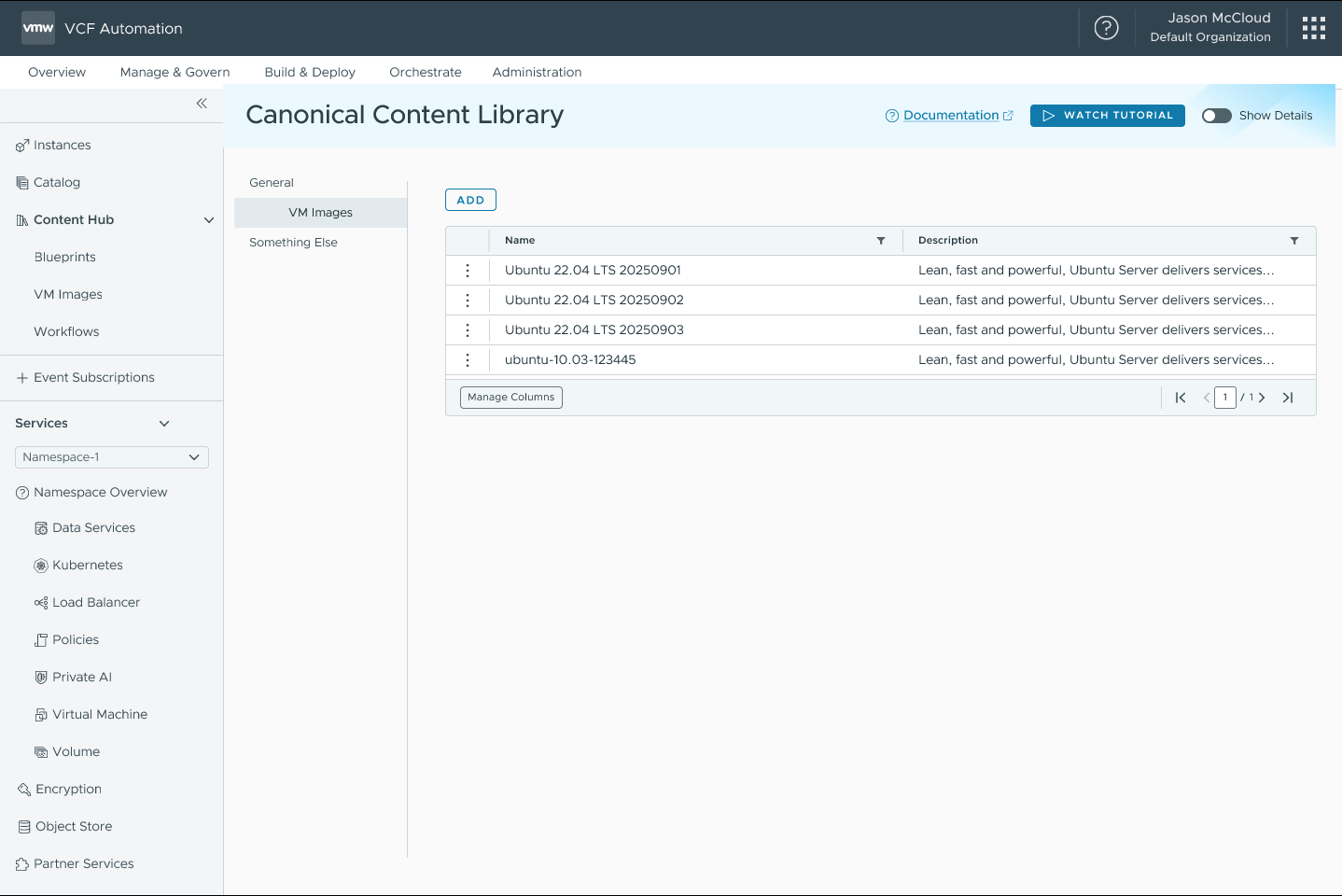
VCF Automation: Canonical Content Library
Project-Level Content Libraries for Team Autonomy
VCF 9.1 will introduce Project-level Content Libraries, enabling Org Admins to create specific content libraries and explicitly scope them to one or more selected Projects within the organization. Once established, the system will grant write access to Project Admins and Project Advanced Users, allowing these users to directly publish, write, and manage images (such as ISOs and OVAs) within their scoped library.
This will deliver autonomy by reducing Project Teams’ dependency on Org Admins to curate and maintain project and application-specific content libraries. It will provide extensibility by enabling Packer workflows that allow project members to publish their own VM images. Additionally, it will deliver efficiency by allowing VI Admins to leverage existing VM templates to build VCF Automation content libraries without having to create new VM images.
This will eliminate the operational bottleneck where project teams were previously unable to manage their own content libraries or directly upload essential files such as ISOs and OVAs, ultimately defeating the purpose of consumer self-service and hindering agile development.
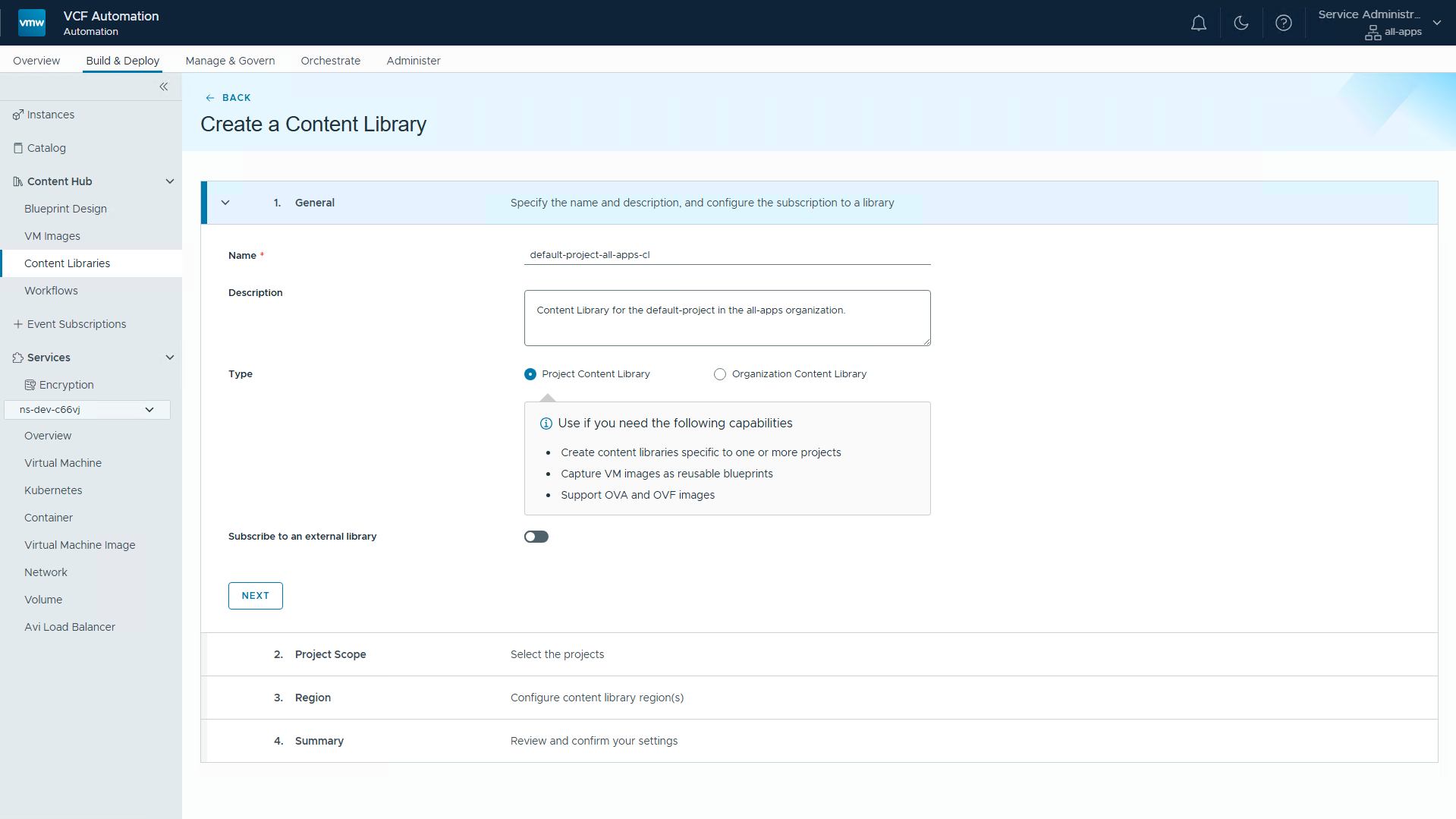
VCF Automation: Project Content Library Management
Additional Capabilities
Namespace Delegation and Governance
VCF 9.1 will enable Org Admins to delegate namespace creation to Project Admins and Platform Engineers with defined guardrails. This will eliminate bottlenecks by allowing application teams to independently manage namespaces while maintaining governance controls.
Terraform Provider Enhancements for Tenant in Policy & Content Management
VCF 9.1 will enhance the Terraform Provider to support full environment provisioning, VM image lifecycle management, and policy-as-code for approval, Day-2 actions, IaaS, and lease policies. This will enable programmatic governance enforcement and facilitate app stack formation through infrastructure-as-code.
For more details, please read the release notes.
3. Improved Governance, Security, and Cost Visibility
New Infrastructure Placement Policies for Better Workload Control
VCF 9.1 will introduce infrastructure placement policies that allow admins to configure VM placement criteria to target specific subsets of VMs based on their attributes. The system will support mandatory policy mode, which applies automatically when assigned to an Org, helping ensure defined placement rules are executed without tenant intervention.
The new infrastructure placement policies will enable license optimization through OS-based placement and simplify compliance by providing tools to control exactly where workloads reside, helping adherence to regulatory or internal standards. Additionally, it will help cloud admins ensure workloads are placed optimally for compliance without hindering self-service access.
Infrastructure placement policies will provide automated workload direction to specific hosts based on attributes such as Guest OS or labels, ensuring specific VM types are consistently placed on the infrastructure best suited or designated for them. The mandatory policy mode will enable strict enforcement of VM placement based on specific workload requirements within multi-tenant environments while maintaining control through policy-based governance.
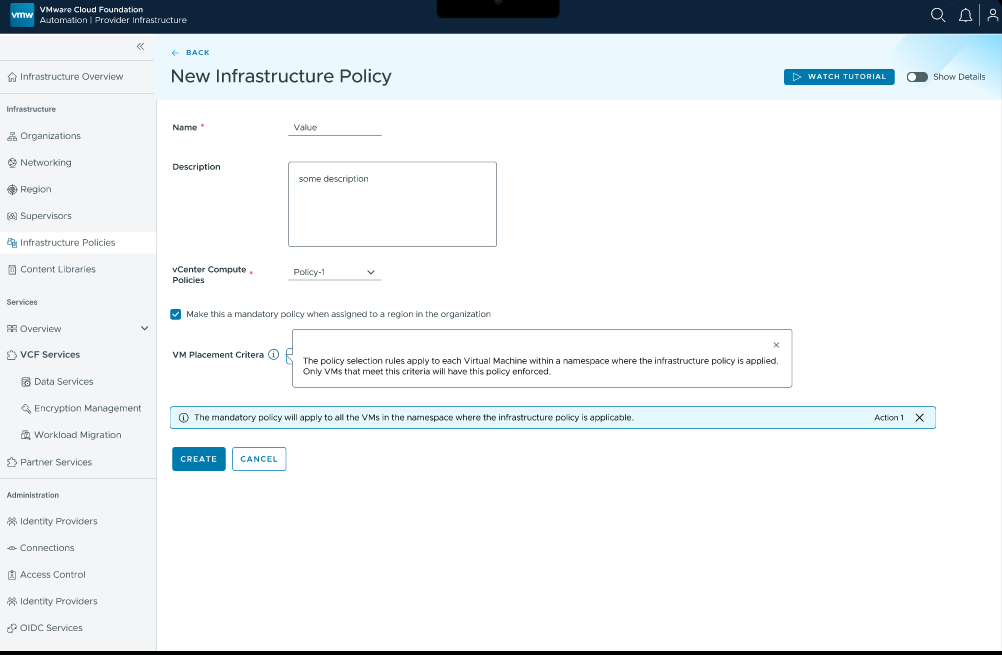
VCF Automation: Placement Policy Configuration
Cost Visibility, Pricing, Notifications (Alerts, Reports, Bills)
VCF 9.1 will display cost data directly within Org and Project dashboards, enabling admins to view total costs aggregated at these levels and drill down into specific cost and inventory details for individual Projects and Namespaces. VCF Automation will provide upfront pricing (a cost estimation based on VCF Operations rate card) within the provisioning workflow, enabling admins to assign pricing to private cloud services such as VM service and VKS service.
VCF Automation will enable email-based alerts and reporting. Admins will be able to configure specific email addresses to receive notifications regarding billing, cost reports, and critical alerts such as quota usage or service availability, with support for generation and direct downloading of reports and bills.
Enhanced visibility with detailed drilldowns into costs by project and namespace will help organizations to control consumption behavior and reduce wasteful capital expenditure. The platform will foster cost awareness and financial accountability by enabling consumers and tenants to view costs associated with their deployed resources, while admins will receive proactive email notifications without needing to manually monitor the system.
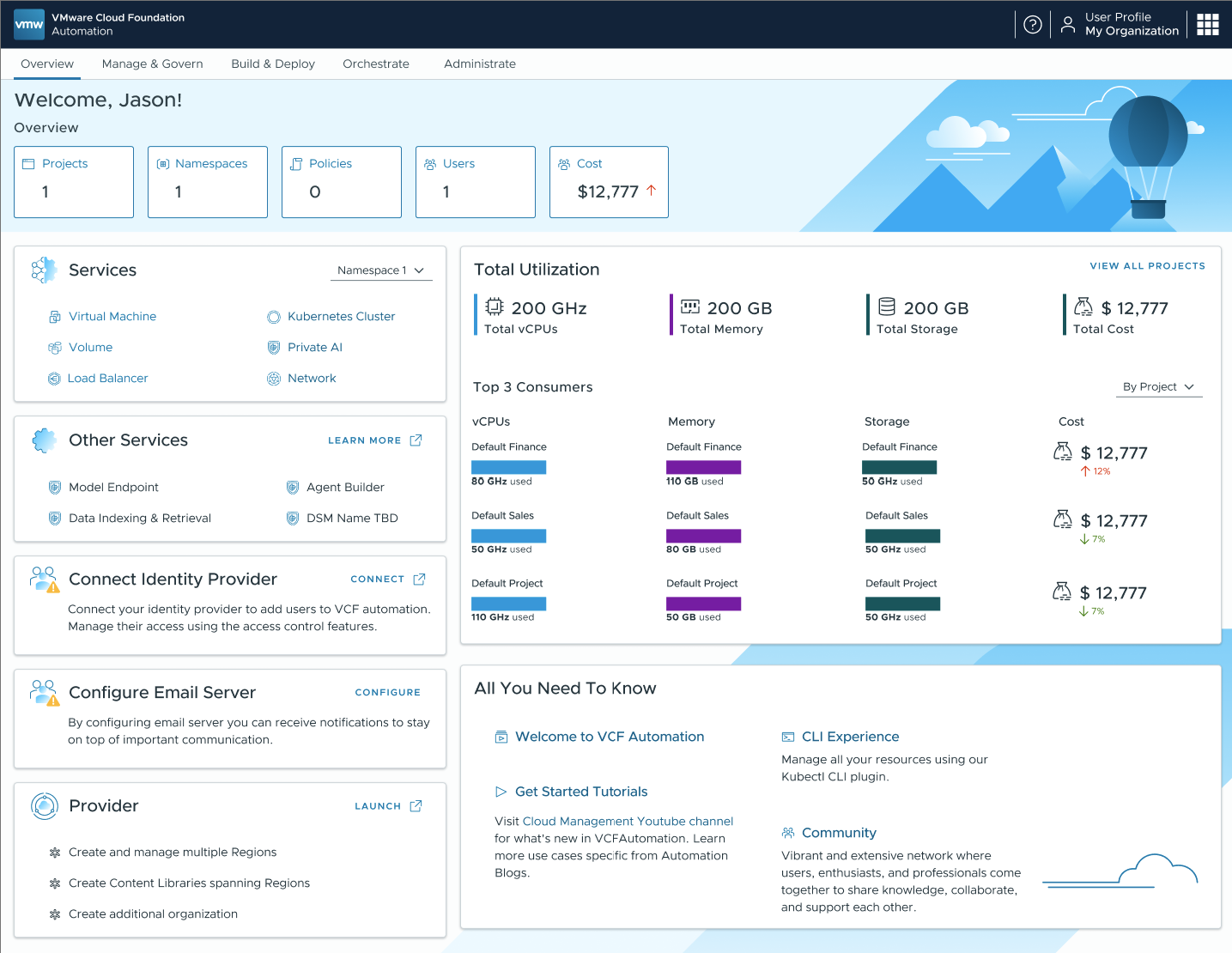
VCF Automation: Cost Visibility Dashboard
Fully Allocated Region Quotas for Tenant Organizations
VCF 9.1 will introduce a fully allocated region quota mechanism, enabling enterprise IT admins to allocate the entire capacity (100% quota) of a region to a tenant organization without specific zonal selections. Admins will be able to apply identical CPU and memory limits and reservations across available zones, decoupling the region from a single Supervisor and permitting multiple Supervisors and vCenters within a single region quota.
These capabilities will simplify allocation, easing infrastructure management for enterprises that do not require strict quota enforcement. On Day 2, admins will be able to modify allocations by adding reservations or reducing the quota from the full region to specific limits.
This will enable the region to function as a unified resource pool by allowing Organizations to consume infrastructure across multiple Supervisors instead of being restricted to a single Supervisor. Organizations will gain shared, first-come first-served access to infrastructure capacity, resulting in greater flexibility and resource utilization across the environment.
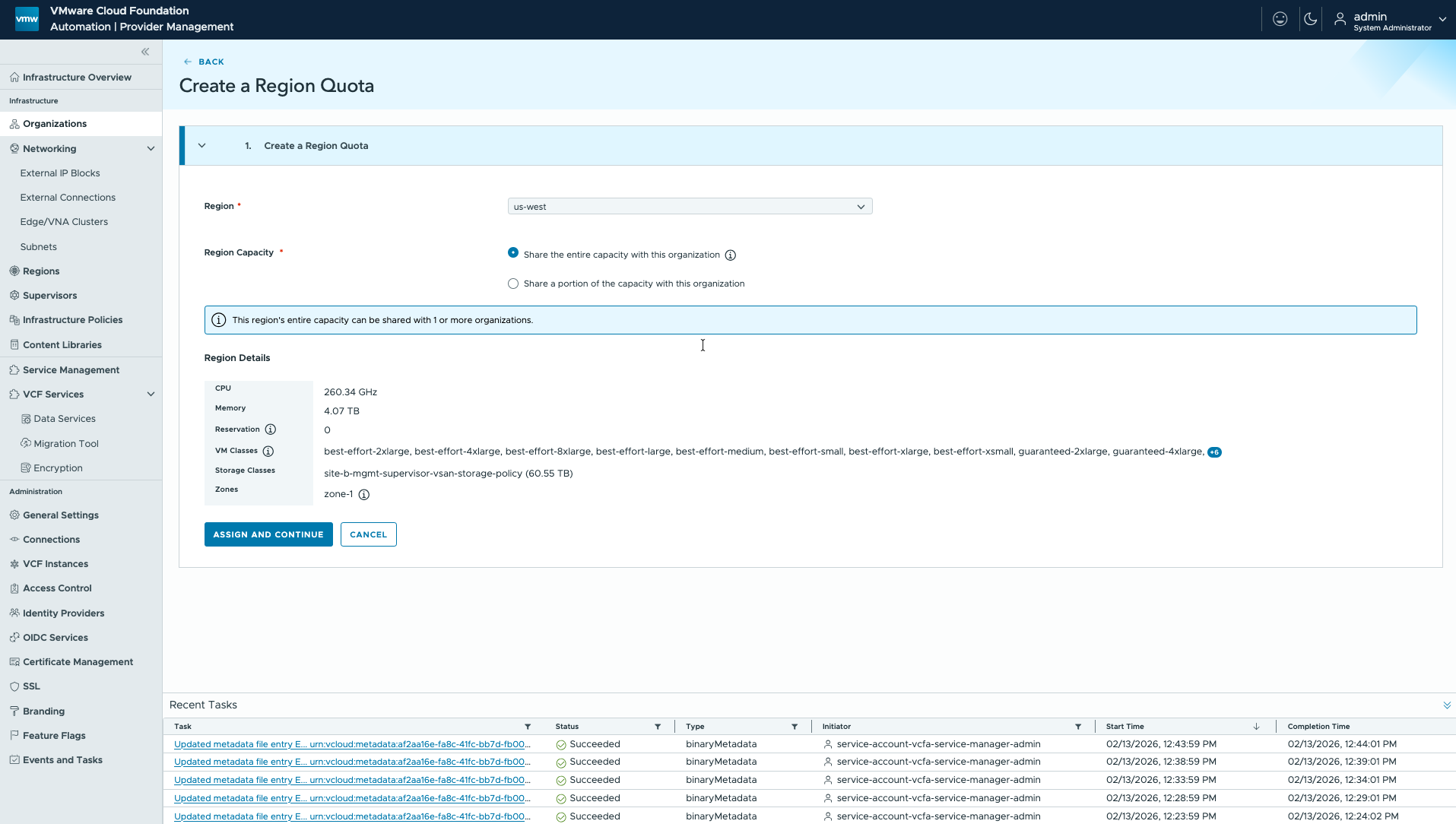
VCF Automation: Regional Quota Allocation
Additional Capabilities
Unified VKS Cluster Management API
VCF 9.1 will standardize the VKS cluster management API by aligning it with the VCF API pattern, unifying VM, container, and VKS management. This will enable consistent interaction across all services, streamlining resource management via VCF CLI, Terraform, or kubectl.
For more details, please read the release notes.
Discover Self-Service Private Cloud from Broadcom
VCF 9.1 will redefine what’s possible with private cloud infrastructure. Powered by VCF Automation, VMware Cloud Foundation will help you jump start and scale a multi-tenant private cloud that enables your application teams to build workloads faster, more securely, and at lower cost.
Whether you’re looking to replicate the scalability and agility of the public cloud in your data center, implement a centralized consumption interface for both VMs and containers, or drive greater business and IT agility through self-service capabilities—VCF 9.1 will deliver the innovations you need.
The future of enterprise IT is here: a true cloud experience with private cloud security, performance, and control. VCF 9.1 will provide the platform, capabilities, and automation to transform your data center into a modern, self-service private cloud that empowers application teams while maintaining the governance and compliance that enterprise IT demands.
Ready to unlock the potential of your IT resources? Join us on May 20 at 10 a.m. PDT for our webinar, “Delivering the Agile Private Cloud: Fast Deployments, Reusable Stacks, and Cost Visibility.” We’ll demonstrate these capabilities live and show you how to transform your data center into a modern, self-service private cloud. Register now to reserve your spot.
Learn More
- Press Release: Broadcom announces VMware Cloud Foundation 9.1
- VCF 9.1 Blog: Announcing VCF 9.1: Modern Private Cloud Built for Efficiency and Resilience
- Blogs: Read more about VMware Cloud Foundation
- Hands-on Labs: Experience VCF 9.1 capabilities firsthand
- VCF Automation Overview: Learn more on the VMware Cloud Foundation Automation webpage
- VCF Automation Solution Brief: Self-Service Private Cloud with VMware Cloud Foundation
- VCF Automation Datasheet: VCF Automation
- Follow Us: Stay updated on X @vmwarevcf
1 Broadcom. Fast Deploy Performance Testing Results. VCF Performance Team, 2026.
Discover more from VMware Cloud Foundation (VCF) Blog
Subscribe to get the latest posts sent to your email.