
Infrastructure teams face a paradox: environments are growing more complex while budgets and headcount remain flat. VMware Cloud Foundation (VCF) 9.1 will address this head-on with innovations that improve efficiency, accelerate application delivery, and strengthen cyber resilience while maintaining operational simplicity.
Over the past few years, the conversation around infrastructure has shifted. It is no longer just about where workloads run, but how efficiently they run, how quickly they can be delivered, and how resilient they are against an increasingly complex threat landscape. Organizations are operating large, complex environments that have evolved over time, spanning virtual machines, containers, and increasingly AI-driven workloads. At the same time, teams face pressure to move faster, reduce costs, and strengthen security without adding operational overhead.
VMware Cloud Foundation 9.1 is built for this reality. This release will evolve the private cloud into a platform that scales efficiently, delivers applications with consistent performance, and builds resilience directly into the infrastructure.
What’s New in VCF 9.1 Across the Platform
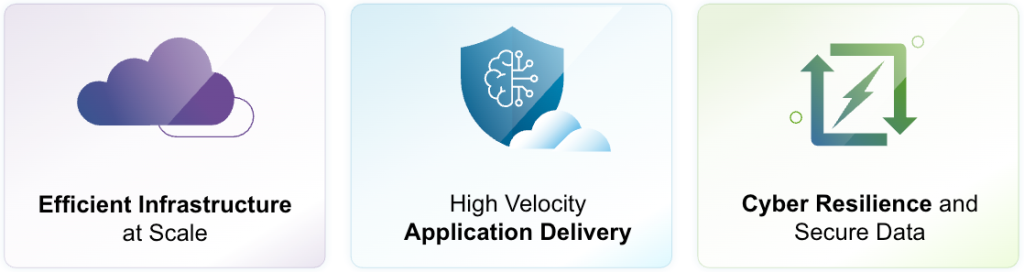
VMware Cloud Foundation 9.1 will introduce innovations across three key areas of the platform to improve efficiency, application performance, and resilience.

As environments grow, the challenge is not just adding more capacity. It is operating that capacity efficiently without increasing cost or complexity. VCF 9.1 will introduce several enhancements that improve how infrastructure is utilized, provisioned, and managed at scale.
Enhanced NVMe memory tiering will introduce a unified memory model where hot data remains in DRAM and colder pages are offloaded to NVMe, increasing effective memory capacity without impacting application behavior. VCF 9.1 will improve performance, add native software mirroring, and simplify deployment, enabling higher consolidation ratios and up to 40 percent lower total cost of ownership.
vSAN global deduplication and enhanced compression will reduce the amount of physical storage required across the cluster by eliminating redundant data and improving compression efficiency. These capabilities will operate continuously in the background and support encrypted environments, helping organizations lower storage costs without sacrificing performance.
vSphere Elastic Provisioning will simplify how hosts are brought online and assigned to workloads by enabling parallel imaging, automated discovery, and consistent configuration. This will reduce provisioning time and make it easier to scale or repurpose infrastructure as demand changes.
VMware vSphere Kubernetes Service (VKS) will continue to scale as a core part of the platform, enabling platform teams to run both traditional and modern workloads with a consistent operational model. VCF 9.1 will increase scalability to support up to 500 Kubernetes clusters per Supervisor, while also improving provisioning speed and operational efficiency. This scale is critical for organizations building multi-tenant platforms or isolating workloads for compliance, allowing platform teams to support hundreds of development teams from a single management backbone. These enhancements will make it easier to isolate workloads, reduce operational overhead, and support large-scale application and AI deployments without re-architecting infrastructure.
Together, these improvements will help organizations get more out of the infrastructure they already have, while reducing the operational effort required to manage it.
Additional capabilities in this area will include:
- Support for up to 5,000 ESX hosts
- Increased upgrade scale with parallel lifecycle operations across large environments
- Topology-aware scheduling to improve performance on modern high core count processors
- Real-time operational observability across infrastructure and workloads
- Enterprise support for Ubuntu OS images

Modern applications, especially AI and data-intensive workloads, place very different demands on infrastructure. It is no longer just about running applications, but delivering them quickly, consistently, and at scale. VCF 9.1 will bring several improvements that help reduce operational friction while improving performance and deployment speed.
- vMotion encryption offload will reduce the CPU overhead associated with secure workload mobility by offloading encryption processing to hardware. This can result in up to approximately 70 percent CPU savings during migrations, improving application performance during movement and allowing hosts to return to steady state faster.
- VMware vSphere Kubernetes Service (VKS) enhancements will improve how modern applications are deployed and scaled across the platform. With faster provisioning and support for up to 500 clusters per Supervisor, platform teams can deploy applications more quickly while maintaining isolation and consistency across environments.
- Native object storage will provide a built-in option for applications that require scalable, S3-compatible storage, simplifying how developers consume storage services without needing external platforms.
- Live application stack blueprints will let platform teams capture a running application (complete with compute, networking, and storage configuration) and turn it into a reusable template. This means new environments can be deployed in minutes instead of hours, with zero manual configuration and perfect consistency across development, test, and production. For DevOps teams provisioning environments at scale, this will be a game-changer.
With these capabilities, organizations will be able to move from managing infrastructure to delivering applications with greater speed and predictability.
Additional capabilities in this area will include:
- Simplified container-as-a-service experience for developers
- Integration with Tanzu Marketplace for access to validated services and tooling
- Private AI model and GPU observability

Security and recovery are no longer separate concerns. They are expected to be built into the platform itself. VCF 9.1 will strengthen cyber resilience by improving how organizations protect, recover, and operate their environments without adding complexity.
- vSAN for Recovery will enable efficient replication of workloads and protection using native snapshot capabilities, providing a streamlined approach to both disaster recovery and ransomware recovery. By leveraging deep snapshot chains and integrated replication workflows, organizations can recover quickly while maintaining operational simplicity across environments.
- Continuous compliance enforcement with Advanced Cyber Compliance (ACC) will provide automated assessment and remediation against security baselines such as VCF security guidelines and PCI DSS benchmarks. With built-in drift detection and centralized visibility across the stack, organizations can maintain a consistent security posture, reduce audit preparation time, and address compliance issues proactively rather than reactively.
- Encrypted vMotion with hardware acceleration will improve the security of workload mobility while reducing the performance overhead traditionally associated with encryption. This will allow organizations to maintain secure operations without sacrificing efficiency during migrations.
- Live patching enhancements will reduce the need for planned downtime by allowing critical security updates to be applied without disrupting running workloads. This will help organizations maintain compliance and security posture while minimizing the operational impact typically associated with patching cycles.
These capabilities will help organizations move from reactive security measures to a more proactive and resilient operational model.
Additional capabilities in this area will include:
- Expanded support for secure workload mobility across environments
- Improved visibility into security posture and operational state
- Self-service security and automated load balancing
Open and Extensible Ecosystem
While much of the innovation in VCF 9.1 focuses on infrastructure efficiency, application performance, and cyber resilience, the platform will continue to expand through a growing ecosystem of integrations and partner solutions.
- Networking ecosystem integrations with platforms such as Arista, Cisco, and SONiC will provide greater flexibility in how customers connect and extend their environments.
- Advancing AI with AMD Instinct GPUs will introduce Enhanced DirectPath I/O support for MI350 Series GPUs, enabling virtualization for AI workloads with improved operational flexibility. Organizations can maintain uptime during maintenance with capabilities such as live patching and high availability, while also scaling resources dynamically to match demand. These enhancements will help reduce operational overhead and improve total cost of ownership for AI-driven environments.
- Security ecosystem integrations, including CrowdStrike EDR integration for ransomware recovery workflows, will embed endpoint validation directly into the recovery process. Recovered workloads can be scanned in isolated clean room environments before being returned to production, helping reduce reinfection risk and accelerating safe recovery using existing security tools.
These integrations will give organizations the flexibility to build on top of VCF using the tools and services that best fit their operational model, while still maintaining a consistent platform foundation.

Go Deeper with the Virtually Speaking VCF 9.1 Series
To go beyond the feature overview, we put together a dedicated Virtually Speaking video series focused on VMware Cloud Foundation 9.1.
In this series, we sit down with the engineers, product leaders, and architects behind the release to break down what’s new, how it works, and where customers are seeing real impact. Each episode focuses on a specific area of the platform, from infrastructure efficiency and application delivery to cyber resilience and AI.
If you want a closer look at the details behind these capabilities, this is a great place to start.
Get Started
If you are evaluating how to simplify operations, improve performance, and strengthen resilience across your environment, this release is worth a closer look. Whether you are expanding existing environments or planning for modern workloads and AI, VCF 9.1 is designed to help you get there with less complexity.
Explore What’s New in More Detail
This post highlights the major updates in VMware Cloud Foundation 9.1, but there is a lot more to unpack across the platform.
For a deeper look at specific capabilities, check out the following blogs:
- Streamline, Simplify, and Protect all your AI Workloads with VCF 9.1
- AI with VCF 9.1 on AMD GPUs: Build with open frameworks and simplify management, at a lower TCO
- Deploy Modern Apps Faster, Scale Smarter, and Lower Your TCO with vSphere Kubernetes Service on VCF 9.1
- Scale Smarter, Save More: Redefining Infrastructure Economics with vSphere in VCF 9.1
- Strengthen Zero Trust Platform Security and Resilience with VCF 9.1
- Announcing VMware Cloud Foundation Edge 9.1: A Scalable, Autonomous Edge Platform
- Continuous Compliance, Integrated Cyber Recovery, and Enhanced Platform Security for VCF 9.1
- Accelerate, Streamline, and Control Your Self-Service Private Cloud with VMware Cloud Foundation 9.1
- Modernizing Infrastructure Economics with VMware vSphere Foundation 9.1
- VMware and Crowdstrike Announce Partnership to Deliver New Integration for Cyber Recovery Workflows
- Announcing EVPN-based interoperability with Arista Networks in VCF 9.1
- Scale, Simplify, and Secure Your Private Cloud Operations with VCF 9.1
Discover more from VMware Cloud Foundation (VCF) Blog
Subscribe to get the latest posts sent to your email.