In VMware Cloud Foundation (VCF) Operations 9.1 the Broadcom team has re-engineered the Diagnostics Management Pack. We split the Diagnostics Management Pack into two parts, the Diagnostics Management Pack and the Diagnostics Content Pack, so we can deliver findings more quickly to our customers.
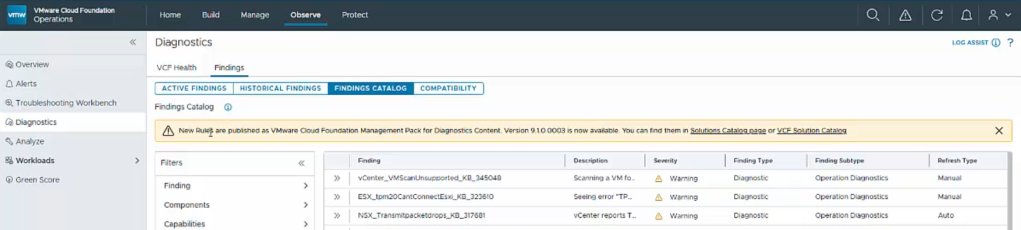
When the findings were bundled into the Diagnostics Management pack, they were released along with product releases. This limited the number of finding releases and increased the time to inform customers of new security vulnerabilities and known issues in their environments. Splitting the findings out of this management pack allows us to add content packs to the Solution Catalog and not tie finding releases to solely product releases. The best way to think of this is the Anti-Virus definition model: the Diagnostics Management Pack is the required engine component and the Diagnostics Content Pack is the definition file that gives signatures of the known vulnerabilities. A new feature alerts customers when a new content pack is released to the solution catalog. From the Active Findings screen and Findings Catalog, customers will see the following notification banner.
In the first content pack that we released to both VCF Operations 9.1.0 and 9.1.1, we included security-based, adoption blocking, and high global support trending issues. Most of the proceeding content packs will be focused on VMSA/CVE type findings. Below are some highlights of the findings in this content pack.
Security Vulnerabilities
In VMSA-2026-0006, Broadcom informs customers of multiple CVEs impacting both vCenter and ESX. VMware vCenter contains an authentication bypass vulnerability in the VMware Directory Service (CVE-2026-59309). A malicious actor with network access to vCenter may exploit this issue to bypass authentication and gain unauthorized access to the system. VMware vCenter contains a directory traversal vulnerability in the Syslog server (CVE-2026-59310). A malicious actor with network access to vCenter may exploit this issue to execute arbitrary code. VMware ESX contains an out-of-bounds write vulnerability in the VMXNET3 virtual network adapter. A malicious actor with local administrative privileges on a virtual machine with VMXNET3 virtual network adapter may exploit this issue to execute code on the host.
vCenter_CVE_2026_59309to10_VMSA_202606 / ESX_CVE_2026_47876_VMSA_202606
VCF Adoption Blocking Issues
Broadcom Technical Support has been focusing on resolving adoption blocking issues. One of the findings found in the content pack is a vCenter UUID case mismatch which impacts vCenter licensing. This is a vCenter Instance UUID case mismatch between vCenter and VCF Operations that causes this issue. This issue is resolved in VMware vCenter 9.1.0.0200. The workaround for this issue is to match the UUID case between VCF Operations and vCenter server.
vCenter_UUIDCaseMismatch_KB_440982
Broadcom Technical Support Trending Issues
Broadcom Technical Support trending issues are Knowledge Base articles that have solved many cases and/or are viewed many times. One of the findings in the content pack is a vCenter login failure. This can happen when the client credentials used by the vCenter’s oauth2 client becomes invalid because it has expired. In VCF 9.0, there is a logic to rotate the vCenter’s OAuth2 client credentials every 90 days. This issue is resolved in vCenter 9.0.2 and workarounds are available in 9.0.0 and 9.0.1.
vCenter_oauth2credentialsinvalid_KB_414489
We plan on releasing more Diagnostics Content Packs in the next coming weeks. Please subscribe to KB https://knowledge.broadcom.com/external/article/371661 for the latest updates.
Discover more from VMware Cloud Foundation (VCF) Blog
Subscribe to get the latest posts sent to your email.