
Guest post by Carl Lehmann, S&P Global Market Intelligence
Findings from a recent 451 Research report, “A Unified Platform Approach to Building Private Clouds for Modern Workloads,” reveal how enterprises are increasingly adopting private clouds to run modern applications, advanced data platforms, and AI. The report also introduces a simplified approach to building and maintaining private clouds based on three core strategies that, when implemented, form a centralized control plane to orchestrate the necessary tools, processes and teams. This blog is the first in a three-part series that serves as a companion to the main report, further exploring those strategic themes. This first blog examines how self-service consumption accelerates developer productivity. The second blog will explore how lifecycle automation enables operational scale, and the final blog will discuss how policy-driven governance ensures secure, multi-tenant control. Together, these strategies transform the private cloud into a scalable, product-like platform that empowers enterprises to confidently support the demands of modern workloads.
Unified self-service consumption
A unified platform with self-service consumption has emerged as a foundational capability for modern private clouds, enabling enterprises to align infrastructure operations at the speed and scale required by growing private cloud investments. Improving integration between tools and systems, which enables a unified platform, is the most desired organizational technology improvement, cited by 41% of 250 respondents in 451 Research’s Voice of the Enterprise: Workforce Productivity & Collaboration 2025 survey.
At its core, self-service consumption is about shifting infrastructure delivery from a manually mediated process to an on-demand experience that mirrors public cloud, while preserving the control, performance, and compliance advantages of private environments. This includes ready-to-use services such as virtual machines, Kubernetes clusters, and AI-ready infrastructure that can be requested directly through a unified interface. For organizations supporting Kubernetes, AI pipelines, data platforms, and modernized VM-based applications, this shift is becoming essential to maintaining developer velocity and operational efficiency.
Abstracting infrastructure complexity
In practice, unified self-service consumption begins by abstracting infrastructure complexity behind standardized services. Rather than exposing users to individual tools for compute, storage, networking , and security, a unified platform presents curated services through a single interface or API. These services are built from reusable blueprints that encode approved architectures, configurations, and integrations.
The curated offerings are typically organized into resource catalogs, giving developers a consistent, predictable set of options that eliminates guesswork and reduces variability. A developer requesting a Kubernetes cluster, for example, does not assemble components manually or choose from dozens of options; instead, the platform provides a pre-defined, policy-compliant environment that already includes networking, identity integration, observability hooks, and security controls. This abstraction ensures that every environment aligns with enterprise standards from the moment it is deployed.
Shifting collaboration between platform and application teams
Self-service consumption also changes how infrastructure teams collaborate with application teams. Platform teams shift from fulfilling tickets to designing and maintaining the service catalog itself. Their expertise is captured once in templates and workflows that can be reused indefinitely, allowing the platform to scale without proportional increases in operational effort. For application teams, the experience becomes predictable and repeatable. Environments can be provisioned in minutes rather than weeks, enabling rapid experimentation and smoother transitions from development to production. This alignment between infrastructure delivery and application lifecycles reduces friction and accelerates time to market.
Accelerating AI and data-intensive workloads
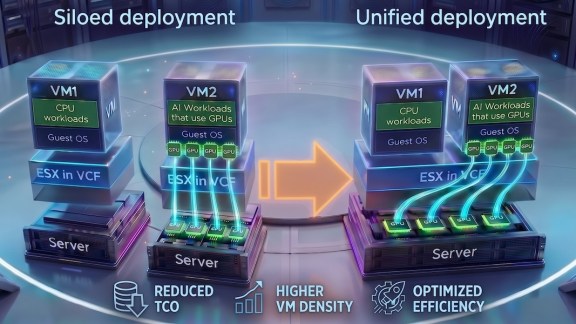
For AI and data-intensive workloads, unified self-service to build private clouds is especially impactful. AI-ready infrastructure often requires specialized configurations such as GPU allocation, high-performance storage, and proximity to large datasets. Without a unified platform, provisioning these environments typically involves multiple teams and custom processes. With self-service, these complex requirements are encapsulated in preapproved services that developers and engineers can consume directly.
The result is faster development and deployment, with guardrails that prevent over-provisioning and misuse of scarce and expensive resources. This will soon become even more relevant. In 451 Research’s Voice of the Enterprise: Cloud, Hosting & Managed Services, Cloud Infrastructure for AI 2025 survey, 43% of 273 respondents project that the preferred IT environment for generative AI workload deployment in two years will be private cloud (on-premises, colocation, or hosted) as opposed to public cloud and SaaS alternatives.
Strengthening governance through embedded policies
From a governance perspective, unified self-service does not mean relinquishing control. On the contrary, it strengthens control by embedding it within the consumption model. Policies define who can access specific services. They also enforce quotas and limits, ensuring compliance without manual intervention. Because services are standardized, security and compliance teams gain consistent visibility across environments, reducing audit complexity and risk. At the same time, cost transparency improves as resource consumption is tied to services, projects or teams, supporting chargeback or show-back models.
Private cloud as a product
Ultimately, unified self-service consumption reframes private cloud as a product rather than a collection of infrastructure assets. It delivers the speed and simplicity that application teams expect, while giving IT the consistency, governance and operational efficiency required to scale. As enterprises continue to modernize workloads and bring AI into production, this capability will be central to making private cloud not just viable, but competitive with public cloud experiences.
Unified self-service ultimately becomes the experience layer that enables private clouds to operate with the speed and simplicity that modern teams expect.
Looking ahead, we will discuss operational scalability and lifecycle management.
About the Author:
Carl Lehmann is a senior research analyst in the Applied Infrastructure & DevOps and Cloud Native research channels at 451 Research from S&P Global Energy Horizons. He leads coverage of process automation and integration in hybrid IT and cloud-native architectures, as well as how hybrid IT and emerging agentic AI affects business strategy and operations. His research focuses on agentic process automation platforms, along with ongoing coverage of digital automation suites, robotic process automation, process discovery and mining technologies, and hybrid integration platforms (including integration PaaS and API management). Previously, Carl served as senior vice president of strategy and product management at a B2B integration firm (now part of OpenText) and spent a decade as a vice president of research at Gartner and META Group, advising Fortune 500 organizations. He is the author of Strategy and Business Process Management: Techniques for Improving Execution, Adaptability, and Consistency, published by Taylor & Francis. Carl began his career as a project manager at AT&T and a product manager at Digital Equipment Corporation (now Hewlett Packard Enterprise). He is a graduate of Boston University’s School of Management.

Discover more from VMware Cloud Foundation (VCF) Blog
Subscribe to get the latest posts sent to your email.