
Organizations recognize that agentic AI is a competitive mandate, but ambition is severely outpacing enterprise readiness. An estimated 80% to 90% of enterprise data remains trapped in unstructured formats like PDFs, images, and legacy silos. Feeding this raw, ungoverned data into advanced reasoning models leads directly to hallucinations. Conversely, attempting to centralize all this data into SaaS data clouds often introduces staggering egress fees and unpredictable per-token billing, alongside unacceptable compliance risks.
To help organizations address the challenges of safe enterprise data access posed by autonomous AI agents, we are thrilled to announce general availability of AI-ready data foundations in VMware Tanzu Platform, first introduced at VMware Explore earlier this year. This release delivers the enterprise-grade data solution designed to help data engineering teams turn fragmented, multi-modal data into secure, governed, context-rich, self-service data products for production AI agents, resulting in less friction, more predictable egress costs, and reduced risk.
This solution addresses the most critical bottleneck in enterprise AI adoption: the data architecture.
An AI agent is only as capable as the context and tools it can access. Traditional software pipelines rely on deterministic code, where fixed inputs yield fixed outputs. Agentic systems are non-deterministic; they observe environments, reason over goals, and call external tools to formulate execution plans on the fly. AI agents also rely on data for nearly everything they do in order to reason, execute and respond to prompts.
To safely adopt AI agents, enterprises cannot rely on legacy data infrastructure. Today’s agentic AI use cases require a holistic system that translates raw enterprise data from federated sources into semantically rich, strictly governed data products with added context for agents. AI-Ready data foundations in Tanzu Platform delivers this with three operational pillars: bringing the compute running the agents directly to the data, standardizing secure agent access, and establishing predictable economics.
How AI-Ready Data Foundations Help Enterprises Scale
The capabilities introduced in this launch are designed to clear away the integration debt that stalls AI projects, providing a hardened path from prototype to production.
Federation Over Migration: Data gravity is a big barrier to AI adoption. Centralizing petabytes of distributed enterprise data into a single repository takes months and burns through IT budgets. Tanzu Platform bypasses this by bringing AI compute directly to the data in an AI-ready data foundation. Using advanced federated querying, agents can access and join data across structured relational databases and unstructured object storage directly in place. Organizations avoid creating duplicate data silos and eliminate the risk and delay of massive migration projects.
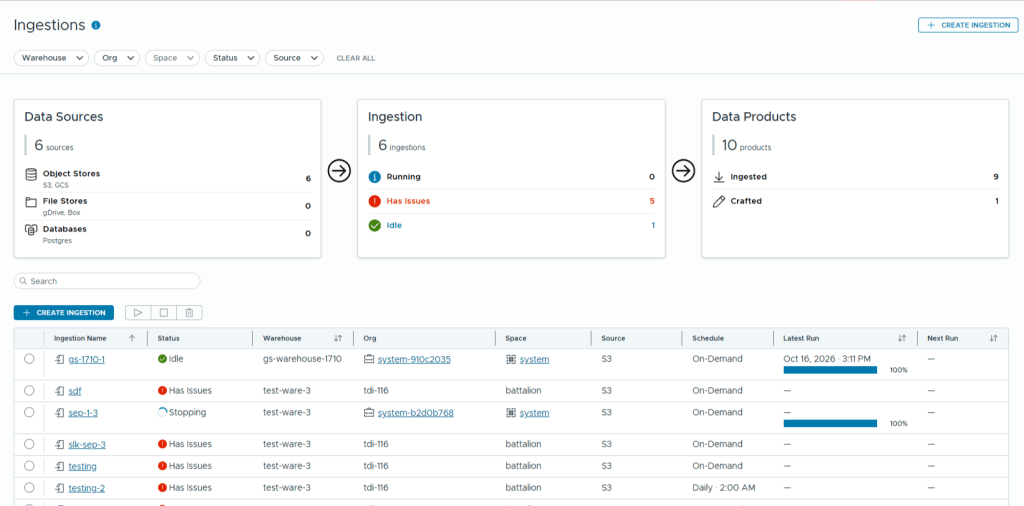
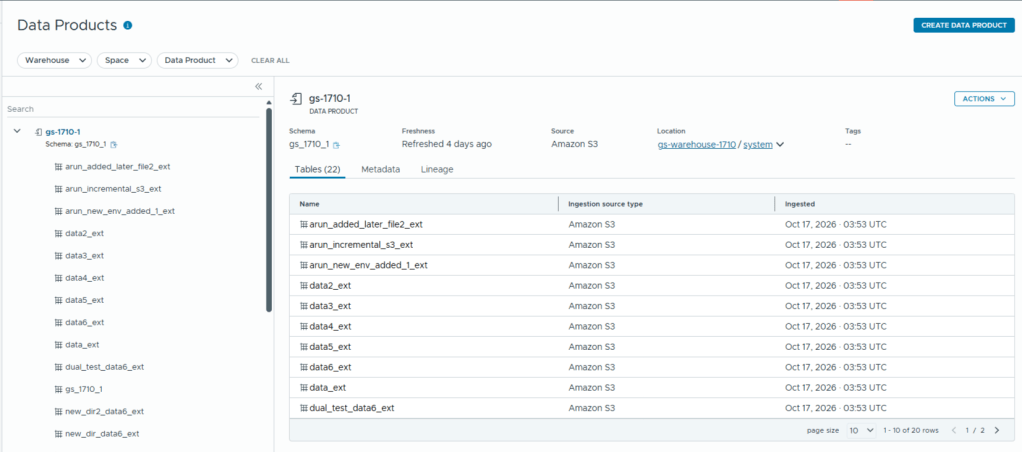
Governed Data Products and MCP Integration: Developers should not need to spend their time coding bespoke API wrappers for every new data source. AI-ready data foundations allow data teams to curate and publish data products to a self-service marketplace. These data products are made up of certified, governed datasets plus business glossaries, masking rules, and lineage tracking.
Crucially, Tanzu Platform exposes these data products via embedded Model Context Protocol (MCP) servers. This standardizes how agents discover and query enterprise data. An agent can connect to the internal Tanzu marketplace, authenticate via the AI Gateway, and instantly query a masked dataset without the developer writing custom integration code. In addition, the machine-readable marketplace catalog enables agents to autonomously discover and query verified data products using natural language, while upstream access controls ensure only agents with explicit, verified access rights can bind or query the data. Whether the consumer is a human analyst writing SQL or an autonomous agent querying via MCP, the exact same relational masking and platform boundary rules apply.
Sovereign Control and Predictable Economics Deploying agents on metered public SaaS platforms creates a compounding economic trap. Every time an agent loops through a reasoning cycle, calls a tool, or retrieves memory, it consumes tokens. Costs scale linearly with autonomy. Furthermore, sending unvetted enterprise IP out to third-party language models violates data sovereignty mandates like the EU AI Act or US federal compliance standards.
By anchoring AI-Ready data foundations on VMware Cloud Foundation (VCF), enterprises can retain absolute physical and jurisdictional control. Context, memory, and telemetry stay strictly behind the corporate firewall. Administrators provision dedicated compute capacity governed by internal quotas, ensuring that as agentic workflows scale in complexity, infrastructure costs remain entirely predictable.
Real-World Use Case Patterns
The value of an AI-ready data foundation extends across industries, providing reusable architectural blueprints for complex, multi-modal workflows where governance, accuracy, and predictable economics are non-negotiable. While specific implementations vary – from financial fraud triage to manufacturing operations or defense intelligence, the platform provides the core capabilities needed to build, execute, and govern autonomous agents reliably without tool sprawl or data migration debt.
Below are three representative patterns demonstrating how an AI-ready data foundation enables safer, more cost-effective, and scalable agentic workflows:
1. Multi-Modal Anomaly Investigation & Triage
Example business use cases: Fraud detection, claims review, identity verification
- Challenge: Verifying alerts requires manually joining fast-moving structured records with complex unstructured files (PDFs, identity scans) without exposing sensitive information.
- How It Delivers:
- Upstream Masking & Governance: Masks sensitive fields directly at the database tier so agents analyze records without exposing plaintext PII to language models.
- Zero-Code Integration: Uses embedded MCP servers and natural language catalog search so agents discover certified data products without custom API wrappers.
- Token Optimization: Pre-extracts document structure and semantics upstream, slashing runtime token burn and eliminating errors caused by unrefined inputs.
2. Cross-Silo Root Cause & Blast Radius Analysis
Example business use cases: Supply chain rerouting, incident response, resource allocation)
- Challenge: Tracing disruption impact across disconnected systems (ERP databases, shipping manifests, supplier contracts) typically forces costly, complex data consolidation.
- How It Delivers:
- Federation Over Migration: Queries relational and object storage in-place, bypassing months of ETL pipeline development and eliminating double-storage costs.
- Unified Multi-System Reasoning: Enables an agent to cross-reference PDF manifests, inventory databases, and vendor agreements in a single workflow.
- Sovereignty & Cost Protection: Keeps confidential pricing, partner data, and reasoning loops within the private cloud perimeter, avoiding public cloud compute markups and egress fees.
3. Sovereign Multi-Agent Collaboration in Restricted Zones
Example business use cases: Defense intelligence, clinical healthcare, public sector)
- Challenge: Regulated environments forbid external cloud transit, yet mission workflows require multiple specialized agents sharing ground truth under zero-trust controls.
- How It Delivers:
- Unified Catalog Discovery: Publishes curated data products available for automated discovery in a centralized marketplace.
- Equal Governance for All Consumers: Enforces the exact same tenancy scopes and row-level access rules whether accessed by human analysts using SQL or agents binding via MCP.
- Predictable Private Cloud Scale: Operates on provisioned private infrastructure quotas, preventing unpredictable per-token SaaS metering traps during intensive agent collaboration.
From Vision to Sovereign Data Reality
The transition from exploratory GenAI prototypes to production-grade agentic workflows in the enterprise demands an infrastructure designed for enterprise ground truth. By eliminating the friction of data migration, standardizing context delivery through governed MCP data products, and anchoring runtime execution securely within a sovereign private cloud, AI-ready data foundations bridge the gap between ambition and enterprise readiness. With VMware Tanzu, organizations gain the control plane and predictable economics required to safely empower autonomous agents, transforming complex, multi-modal enterprise data into decisive action at speed.