

VMware vDefend directly conforms to NIST CSF, HIPAA, and PCI DSS requirements, providing organizations with the critical controls needed to satisfy regulatory mandates and mitigate modern threats.
Regulatory compliance has become a strategic imperative across all industry sectors due to a growing global focus on data privacy, supply chain transparency, and operational resilience. This urgency is further amplified by the rapid adoption of AI and the rise of AI-accelerated cyberattacks. These advanced threats often target software vulnerabilities and spread laterally through east-west traffic to access high-value targets such as electronic protected health information (ePHI) or Cardholder Data Environment (CDE). As a result, security and compliance teams must deploy comprehensive controls to provide visibility and enforcement, restrict lateral movement, detect threats, and enable mitigation before damage can occur.
To effectively address these challenges and ensure compliance, organizations must align their security architecture with the necessary control points. This alignment is typically achieved through a layered approach, using regulatory frameworks tailored to their industry, data type, and security maturity:
- The Strategic Baseline (NIST CSF 2.0): A highly flexible, risk-based set of guidelines (Identify, Protect, Detect, Respond, Recover). It is often used as a baseline for overall cybersecurity maturity or mapped to fulfill other requirements.
- The Prescriptive Mandates (PCI DSS 4.0.1 & HIPAA): These granular, rules-driven standards are designed to safeguard specialized assets such as cardholder data and ePHI, requiring robust technical boundaries, workload isolation, and deep traffic surveillance.
To provide an objective, professional evaluation of vDefend’s alignment with these mandates, VMware partnered with Coalfire, a leading independent cybersecurity advisory firm. This partnership resulted in the publication of authoritative Product Applicability Guides (PAGs), which provide a detailed assessment of VMware vDefend’s capabilities against established regulatory requirements.
VMware vDefend is a comprehensive Zero Trust lateral security solution designed to protect against cyber threats. This hypervisor-native, software-defined solution provides deep visibility into both network and application activities, effectively eliminating security blind spots. It enforces a multi-layered defense and mitigation strategy against ransomware and advanced persistent threats.
VMware vDefend is a comprehensive lateral security solution that includes multiple capabilities: distributed and gateway firewalls (DFW, GFW), distributed Intrusion Detection and Prevention Service (IDS/IPS), Malware Prevention Service (MPS), Network Detection and Response (NDR) with an NDR Sensor, and Network Traffic Analysis (NTA). This solution offers deep traffic visibility and creates a closed-loop security system for VCF private cloud, ensuring visibility, prevention, detection, and mitigation of cyber threats.
The following sections explore how VMware vDefend aligns with the essential lifecycle mandates of these critical compliance frameworks.
The Strategic Baseline: NIST CSF 2.0
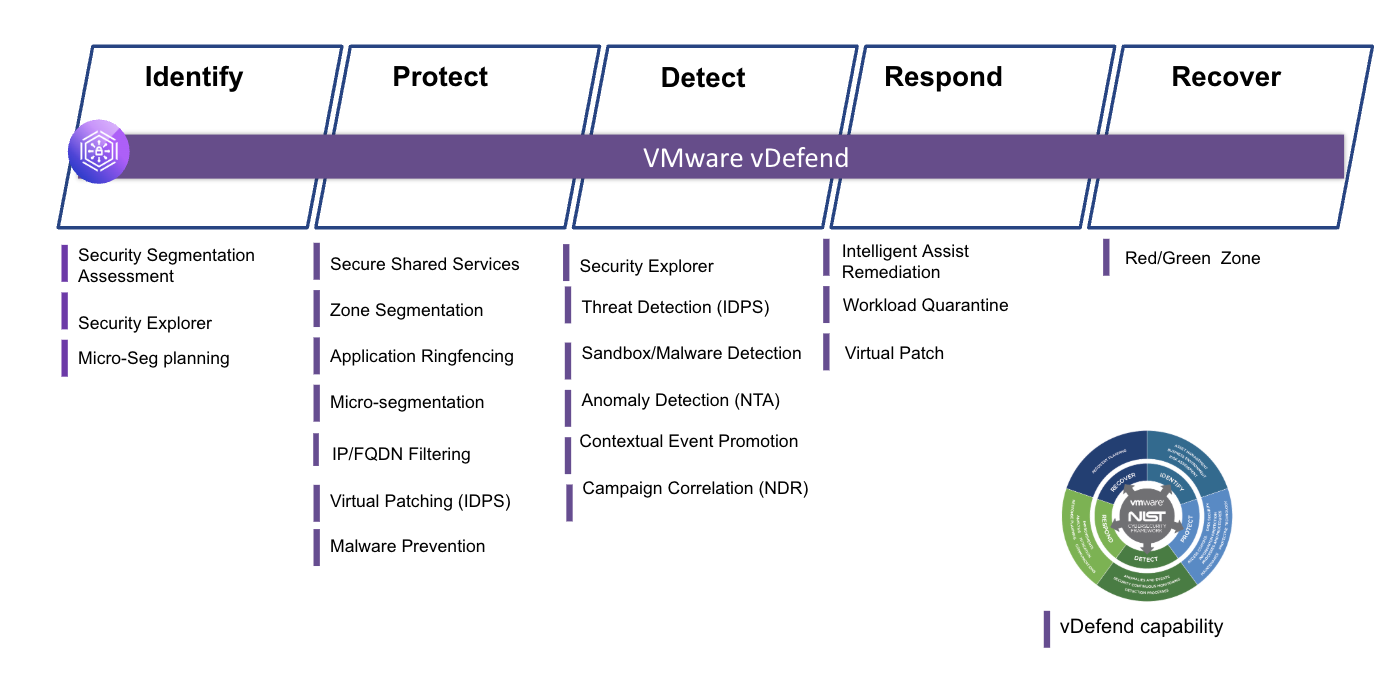
The National Institute of Standards and Technology (NIST) Cybersecurity Framework (CSF) 2.0 serves as a foundation for modern security design. Rather than offering a simple checklist, it presents a systematic approach organized around five key technical functions: Identify, Protect, Detect, Respond, and Recover.
The following sections detail how vDefend’s comprehensive security capabilities align with the objectives of each NIST framework function.
Identify
Proper identification and mapping of various critical IT assets form the foundation of a comprehensive defense strategy. With vDefend, enterprises can organize workloads statically or dynamically using a tag-based labeling system to trigger specific security policies. Static policies apply to a fixed set of tagged workloads, while dynamic policies automatically adjust and apply based on specific tags. This dynamic enforcement ensures that the corresponding level of compliance, be it regulatory (e.g., HIPAA, PCI DSS) or internal security posture requirements, is met instantly and consistently as new workloads are spun up or existing ones change.
VMware vDefend’s Security Intelligence provides real-time, distributed visibility across the entire data center and cloud infrastructure by continuously monitoring and analyzing all identified traffic flows between workloads. By observing these communication patterns, the Security Intelligence platform can automatically detect and map the “desired” or “baseline” behavior of applications. Based on this traffic flow analysis, the platform provides highly calibrated, actionable policy recommendations that can significantly reduce the attack surface and enhance the overall security posture.
With a clearly identified asset inventory and defined policy baselines, the focus then shifts to proactive enforcement.
Protect
Protecting enterprise workloads from known and previously unseen (zero-day) threats is a core capability of the vDefend solution.
While vDefend Gateway Firewall (GFW) provides conventional NGFW edge controls, albeit with a modern software-defined architecture, the vDefend Distributed Firewall (DFW) employs a distributed (and scale-out) ‘security-per-workload’ model, securing each workload at the virtual NIC layer. Lateral movement, the technique in which attackers pivot from a compromised system to high-value targets, is the primary mechanism by which modern threats, such as sophisticated ransomware and advanced persistent threats, spread internally. By enforcing security policies for every workload, vDefend DFW effectively stops unauthorized lateral movement and restricts breaches from spreading. This critical defense-in-depth mechanism dramatically shrinks the attack surface to an individual workload.
While the Distributed Firewall restricts spread, continuous detection is required to flag anomalies and sophisticated threats that bypass conventional defenses.
Detect
The Detect function focuses on identifying a cybersecurity event in real time, not just after the fact, enabling rapid response and containment. In today’s dynamic threat landscape, this function has undergone a significant transformation. vDefend Advanced Threat Prevention (ATP) has evolved the detection capability by leveraging a multi-layered approach to threat detection, ensuring that security gaps are minimized and evasive threats are captured:
- Distributed Intrusion Detection/Prevention System (IDS/IPS): The vDefend distributed IDS/IPS inspects network traffic and actively matches traffic patterns against an extensive, continuously updated library of over 10,000 known threat and vulnerability signatures. This distributed deep inspection – applied on a per-workload basis – is crucial for detecting both external attacks and east-west traffic anomalies, and for identifying potential vulnerabilities before they can be exploited.
- Network Traffic Analysis (NTA): NTA detects highly sophisticated attacks that bypass perimeter defenses by using behavioral analytics and machine learning on network metadata and flow information. NTA excels at immediately flagging subtle signs of an ongoing internal breach, particularly lateral movement, a key indicator of a successful intrusion.
- Sandboxing for Malware Analysis: vDefend provides an advanced sandboxing feature to neutralize the threat of zero-day exploits and polymorphic malware. This technology isolates suspicious files and URLs in a secure, virtualized environment (the “sandbox”), where the file is “detonated” or executed within a limited blast radius to observe the true behavior. If the file exhibits malicious characteristics, it is blocked, and the signature information is updated to prevent future occurrences.
- Network Detection and Response (NDR): vDefend NDR correlates multiple disparate data points from various sources into visually intuitive attack maps. These detailed, chronological, and graphical representations of an attack campaign result in highly relevant, actionable security intelligence for security teams.
Taken together, these capabilities give organizations a holistic, real-time picture of threats across their environment. The comprehensive, correlated data and visual attack maps also serve as verifiable evidence of due diligence during audits.
Respond
The response involves a rapid, coordinated incident management effort to contain threats and minimize damage.
When a threat is detected, vDefend can automatically trigger a Quarantine Policy, moving the infected VM into an isolated “Security Group” with access limited to forensics tools. When coupled with correlated intrusion campaign data from NDR, the incident management team can visualize the entire attack chain on a map. Furthermore, vDefend’s advanced troubleshooting tools—such as traceflow, packet capture, and detailed firewall logs—provide the forensic data needed to demonstrate compliance during an audit.
Once the immediate threat is contained and the attack chain is documented, the final step is ensuring full operational recovery.
Recover
The Recover function focuses on the rapid and complete restoration of services to the pre-incident operational state, ensuring the integrity of all reinstated data. VMware vDefend offers robust capabilities for incremental and full configuration backups. Furthermore, integrating VMware Live Recovery with vDefend significantly enhances the overall resilience strategy, covering both incident response and subsequent recovery.
In summary, the VMware vDefend solution enables foundational security controls that not only provide enterprise-grade protection but also streamlines the complex process of achieving and maintaining continuous compliance across diverse regulatory landscapes. Coalfire’s evaluation recognizes vDefend for its excellent structural coverage throughout the entire NIST lifecycle.
Coalfire assessed vDefend against all 106 subcategories in NIST CSF 2.0, and the results demonstrate the breadth and depth of vDefend’s compliance coverage. vDefend achieves full or strong coverage across the vast majority of applicable subcategories. The ability to monitor, inspect, and enforce policy on east-west traffic within a VCF environment is the architectural advantage that drives this coverage, translating directly into measurable, assessor-validated outcomes across Identify, Protect, Detect, and Respond.
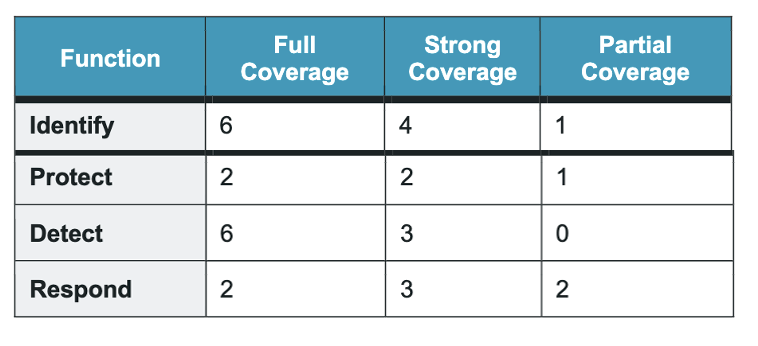
It is worth noting that NIST CSF 2.0 is intentionally broad — many of its subcategories address organizational and business processes that extend beyond any single technology platform. vDefend delivers deep, validated coverage of the technical control layer, and when combined with the organizational security program built around it, organizations are strongly positioned to demonstrate comprehensive CSF 2.0 alignment.
The detailed NIST CSF 2.0 Product Applicability Guide is available here.
The Prescriptive Mandates: PCI DSS 4.0.1 & HIPAA
In contrast to the broad NIST framework, data-specific regulations such as PCI DSS and HIPAA involve highly prescriptive technical requirements. Whether securing credit card data or electronic health records, vDefend serves as an essential, independently validated technical control point for both standards. The sections below explain these in detail.
PCI DSS 4.0.1 Alignment
The Payment Card Industry Data Security Standard places a strong emphasis on isolating the Cardholder Data Environment (CDE) and restricting access to it. In a virtualized environment, this means enforcing precise east-west traffic controls—the core architecture vDefend is built around. Coalfire’s Product Applicability Guide highlights vDefend’s coverage across all 12 major PCI DSS requirements:
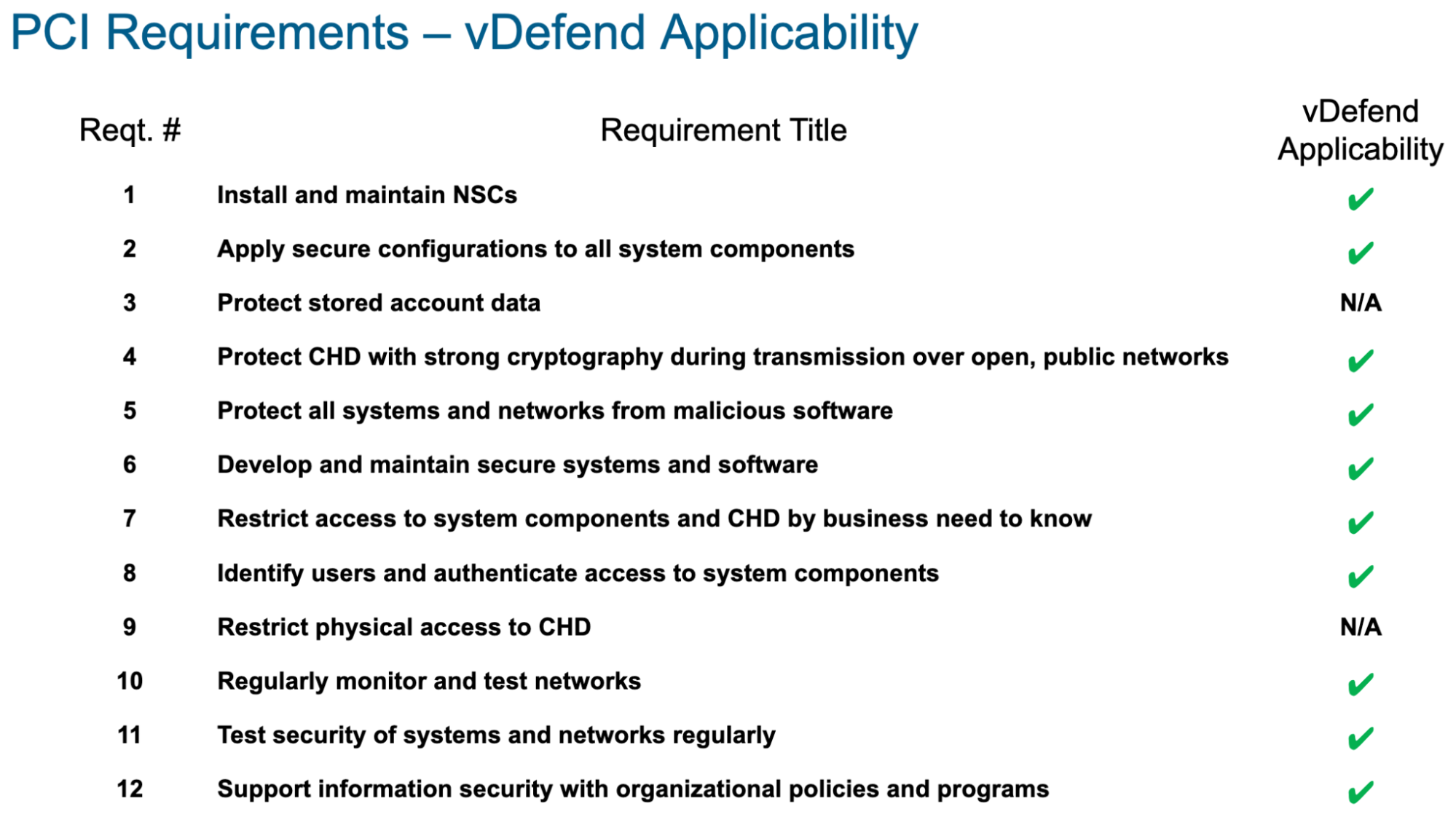
Note: Requirements 3 and 9 are marked N/A as they address stored account data and physical access controls, respectively — areas outside the scope of a network security platform.
The detailed PCI DSS 4.0.1 Applicability Guide is available here.
HIPAA Technical Safeguards Mapping
In healthcare environments, the stakes of inadequate security controls are particularly high. East-west traffic between clinical applications, databases, and administrative systems creates a wide attack surface for ePHI exposure. vDefend directly addresses this risk through its distributed enforcement model.
Under the HIPAA Security Rule, healthcare covered entities must deploy specific technical safeguards to ensure the confidentiality, integrity, and availability of ePHI. Coalfire’s validation confirms that vDefend aligns directly with these rigorous provisions:
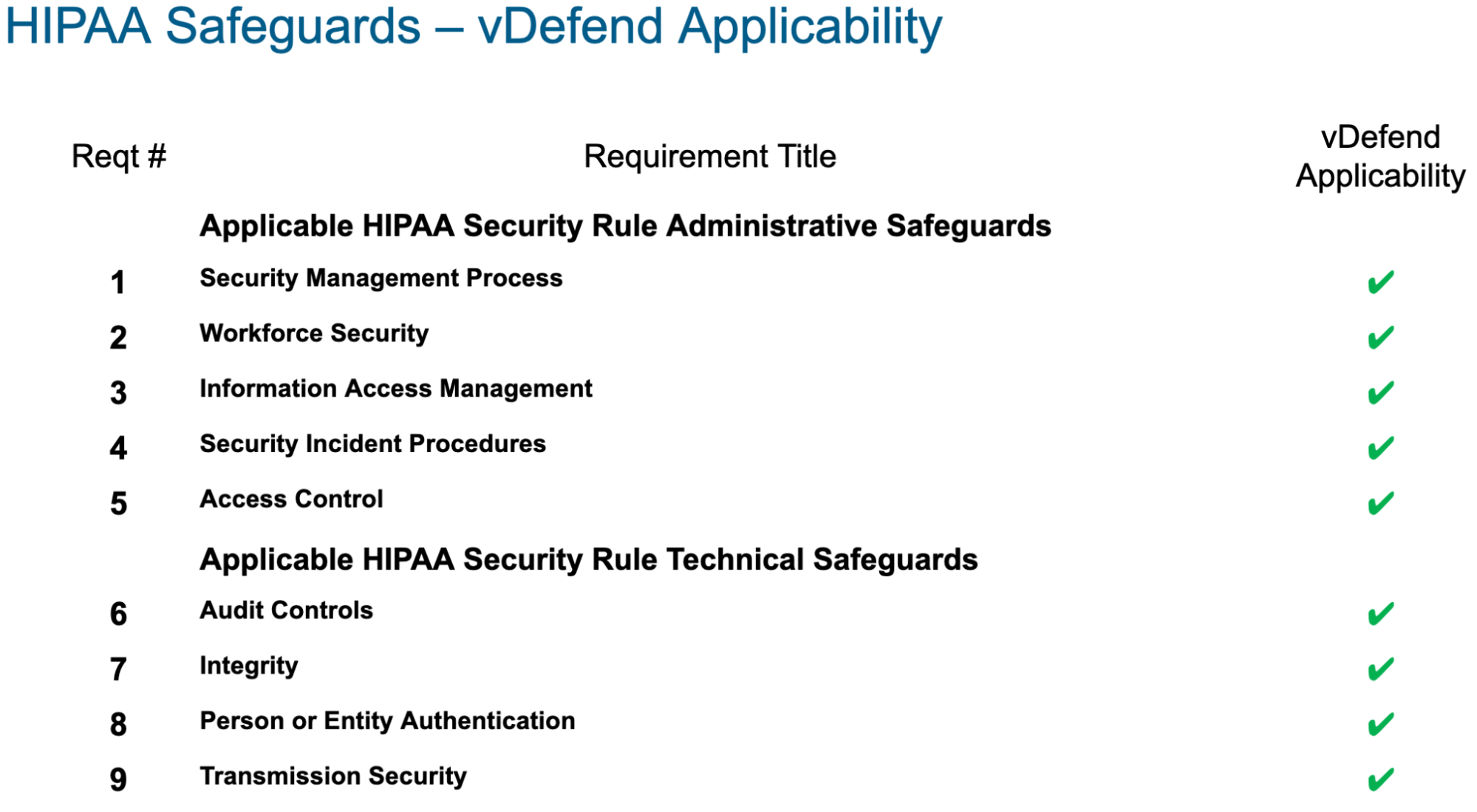
The Administrative Safeguards (requirements 1–5) address process and access governance; the Technical Safeguards (requirements 6–9) enforce those controls at the system level. vDefend is independently validated across all nine, providing covered entities with a strong, documentable compliance foundation.
The detailed HIPAA Applicability Guide can be found here.
VMware vDefend provides essential technical control points for data-specific regulations. Coalfire’s validation confirms its direct alignment with both the PCI DSS 4.0.1 requirements for isolating the Cardholder Data Environment (CDE) and the HIPAA Security Rule’s rigorous provisions for safeguarding the confidentiality, integrity, and availability of ePHI.
Conclusion
VMware vDefend delivers a comprehensive set of control points for both broad frameworks, such as NIST CSF, and data-specific compliance mandates, such as PCI DSS and HIPAA. Adopting VMware vDefend allows organizations to implement a robust security strategy while gaining the necessary control points for compliance. By integrating visibility, prevention, detection, and mitigation directly into a closed-loop security system, vDefend significantly accelerates an organization’s journey toward a Zero Trust posture and continuous compliance.
To learn more about the benefits of vDefend, see the links below.
- vDefend Product Applicability Guide for PCI-DSS
- vDefend Product Applicability Guide for HIPAA
- vDefend Product Applicability Guide for NIST CSF 2.0
- VMware vDefend Distributed Firewall
- VMware vDefend Advanced Threat Prevention
- VMware vDefend Datasheet
- vDefend DFW 1-2-3-4: A Prescriptive Path to Zero Trust Microsegmentation
- VMware vDefend How to Videos on YouTube