
The global threat landscape shifted dramatically today following the disclosure of PHP2Shell, a pair of critical Remote Code Execution (RCE) vulnerabilities tracked as CVE-2026-109618 (OOM memory corruption) and CVE-2026-109619 (stale global state). Both carry a CVSS score of 9.2 and affect core memory handling across decades of PHP releases.
Because PHP powers a vast portion of the modern web, from major enterprise portals to modern microservices running in containerized environments, the fallout was immediate. Across Europe and beyond, government agencies, cybersecurity organizations, and enterprise IT teams took the unprecedented step of taking critical web applications and public portals completely offline as a precautionary measure while scrambling to apply emergency updates. Pulling systems offline buys time in a crisis, but a long-term defense strategy requires controls that keep applications protected without forcing unnecessary downtime.
While VMware vDefend, VMware vDefend Security Services Platform (SSP) and VMware Avi Load Balancer are not impacted by these vulnerabilities, they can help protect customer workloads from the CVEs.
In this post, we highlight how:
- VMware vDefend Gateway Firewall can block the PHP vulnerability via virtual patching
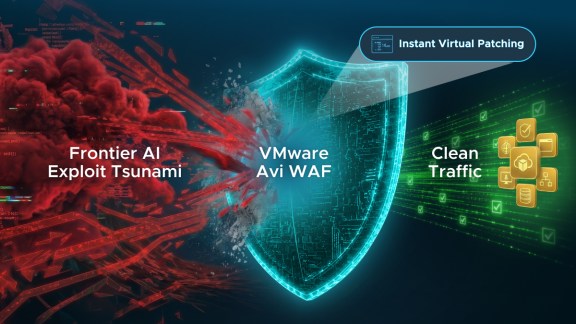
- VMware Avi Load Balancer (Avi WAF) can block the PHP vulnerability via virtual patching
Additionally, vDefend DFW micro-segmentation along with ATP across internal workloads can deliver live network-level visibility stopping PHP2Shell exploits without requiring application downtime or immediate code modifications.
Note: Virtual Patching is the ability to apply a network-based mitigating control to vulnerable workloads, without needing to take those workloads offline, enabling immediate protection while the software patch can be applied safely during a maintenance window.
The Anatomy of the PHP2Shell Crisis
The PHP2Shell vulnerability duo breaks basic assumptions about how web servers manage request memory during unexpected failures:
1. CVE-2026-109618 (Out-of-Memory Corruption): Triggered when a request crosses PHP’s memory_limit during operations like multipart file uploads. The memory abort mechanism (longjmp()) leaves internal request data partially initialized. Cleanup routines subsequently parse uninitialized heap memory controlled by the attacker, allowing unauthenticated execution before any application logic ever executes.
2. CVE-2026-109619 (Stale Global State Execution): Caused when fatal errors leave module-level global pointers pointing to per-request heap space that was already freed. Subsequent requests handled by the same worker process execute against that stale memory space.
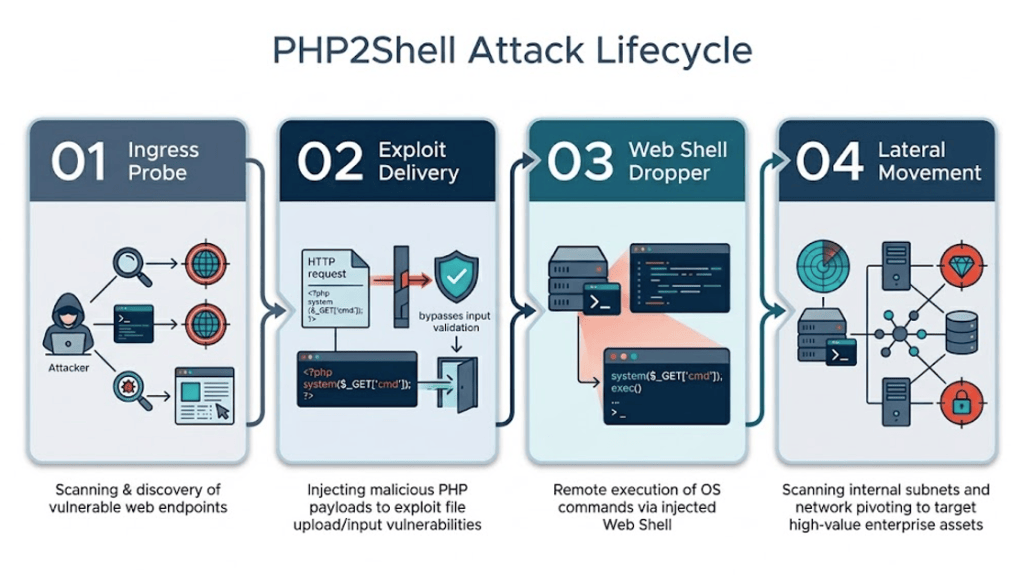
Because an unauthenticated request can trigger memory corruption before application code even executes, traditional web application input sanitization is insufficient.
The PHP Visibility Problem: You Can’t Patch What You Don’t Know Exists
The primary reason organizations resorted to taking websites offline today stems from a fundamental visibility gap.
Over years of software development, PHP gets embedded into legacy enterprise portals, third-party vendor appliances, custom utility microservices, and containerized internal dashboards. Traditional static asset inventories miss many of these instances, leaving security teams facing critical questions during a crisis:
- Where across our multi-cloud fabric are vulnerable PHP instances actively running?
- Which services are directly exposed to north-south internet traffic vs. east-west internal networks?
- How do we prioritize patching without breaking business continuity?
Relying on scheduled patch deployments forces teams into a binary choice: leave vulnerable instances exposed to automated AI-driven scanning or shut down public operations entirely.
VMware vDefend Gateway Firewall (GFW) with TLS Decryption
Because PHP2Shell attack payloads arrive over encrypted HTTPS channels, deep threat inspection requires decrypting the payload at a control boundary. VMware vDefend Gateway Firewall (GFW) equipped with TLS Inspection (Decryption) serves as the critical enforcement point to inspect, unmask, and virtually patch encrypted traffic.
Protecting Inter-Segment Traffic
Threats like PHP2Shell are rarely confined to initial north-south ingress. Attackers use compromised internal jump-boxes or unmanaged web microservices to pivot laterally across network subnets. vDefend GFW acts as an inter-segment gateway firewall. By placing GFW with TLS Decryption at Tier-0 and Tier-1 gateway boundaries between internal application zones, organizations ensure that encrypted east-west traffic moving across network segments undergoes full payload inspection.
Instant Activation for Existing NSX Overlay Customers
For organizations already utilizing NSX overlay networking, the operational friction to enable this level of protection is virtually zero. Because NSX Edge Nodes are already deployed in your environment to handle gateway routing, enabling vDefend GFW with TLS Decryption requires no architecture changes, extra appliance provisioning, or network re-plumbing. Administrators simply enable TLS Inspection policies directly on the existing Tier-0/Tier-1 Gateway Firewalls to start decrypting and inspecting inbound and inter-zone encrypted traffic.
Dedicated IDPS Signatures for PHP2Shell Virtual Patching
Once traffic is decrypted at the Gateway Firewall, vDefend’s integrated IDPS engine inspects the unencrypted HTTP payload stream. To address the PHP2Shell threat immediately, VMware Threat Analysis Unit has officially released a number of IDPS signatures for real-time virtual patching:
- Exploitation Prevention for CVE-2026-109618 (OOM Memory Corruption):
To block unauthenticated exploit attempts targeting the memory-allocation abort flaw during large or malformed HTTP requests, vDefend enforces signature IDs 1156209, 1156228, 1156229, 1156230, and 1156231. - Exploitation Prevention for CVE-2026-109619 (Stale Global State Execution):
To detect and intercept malicious payloads attempting to leverage dangling global module pointers across PHP worker process lifecycles, vDefend enforces signature IDs 1156232 and 1156235. - INFO-Mode Behavioral Detectors for Threat Analysts:
In addition to active blocking signatures, vDefend provides specialized INFO-mode (behavioral) detectors to grant security operations center (SOC) analysts deep visibility into anomalous PHP request patterns and early-stage reconnaissance across the network fabric:
– Signature #1156210: Suspicious PHP SessionUploadProgress Request
– Signature #1156233: Suspicious HTTP Request to a PHP Server
– Signature #1156241: Suspicious HTTP Request to a PHP Server
By deploying GFW with TLS Decryption across network boundaries and enabling this full spectrum of active blocking rules (#1156209, #1156228–1156232, #1156235) alongside INFO-mode detectors (#1156210, #1156233, #1156241), security teams achieve instant virtual patching against CVE-2026-109618 and CVE-2026-109619 while arming threat hunters with real-time detection telemetry, all without taking web applications offline or making emergency source code modifications.
Stopping Web Exploits with Avi WAF
VMware Avi Load Balancer (Avi WAF) acts as an intelligent barrier for your public as well as internal web applications.
1. Real-Time Version Discovery
Avi WAF continuously parses live HTTP/S traffic streams. By analyzing header signatures (Server, X-Powered-By), Avi can help identify vulnerable versions of your PHP-based application.
2. Virtual Patching
Instead of waiting weeks for software regression testing, administrators can push targeted virtual patches at the load balancer layer within minutes. Avi WAF inspects incoming HTTP payload structures, multipart headers, and field lengths to drop exploit payloads before they touch backend application workers.
3. Payload De-obfuscation & Request Normalization
Attackers routinely obfuscate PHP RCE requests using double URL-encoding, base64 wrappers, or nested string concatenations. Avi WAF normalizes and decodes HTTP request bodies, headers, and query strings in real time, exposing malicious memory-manipulation attempts.
Avi WAF can provide protection against PHP vulnerabilities with the following controls:
- CRS Rules enforcement as part of Avi WAF Policy:-
- Rules 920170 & 920180 (Multipart Request Anomalies): Inspects multipart payloads and headers to mitigate exploit attempts.
- Rules 920370 & 920380 (Header and Argument Thresholds): Limits headers and parameters to prevent out-of-memory denial of service.
- Rules 932100–932200 (Remote Command Execution): Detects OS shell injection patterns like /bin/sh invocation.
- Rules 933100–933190 (PHP Application Attacks): Evaluates request streams to block rogue PHP code execution.
- Also enable Avi Virtual Patch via CVE-specific rules in Enforcement mode. The rules are available at https://knowledge.broadcom.com/external/article/460068.
- As a best practice, enable Avi IP Reputation to block traffic from malicious IP addresses.
Zero Trust Micro-Segmentation & Containment: VMware vDefend DFW & ATP
Virtual patching blocks known exploit vectors, but modern resilience requires containing post-exploitation activity if an unmanaged or internal asset is breached. VMware vDefend Distributed Firewall (DFW) and Advanced Threat Prevention (ATP) provide the necessary containment and behavioral defense.
Distributed Firewall (DFW): Micro-segmentation & Zero Trust Isolation
Operating directly inside the hypervisor kernel at every workload’s virtual NIC, vDefend DFW enforces strict least-privilege micro-segmentation:
- Blast Radius Reduction: Web applications running PHP are strictly isolated. Even if a local web shell is dropped on a PHP host via an unmanaged vector, DFW blocks the workload from scanning, probing, or communicating with database tiers, internal APIs, or domain controllers.
- Strict Egress Rules: Prevents compromised workloads from initiating outbound connection attempts to unauthorized internal subnets.
Advanced Threat Prevention (ATP): Post-Exploitation & C2 Defense
For novel exploit variants or evasive execution paths, vDefend ATP delivers multi-layered behavioral analysis:
- Automated Sandboxing: Suspicious file uploads or dynamic payloads executed by web processes are mirrored to the vDefend Sandbox for on-premises dynamic detonation and behavioral analysis.
- C2 & Reverse Shell Blocking: Network Detection and Response (NDR) continuously monitors traffic for anomalous outbound callbacks. If an exploited PHP process attempts a command-and-control (C2) callback or reverse shell, ATP blocks the connection and isolates the workload instantly.
The table below summarizes virtual patching and additional protection delivered through VMware vDefend and Avi WAF.
| Defense Layer | VMware Security Component | Core Operational Function |
| Web Application Layer | Avi Load Balancer WAF | Discovers running PHP instances in real time and blocks inbound exploit patterns on public endpoints. Avi WAF with the recommended CRS controls for Remote Code Execution (RCE), Protocol validation, custom signature Virtual Patch along with IP reputation enforcement.Refer to https://knowledge.broadcom.com/external/article/460068 |
| Gateway & TLS Decryption | vDefend GFW + IDPS | Decrypts TLS traffic on existing NSX Edge Nodes and enforces IDPS Signatures for instant virtual patching of CVE-2026-109618 & CVE-2026-109619. |
| Threat Containment | vDefend DFW (Micro-segmentation) | Enforces hypervisor-level Zero Trust boundaries to prevent unauthorized lateral movement and contain threats. |
| Post-Exploit Defense | vDefend ATP | Detonates suspicious payloads in an isolated sandbox and blocks outbound C2 reverse shell attempts. |
Related Resources & Signature Links
- VMware vDefend Threat Intelligence Service – IDPS Signatures
- VMware Avi Load Balancer – Mitigation for CVE-2026-109618 and CVE-2026-109619