
Multi-Tenancy Is the Engine of the Modern Private AI Cloud
The private cloud is undergoing a profound transformation. Today’s enterprise IT organizations are tasked with supporting diverse, resource-intensive workloads, spanning AI, Kubernetes / containers, and virtual machines, on shared infrastructure. Simultaneously, they must enforce strict isolation between business divisions, developers, or external clients. When isolation relies on manual administrative processes, IT teams can expect configuration drift, security vulnerabilities, sluggish provisioning, and wasted resources. To build a true cloud ecosystem rather than merely bolting self-service portals onto static infrastructure, multi-tenancy is a critical necessity.
Enter VMware Cloud Foundation (VCF) 9, a platform that enables enterprises to establish a fully governed, multi-tenant private AI cloud aligned with how modern applications are built. Written for IT executives, cloud architects, platform engineers, and administrators, our new whitepaper focuses on the “why” and “what” of multi-tenancy, highlighting the business problems it solves rather than deep implementation details. By explaining why multi-tenancy matters now, how VCF Automation delivers it, and what makes it different, the paper shows how IT can provide secure, self-service consumption while maintaining strong control.
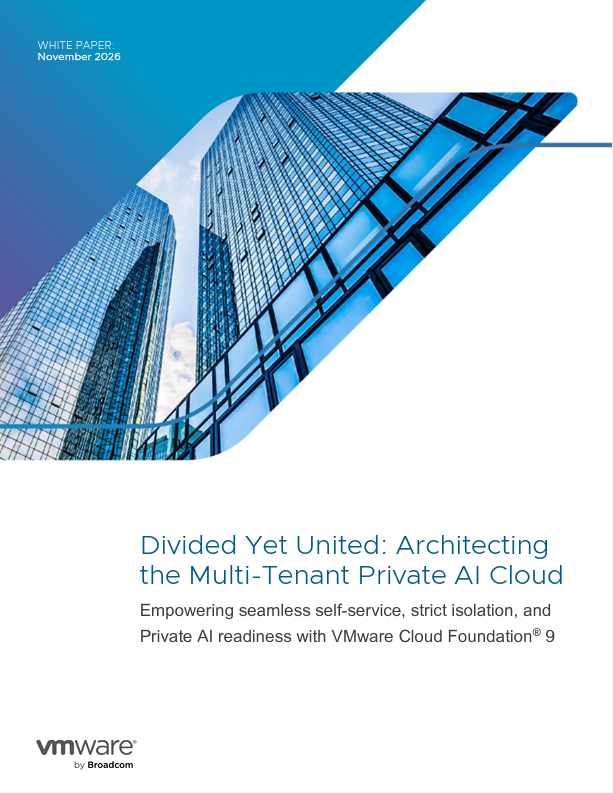
Here’s a preview of the core architectural concepts and business outcomes of a multi-tenant private AI cloud explored in the full whitepaper.
A Kubernetes-Native Foundation for All Apps
VCF 9 reimagines multi-tenancy by rooting it in a Kubernetes-based architecture. At its core lies the VMware vSphere Supervisor, a Kubernetes-based control plane executing directly on vSphere clusters. This architecture drives the “All Apps” organization, exposing infrastructure and services through Kubernetes APIs and Custom Resource Definitions (CRDs). By utilizing a common declarative API surface, platform teams and developers can consume private cloud services, including KubeVM, VMware vSphere Kubernetes Service (VKS), container, networking, database services, and more efficiently.
Empowering the Provider and the Consumer
Multi-tenancy and self-service are fundamentally inseparable; delivering self-service without structural isolation can introduce security and governance risks. VCF Automation resolves this via a provider/consumer model that mirrors public cloud operations. Enterprise IT acts as the provider, managing the underlying fabric, allocating resources, and defining global security guardrails. Meanwhile, lines of business operate as tenants inside secure, autonomous boundaries. This dynamic operates on a concentric model: enterprise control sits at the outer ring, tenant autonomy and security guardrails form the middle ring, and frictionless developer consumption resides at the inner ring.
A cornerstone of this autonomy is the Virtual Private Cloud (VPC). Tenants can self-provision isolated VPCs and subnets on demand. Furthermore, they retain direct control over Distributed Firewall policies and NAT configurations within their project boundaries. Supported by VMware vDefend, security mandates are strictly enforced in a sequential hierarchy from the top down, so that corporate rules cannot be bypassed by lower-level users.
Governing the Private AI Frontier
As enterprises scale Private AI, dedicating physical GPU infrastructure to individual teams quickly becomes cost-prohibitive. VCF Private AI Services facilitates multi-tenant model sharing, enabling the secure pooling and sharing of GPU resources across the organization. The Model Runtime permits the secure sharing of AI models between isolated namespaces. This maintains vital data privacy while helping avoid redundant model deployments that waste infrastructure allocation.
Advanced Capabilities and Use Cases for Enterprise Complexity
Our newly published whitepaper details how this architecture supports sophisticated enterprise requirements, unlocking advanced capabilities and use cases:
- Multi-Tenant Disaster Recovery: The Protection and Recovery for VCF Automation service integrates disaster recovery natively into the multi-tenant framework. Tenants can self-serve VM-level replication without exhausting shared recovery capacity. Importantly, tenant isolation boundaries are continuously maintained across replication and failover phases.
- Policy as Code: VCF Automation enforces governance through Kubernetes Validating Admission Policy, allowing administrators to apply granular YAML-based controls over IaaS resource provisioning.
- App Stack Formation: Platform engineers can capture a running sandbox environment, including its network configurations, as a reusable blueprint. Teams can redeploy identical or differentiated copies of these complex application topologies to reduce configuration drift.
Maximizing ROI with Embedded FinOps
Resource hoarding drives inflated CapEx in private data centers. VCF Automation combats this with embedded FinOps capabilities powered with VCF Operations that provide granular, namespace-level cost accountability. Upfront pricing models influence user behavior, while automated lease policies and reclamation workflows systematically reclaim inactive resources. This helps ensure that idle capacity is reclaimed automatically and redistributed, significantly optimizing hardware utilization and reducing Total Cost of Ownership (TCO).
Download the Essential Multi-Tenancy Blueprint
The transition to a modern, multi-tenant cloud is the defining infrastructure challenge of the AI and Kubernetes era. Discover how to architect an environment that delivers public-cloud agility alongside strict private-cloud security. Read the full whitepaper to explore the business outcomes and technical capabilities driving the next generation of platform engineering.
Transform your private cloud strategy today. Download and read the whitepaper here.
Discover more from VMware Cloud Foundation (VCF) Blog
Subscribe to get the latest posts sent to your email.