
Frontier AI is fundamentally altering the cybersecurity landscape by increasing the speed, scale, and sophistication of attacks while simultaneously compressing defensive response windows. These accelerated attack vectors necessitate a proactive defensive posture. We are helping customers navigate this new threat landscape with strategic guidance, as outlined in this blog.
While hardening the private cloud is a critical mandate, the inherent complexity of unique customer environments renders universal playbooks ineffective. Identifying current standings and critical gaps is imperative for prioritizing high-impact best practices, especially for IT teams operating under extreme time pressure.
Today, we are launching the Frontier AI Security Readiness Program globally to provide customers a guided, prescriptive, and tailored trajectory toward a more resilient private cloud. Effective defense against AI-driven threats demands an end-to-end, streamlined security approach rather than disjointed, piecemeal solutions.
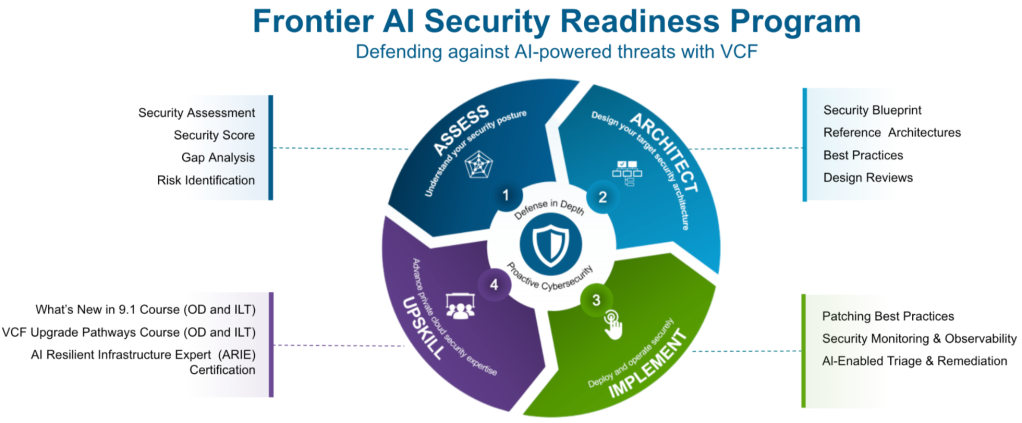
This program synthesizes a comprehensive framework across four interconnected stages:
- Assess: Quantify exposure and posture gaps to establish a data-driven baseline.
- Architect: Define the target state by integrating gap findings with proven five-pillar blueprints.
- Implement: Deploy hardened configurations, leveraging seamless patching, continuous monitoring, and AI-assisted triage.
- Upskill: Mature organizational capability through specialized VMware Cloud Foundation (VCF) 9.1 curricula and the upcoming AI Resilient Infrastructure Expert (ARIE) certification.
In the era of frontier AI, autonomous threats exploit delayed patching and human skills gaps at machine speed. By unifying technology, automation, and talent development, this framework delivers four strategic outcomes: building a resilient private cloud, minimizing attack surfaces, enabling rapid vulnerability response, and sustaining an adaptive security posture.
Apply to join the Frontier AI Security Readiness Program here and reach out to your account team as well: https://go-vmware.broadcom.com/frontier-ai-security-readiness-program
Let’s walk through each of the four stages of the program.
The Assess stage
To build a resilient private cloud, the foundational first step in the security program is assessment—because you cannot defend what you haven’t quantified. The web-based VCF Security Assessment provides objective, score-based visibility into your posture across the entire stack, using risk-based scoring to prioritize high-impact production and DMZ environments over lower-impact lab workloads.
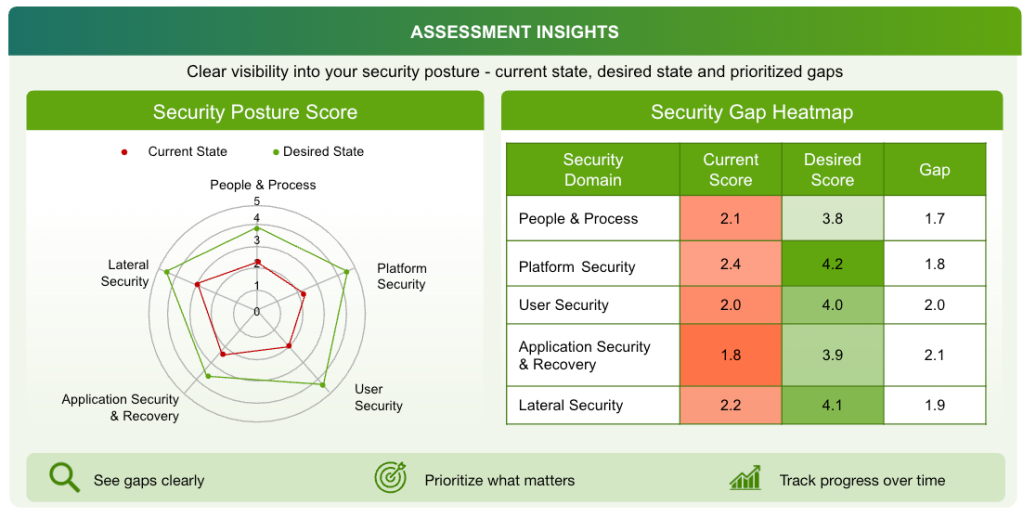
Defending VMware Cloud Foundation (VCF) private clouds against machine-speed, AI-driven threats requires moving beyond static perimeters to an automated, secure-by-design posture. The spider chart and gap analysis generated by the security assessment questionnaire help drive this transition, exposing critical vulnerabilities and providing immediate visual clarity across the five architectural pillars: People and Process, User Security, Platform Security, Lateral Security, and Application Security & Recovery. Armed with these insights, organizations can establish a resilient platform baseline that minimizes attack surfaces, enforces robust identity controls, restricts lateral movement, and enables rapid recovery—transforming reactive patch management into a targeted, continuous defense capable of withstanding Frontier AI-era attacks.
The Architect stage
Once the security baseline is established, the Architect stage translates raw assessment findings into a concrete, resilient target design. Combining security assessment scores and gap heatmaps with VCF Security Blueprints across the same five core pillars: People & Process, Platform Security, User Security, Lateral Security, and Application Security & Recovery, delivers clear, prescriptive recommendations. This provides the exact building blocks needed for execution, from implementing strict RBAC and SSO to upgrading to VCF 9.1+ for automated lifecycle patching and embedding core networking, encryption, and DR controls.
From a frontier AI threat perspective, this systematic pipeline is critical. Autonomous attack engines exploit architectural inconsistency, configuration drift, and delayed patching to chain together exploits far faster than teams can manually react. By pairing the assessment data with five-pillar blueprints to drive these prescriptive recommendations, we can eliminate design guesswork and enforce standardized, hard-coded guardrails across the entire VCF stack, helping ensure your architecture is structurally hardened against continuous, AI-orchestrated attacks.
The Implement stage
Once the target architecture is defined, the Implement and operate stage operationalizes security into daily execution across three core activities:
- Deploying components using validated, hardened blueprints
- Executing seamless, automated patching to maintain compliance
- Leveraging security scanners for VMware Security Advisories to rapidly prioritize vulnerabilities
Beyond these core activities, we integrate evolving AI capabilities, including AI-assisted operations, AI-powered triage and remediation, continuous policy enforcement, and real-time threat intelligence. These capabilities give your teams the power to protect, detect, and respond at scale.
From a frontier AI threat perspective, this operational foundation is your frontline defense. Autonomous attack agents specifically exploit the operational delay between when a security advisory is published and when a patch is applied, executing exploits at machine speed. To fight AI with AI, the automated patching workflows, continuous security intelligence, and AI-driven root-cause analysis shrink your exposure window to near zero. Doing so helps ensure your private cloud dynamically adapts and self-corrects, staying resilient against modern threat vectors.
Across these three stages, customers work hand in hand with their SEs and TAMs or partners. It’s worth noting that VCF Professional Services offers a range of service offerings aligned to the stages of this program (Assess, Architect, Implement), and the expert guidance they provide can meaningfully accelerate project timelines. Talk to your account team for more details on VCF Professional Services.
The Upskill stage
The final pillar of the security readiness program focuses on human readiness through specialized training and industry-leading certifications. In the era of frontier AI, upskilling your talent is a fundamental requirement to ensure teams can expertly design, operate, and maintain a structurally resilient private cloud against evolving, machine-speed threats.
The VCF 9.1 curriculum provides deep visibility into modern upgrade pathways and cyber-resilience features, helping your staff remain current on the latest architectural guardrails.
Explore the latest educational content for VCF 9.1:
On-Demand Digital Learning:
- VCF 9.1 Upgrade Pathways: Featuring technical simulations for Express Patches, Back-in-Time workflows, VCF Inspector, and the interactive Upgrade Planner– External Link
- VCF 9.1: Build, Manage & Secure – External Link
- VCF 9.1: Automate and Operate – External Link
- VCF 9.1: Advanced Troubleshooting – External Link
Instructor-Led Training (ILT):
- What’s New in VMware Cloud Foundation [V9.1] – External Link
- VCF: Build, Manage & Secure [V9.1] – External Link
- VCF: Automation and Operations [V9.1] – External Link
- VCF: Troubleshooting [V9.1] – External Link
AI Resilient Infrastructure Expert (ARIE) Certification Track (Coming Soon)
The upcoming ARIE track delivers three targeted learning paths designed to structurally harden the VCF platform:
- Sales Professionals (4 hours): Focused on AI-resilient fluency, positioning VCF as a security stack, and effective CISO communication strategies.
- Solution Engineers (~10 hours): Technical deep dives into DFW internals, VM-identity, Avi WAF, Live Recovery, and VulnOps for machine-speed defense.
- VCDX Candidates (40 hours): Advanced labs leading to VCAP/VCDX certification, focusing on Zero Trust enforcement and autonomous threat response.
These tailored paths ensure your personnel gain the prescriptive expertise needed to secure the VCF stack against modern vectors.
Upon completion of this specialized curriculum, teams will be equipped to:
- Architect Zero Trust designs aligned with NIST, CIS, and MITRE frameworks.
- Enforce workload defense using vDefend micro-segmentation, IDS/IPS, and Avi WAF.
- Leverage Salt to automate continuous compliance monitoring and drift remediation.
- Operationalize ransomware resilience and execute rapid, accelerated recovery.
With AI Resilient Infrastructure Expert learning, teams don’t just learn about protecting the modern private cloud. They get certified to secure the VCF platform.
Note that Certifications are organized into multiple technology areas with levels for those new to the industry as well as experts in the field. To learn more, visit the VMware Certification webpage.
Next Steps
Interested in joining the Frontier AI Security Readiness Program? Please fill out this interest form: https://go-vmware.broadcom.com/frontier-ai-security-readiness-program
Secondly, connect with your account team or partner to understand the VCF Professional Services offerings that can help to fast-track high-priority IT projects.
Last but not least, leverage the VCF Learning Entitlements to uplevel/reskill with advanced training, new VCAP and VCDX certifications, and stay tuned for the upcoming AI Resilient Infrastructure Expert (ARIE) learning and certification track.
(Thank you to Devyani Pisolkar, Samuel Kommu, and Drew Nielsen for their contributions to this post)
Discover more from VMware Cloud Foundation (VCF) Blog
Subscribe to get the latest posts sent to your email.