
CPU Scheduling improvements in VMware Cloud Foundation (VCF) 9.1 result in higher and more predictable performance with increased scalability. Improved performance modeling in VCF 9.1 makes the scheduler topology aware. This means that it considers specific CPU, cache, memory, migration costs, and other factors all based on the platform’s processor architecture. These improvements enable VCF to evolve with the latest processor architectures and result in significant performance gains.
Optimizations in CPU Scheduler Leads to Gains in Many Areas
The scheduler changes in VCF 9.1 improve memory locality, optimize shared memory/cache access, achieve a better balance of VM placement to avoid overpacking, and optimize placement by considering complicated processor architecture topology.
A diverse set of workloads were tested and found to show measurable and meaningful improvements. Let’s take a look at a few key workloads and the results.
| Workload | Results |
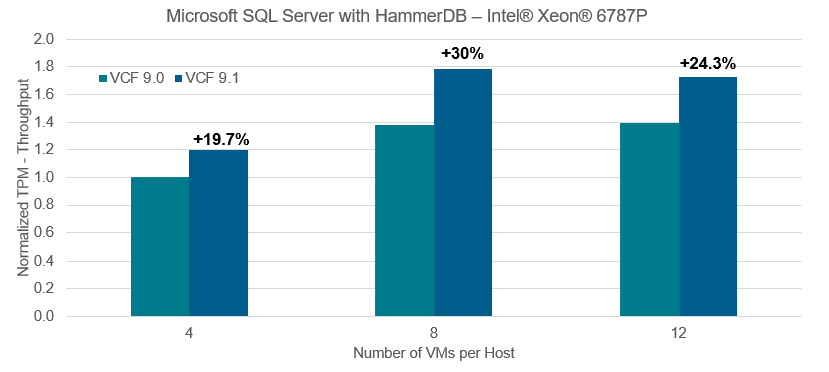
| SQL Server | Up to 30% higher throughput with HammerDB on vSAN |
| Enterprise apps | Up to 25% better DB latencies in VMmark |
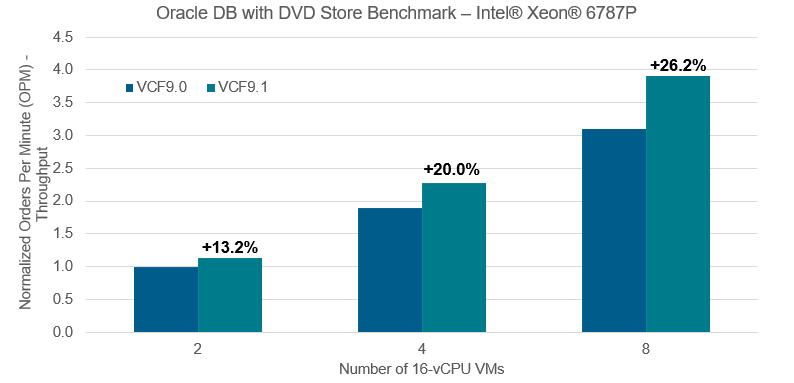
| Oracle Database | Up to 26% higher throughput in DVD Store |
| SAP HANA In Memory database | Higher VM concurrency certified on vSAN resulting in 50% lower TCO |
SQL Server on vSAN
We used HammerDB with SQL Server 2022 on Windows Server 2022 to test performance of the new scheduler enhancements in VCF 9.1 on a six-node RAID-6 vSAN ESA cluster and found improvements in throughput of up to 30%.
VMmark 4.0: Enterprise Application Performance
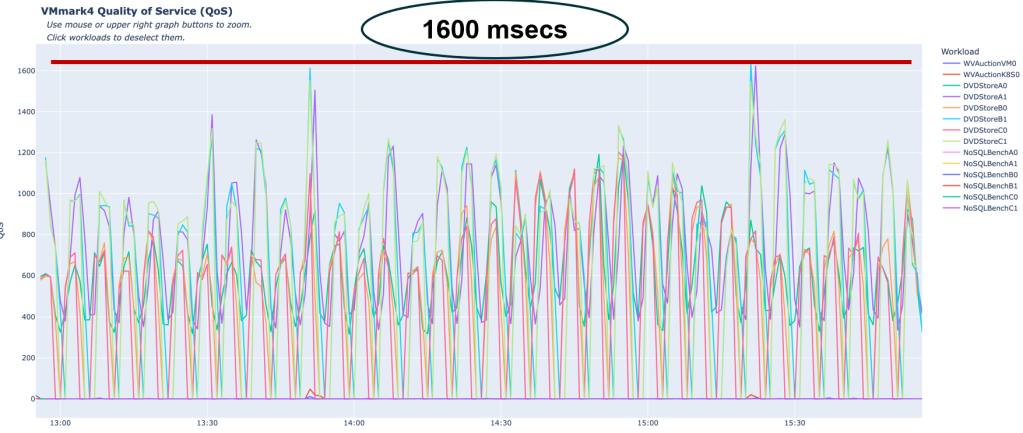
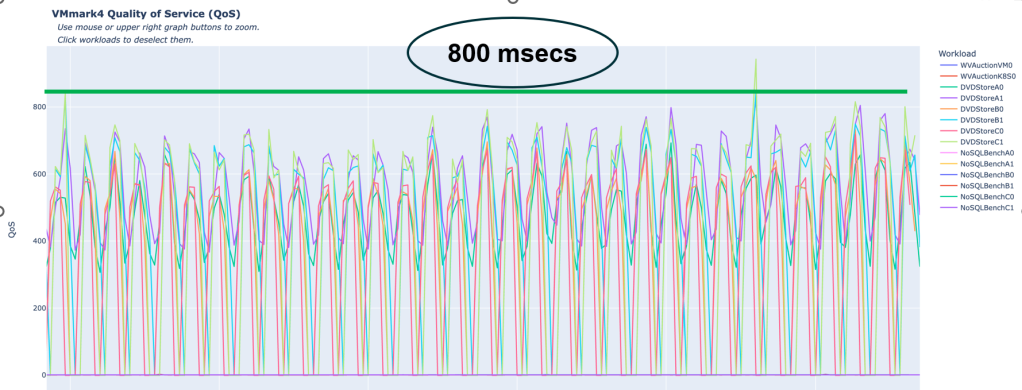
VMmark 4.0, which consists of multiple workloads representing a diverse set of enterprise applications, demonstrated excellent results with a specific improvement in response time for database queries. Average response time improved by 25%. With the new scheduler enhancements, we see max response time improved from 1600 msec in VCF 9.0 to about 800 msecs in VCF 9.1 (a 2x reduction in peak latency):
Oracle Database
Database performance is often the most demanding test for any infrastructure. We used DVD Store 3.5 with Oracle Database 21c on Oracle Enterprise Linux to show how scheduler improvements resulted in gains of up to 26%.
SAP HANA in Memory Database
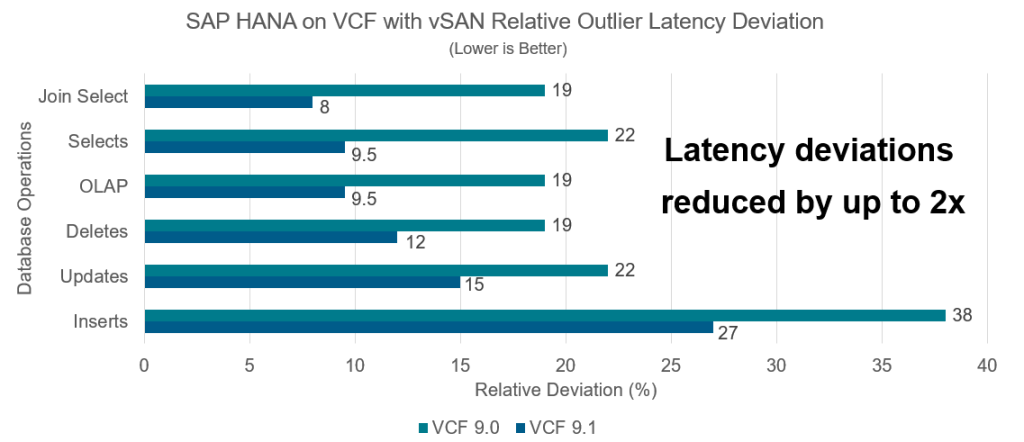
SAP HANA has performance-based certification requirements. With the VCF 9.1 scheduler enhancements SAP HANA was able to be certified with 2 VMs per CPU socket. The certified configuration is on a VCF 9.1 three-node RAID-5 vSAN ESA cluster on Intel(r) Xeon(r) 6787P (aka Granite Rapids) processors with SNC-2 enabled. This new certification with 2 VMs per CPU socket results in a 50% reduction in Total Cost of Ownership (TCO). In testing, this is measurable by looking at how different types of SAP HANA database operations improved from VCF 9.0 to VCF 9.1, as shown in this graph:
Accelerate Your Datacenter with VCF 9.1
Improvements to the VCF 9.1 CPU scheduler result in performance gains across many workloads types:
- Performance gains in SQL Server on Windows Server OS
- Performance gains in mixed enterprise workloads
- Performance gains with Oracle Database on Linux OS
- Performance gains with SAP HANA in-memory database
VMware Explore Session with the Experts
Qasim Ali and Haoqiang Zheng will be talking about this in more detail at VMware Explore 2026 session
Watch for a detailed performance white paper on CPU scheduler enhancements in VCF 9.1 soon.
Learn more:
- What’s New in VMware Cloud Foundation 9.1 blog post
- VMware Cloud Foundation product page
- Contact Sales form
Discover more from VMware Cloud Foundation (VCF) Blog
Subscribe to get the latest posts sent to your email.