
VMware Cloud Foundation & VMware Data Services Manager 9.1
For most enterprises, the database estate is one of the largest sources of avoidable cost and operational complexity. VMware Data Services Manager (DSM) 9.1 changes that equation.
Broadcom | Private Cloud Infrastructure | June 2026
If you run a modern enterprise IT environment, you almost certainly have a database silo problem. You may not call it that. You might call it “our legacy SQL Server environment,” or “the team that manages PostgreSQL for app developers,” or simply “the complexity we’ve been meaning to address.” Whatever the label, the operational and financial reality is the same: separate tools, separate workflows, separate teams, and separate cost centers — all managing databases that serve the same private cloud infrastructure.
Most IT organizations do not set out to build silos. They accumulate them. A MS SQL Server environment stands up under a Windows team with DBA expertise. An open-source PostgreSQL footprint grows as application developers spin up databases for new projects. MySQL fills gaps elsewhere. Before long, each platform carries its own management tooling, its own operational cadence, and its own set of manual processes that resist standardization.
The Cost of Fragmentation
The consequences are no longer manageable through workarounds. Infrastructure silos drive resource underutilization, duplicate licensing costs, and compounding operational overhead. More critically, they introduce security gaps that no compensating control can fully close. When your database estate spans disparate platforms with independent management consoles, enforcing a uniform security posture is an exercise in perpetual catch-up. Maintaining continuous compliance becomes a manual, error-prone process. True data sovereignty becomes practically unattainable.
You cannot secure what you cannot see, and you cannot manage what you cannot unify. Database sprawl is not a technical inconvenience; it is a measurable liability to enterprise security, financial performance, and governance.
For organizations with substantial SQL Server investments, the licensing math compounds the problem further. Microsoft SQL Server licensing represents a major portion of database total cost of ownership for most enterprises; costs that constrain infrastructure design and limit the freedom to place workloads where they can be most efficiently served.
One Platform, Three Critical Database Engines
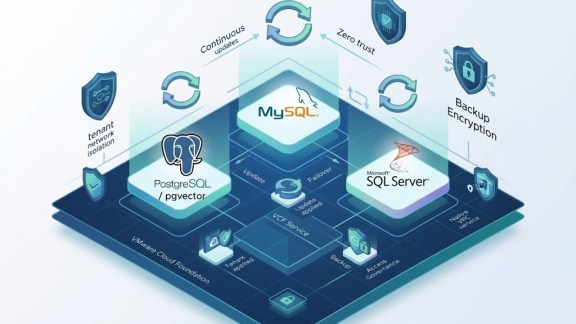
The emergence of Microsoft SQL Server General Availability in VMware Data Services Manager (DSM) 9.1 is the strategic capability that makes database consolidation on VMware Cloud Foundation genuinely achievable. DSM 9.1 delivers production-ready SQL Server 2022 management — all editions, with Windows Authentication via Active Directory, automated failover, comprehensive disaster recovery, and full lifecycle automation — as a native service within VCF.
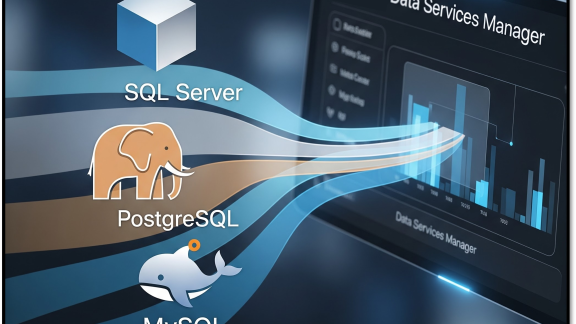
The significance is direct: organizations can now bring Microsoft SQL Server under the same automated, policy-driven control plane as PostgreSQL and MySQL. Provisioning, patching, backup, high availability, and governance are standardized across all three platforms without separate expertise or separate tooling for each. Commercial and open-source workloads share a common pool of compute and VMware vSAN storage — without sacrificing performance, and without maintaining parallel operational teams.
The operational return is substantial. Organizations achieve an average 75% productivity gain for Day 2 database operations — time that DBAs and infrastructure teams redirect from routine maintenance toward strategic work.[2] For application developers, self-service provisioning through a unified catalog means databases are available in under 15 minutes rather than weeks, delivering a 90% improvement in time-to-market for business applications.[2]
A Business Case Built on Proof Points
The financial case for consolidation is not theoretical. Broadcom’s own Global Technology Organization deployed VMware Data Services Manager to automate and standardize database operations across hundreds of clusters. By consolidating commercial and open-source workloads onto a single management plane and moving away from public cloud database silos, the team achieved more than 50% lower operational costs — translating to over $10 million in annual DBaaS savings.[3]
A major financial services company recently selected VMware vSAN and DSM to support eight of its ten most critical business applications, including trading and advisory services. By leveraging unified support for both PostgreSQL and MS SQL Server, the organization eliminated the overhead and licensing premiums of running separate, self-managed database tiers — while maintaining the auditability and control that financial services demand.
For organizations evaluating the build-versus-buy question, the TCO comparison with public cloud managed database services is equally compelling. DSM on VCF delivers the managed database experience of Azure SQL or AWS RDS at 50–60% lower total cost — with no data egress fees, no unpredictable consumption-based billing, and full data sovereignty maintained on private infrastructure.[1][2]
The Case for Action in 2026
Database consolidation has been on IT agendas for years — a perennial priority deferred because the problem felt manageable and the right platform had not existed at the required level of enterprise maturity. That qualification has changed.
VMware Data Services Manager 9.1 delivers production-ready unified management for PostgreSQL, MySQL, and Microsoft SQL Server as a native VCF service — with the enterprise-grade automation, governance, and developer experience that consolidation at scale requires. The operational complexity that sustained database silos no longer has a technical justification. The financial overhead of maintaining parallel management environments no longer has a compelling business case.
For organizations serious about maximizing private cloud value, eliminating unnecessary licensing overhead, and delivering the developer velocity their application portfolios demand: one platform, three critical database engines, and a single operational model that simplifies everything it touches.
The path forward is, quite literally, unified.
References
- Broadcom VMware Cloud Foundation Blog: The CFO’s Case for On-Premises DBaaS: Repatriation and Cost Control (January 2026) — blogs.vmware.com
- Broadcom VMware Cloud Foundation Blog: VMware Data Services Manager 9.1: Automating the Modern Databases that Drive AI and Private Cloud (May 2026) — blogs.vmware.com
- Broadcom GTO Case Study: Data Services Manager — DBaaS Savings and Cloud Repatriation — vmware.com/video | youtube.com
Discover more from VMware Cloud Foundation (VCF) Blog
Subscribe to get the latest posts sent to your email.