Author: Tony Huynh; VCF Product Management
There has been much anticipation and excitement around the VMware Cloud Foundation (VCF) 9.1 release, especially from our Dell VxRail customers. The VCF 9.1 release has been architected to provide a consistent deployment model, and unified operations and management for our customers, while maintaining a consistent operational experience. For VxRail customers, this continues to be delivered through a Dell-engineered and Dell-supported system. Unlike previous VCF releases, new platform capabilities are developed to be available and work consistently across all hardware platforms, including VxRail.
While VCF 9.1 introduces broader platform-level flexibility, VCF on VxRail remains a Dell-exclusive solution. All supported configurations within a VCF on VxRail instance must align with Dell-validated hardware and support boundaries.
Upgrade Path for Existing VxRail Customers
Dell and VMware have collaborated to co-develop an upgrade path to VCF 9.1 for existing VxRail customers. Customers should follow the established VxRail upgrade process used in prior releases to complete this upgrade process. Prior to initiating the upgrade, the existing VMware software on the VxRail environment must be running on version 5.2.2 or greater, and the version of VxRail must be 8.0.361 or higher.
Importantly, this is an “in-place” upgrade, – which means that it does not require customers to repave (wipe and reimage) the hosts on their VxRail appliances.
Please note that customers with Stretch Clusters, Dynamic Nodes, 2-node, or Satellite Node deployments will need to wait for a subsequent release following VCF 9.1 to access a supported upgrade path.
The Challenge of Homogeneity
The modern data center demands flexibility and efficiency. As organizations scale their infrastructure and adapt to evolving business needs, the ability to integrate diverse hardware while maintaining a unified, operationally simple cloud platform becomes paramount.
Historically, VCF deployments were predicated on homogeneity—either exclusively VxRail or exclusively vSAN Ready Nodes. While this provided a clean, standardized approach, it often posed challenges for customers who had already invested in different hardware platforms or who needed to scale using a different hardware model. Scaling a VCF deployment meant being locked into the original hardware choice, potentially delaying expansion.
With the release of VCF 9.1, we are excited to announce a new enhancement that addresses this very need: the capability to deploy mixed hardware. This feature allows customers to combine VxRail and Dell vSAN Ready Node hardware within the same VCF deployment – within defined Dell support guardrails(1), marking a new era of infrastructure deployment versatility.
The VCF 9.1 Solution: Mixed Hardware Support
VCF 9.1 shatters this limitation. Now, when deploying a new workload domain, you have the power to choose between VxRail or Dell vSAN Ready Node Clusters as your hardware of choice:
- VxRail Clusters: Leverage the integrated lifecycle management (LCM) and turnkey experience of Dell Technologies VxRail hyperconverged infrastructure.
- Dell vSAN Ready Node Clusters: Utilize certified hardware, offering flexibility in component selection and procurement.
Some restrictions for VCF mixed hardware instance:
- Within a Workload Domain, the hardware must remain homogeneous – either all VxRail or all Dell vSAN Ready Node
- Dell vSAN Ready Nodes continues to operate under the established Dell solution support model in a VCF mixed instance model.
- Third-party vSAN Ready Nodes are not supported in VCF on VxRail instances.
- VCF Management Domain restriction – when VxRails are present in the VCF instance, the management domain must remain VxRail only.
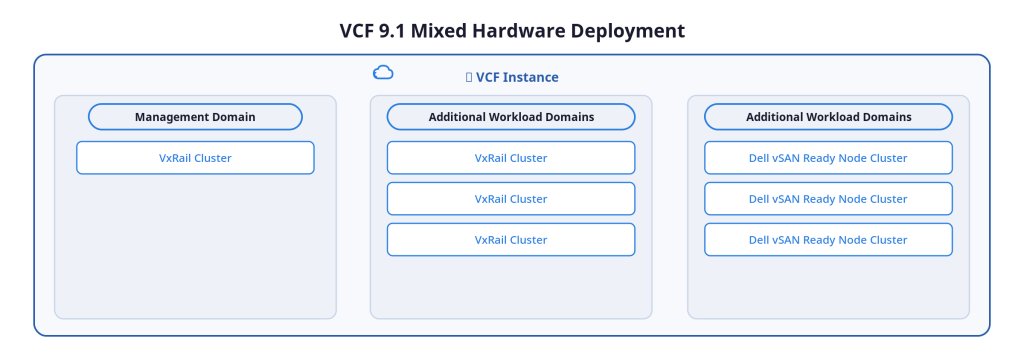
Figure 1: VCF 9.1 Mixed Hardware Deployment Model
Demo: Deploying a New Workload Domain
The following video demonstrates the ability to deploy a new workload domain built with vSAN Ready Nodes inside an existing VCF on VxRail instance that has been upgraded to VCF 9.1.
How It Works
VCF 9.1 manages this heterogeneity by standardizing the control plane and leveraging the underlying capabilities of vSphere, vSAN and NSX. VCF Operations and SDDC Manager orchestrates the deployment and integration, ensuring that all components—compute, storage, and networking—are properly configured and validated to operate together.
While VCF maintains a unified operational view, it intelligently recognizes the differences in lifecycle management for each cluster type. VxRail LCM remains integrated for VxRail clusters, ensuring the unique benefits of the VxRail experience are preserved, while vSAN Ready Node clusters utilize the standard VCF LCM process.
Summary
The ability to support a mixed hardware environment in VMware Cloud Foundation 9.1 is a game-changer for infrastructure teams. It eliminates the deployment rigidity of the past and delivers unprecedented flexibility, making VCF a truly adaptable platform for any enterprise cloud strategy. This new capability empowers IT organizations to upgrade to VCF 9.1 today and start leveraging the operational simplicity and infrastructure flexibility of mixed hardware workload domains to accelerate your digital transformation journey.
This flexibility is delivered within clearly defined Dell guardrails, ensuring consistency, supportability, and preservation of the VxRail experience.
1 – The defined guardrails represent supported configurations. Requests for configurations outside the documented guardrails will require formal review and approval prior to consideration.
Discover more from VMware Cloud Foundation (VCF) Blog
Subscribe to get the latest posts sent to your email.