
AI workloads are reshaping infrastructure economics. Due to recent demand spikes, rising CPU and memory costs have driven up overall server prices. These inflated costs mean IT leaders can no longer solve performance issues or capacity constraints by simply scaling out their hardware footprint. Instead, successful organizations will adopt software-defined strategies to extract maximum value from existing resources. To drive maximum efficiency, IT staff who can optimize infrastructure deployment and Day 2 operations through APIs will find themselves vital to running cost-effective IT teams.
With the release of VMware Cloud Foundation (VCF) 9.1, Broadcom enables organizations to efficiently manage large-scale private cloud environments. VCF Operations will help mitigate enterprise risk by streamlining security hardening with simpler patching workflows. By providing health and diagnostic findings with centralized visibility into both VMware Security Advisories (VMSAs) and Common Vulnerabilities and Exposures (CVEs), VCF 9.1 will ensure rapid vulnerability remediation, simplify lifecycle management, and empower IT teams to proactively strengthen their overall security posture.
VCF Operations will provide dashboards with advanced capacity insights and specific recommendations for NVMe memory tiering to optimize performance. Additionally, it will offer comprehensive cost showback for the VMware vSphere Kubernetes Service (VKS) and will feature proactive fleet management to keep your operations running smoothly. VCF will provide a unified view that will transform reactive infrastructure management into a highly optimized, cost-efficient advantage.
VCF Operations delivers business value—transforming infrastructure management from a reactive burden into a strategic advantage for building, managing, operating, and protecting private cloud infrastructure. Day 2 operation processes will be improved from patching, upgrading, determining infrastructure costs, troubleshooting, and more.
By leveraging unified fleet management for control at scale, simplified Day 2 operations to observe and diagnose issues in real-time, and an enhanced security posture for continuous compliance, organizations will transform their infrastructure from a cost center into a resilient, high-performance engine. The improved security posture will require the VMware Advanced Cyber Compliance add-on.
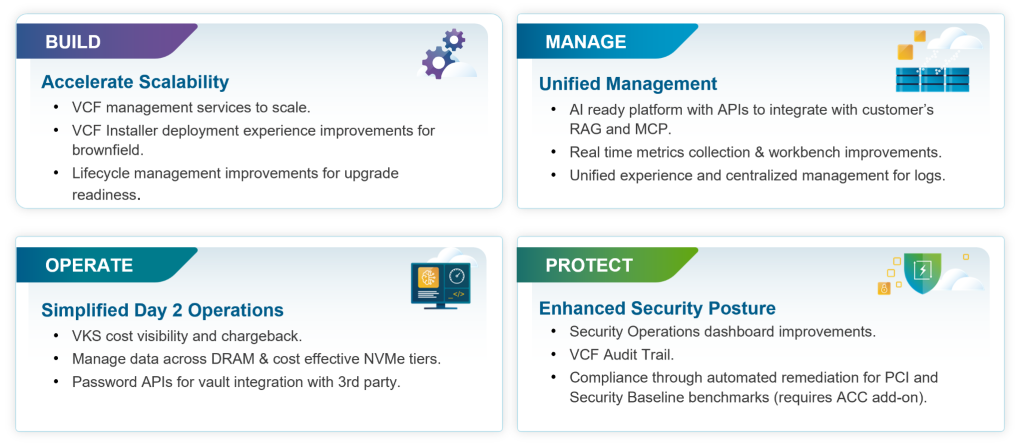
Figure 1. What’s New in VCF 9.1 for VCF Operations. VCF Operations provides efficient infrastructure & operations at scale.
Customer Story
Organizations will see the benefits of VCF’s proactive operations approach. At the Japan Racing Association, the new infrastructure underpins several mission-critical systems. Administrators use VCF Operations to gain full visibility into usage trends and performance forecasts, enabling them to identify and resolve potential infrastructure issues before they impact mission-critical race day operations. Read the Japan Racing Association case study here.
Customer Survey Data
A Broadcom survey of VCF 9 customers (n=44) in March 2026 shows that modernizing their private cloud is about reclaiming their team’s most valuable asset: time. The survey data reveals that customers can achieve an average of these benefits:
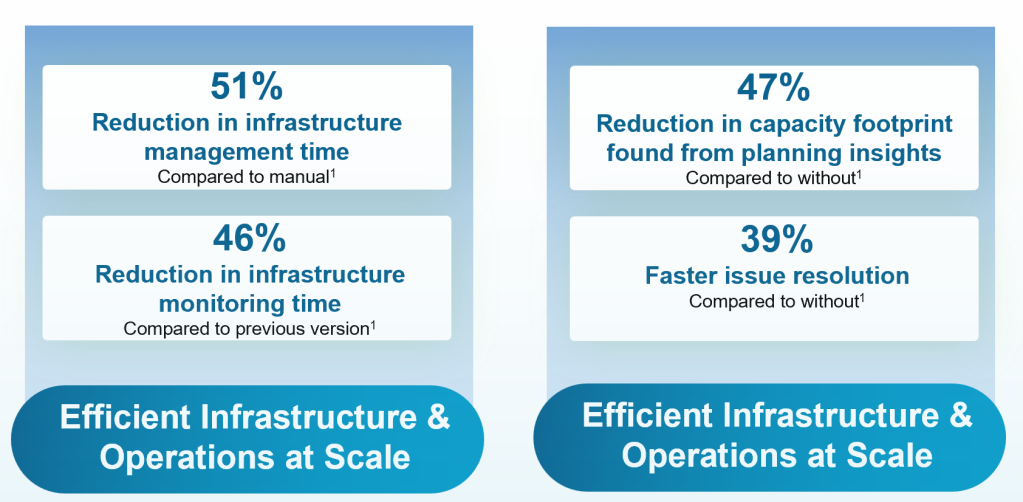
Figure 2. Average benefits found from a Broadcom survey of VCF 9 customers (n=44) in March 2026.
The survey found that customers realized an average 51% reduction in infrastructure management time using VCF 9, which can allow teams to pivot from manual maintenance to efficient operations. By unifying metrics, logs, and flows into a single converged console, the platform reduces average monitoring time by 46%. Additionally, advanced visibility enables a 47% average reduction in required capacity compared to previous capacity projections. Even when issues arise, VCF 9 accelerates resolution by 39% mean time to repair or mean time to innocence (MTTR/MTTI) through integrated diagnostic dashboards and root-cause analysis capabilities.
Build And Scale Faster
Using the VCF Installer, customers will be able to converge an existing vCenter/ESX vSphere 8.0 Update 3 and above environment to a VCF management domain. Using VCF Operations, customers will be able to import VMware vCenter 8.0 Update 3a (and above) or VMware ESX 8.0 Update 3 (and above) environments to a VCF workload (VI) domain. Both approaches will allow customers to leverage existing infrastructure and will not require downtime or a migration of applications or data.
Using VCF Operations, organizations running vSphere 8.0 Update 3 or higher will easily integrate their existing vCenter as a workload domain in VCF 9.1, maintaining business continuity while gaining enterprise management capabilities. The VCF environment will be running VCF 9.1, but VCF Operations will be able to manage a customer’s older vSphere 8.0 Update 3 or higher environment for lifecycle management to keep their business applications running uninterrupted.
Expanded management scale will allow a single instance to support up to 5,000 ESXi hosts, which will be up 2X from the previous release.
VCF 9.1 will now offer a 4x increase in parallel upgrade capacity, supporting up to 256 clusters simultaneously. This enhancement will significantly reduce downtime and will allow operators to complete maintenance tasks much faster within their scheduled windows.
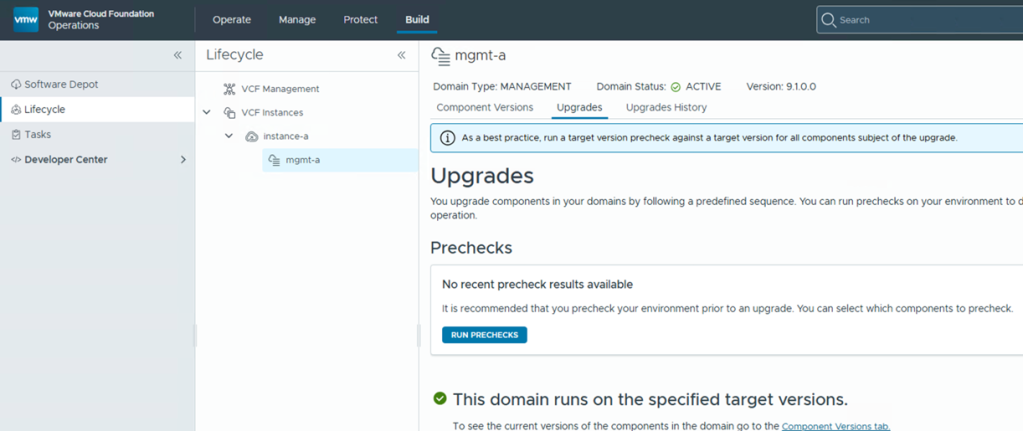
Figure 3. VCF Operations will make it easier to upgrade and patch the private cloud infrastructure.
VCF Operations will consolidate the patching and upgrading of all components into a single, unified UI for lifecycle management. From this centralized dashboard, you will be able to seamlessly plan fixes for critical CVEs, plan, and execute updates across both global VCF fleet components and workload domains. VCF operations will provide update plans that outline the number of steps and the precise sequence required, taking the guesswork out of maintenance windows. Best of all, because VCF fully integrates the latest vSphere and ESX patching innovations, you will be able to orchestrate these comprehensive workflows with total confidence that your live workloads will experience minimal to zero operational disruption.
In VCF 9.1, VCF Operations health and diagnostics will introduce public APIs that will allow you to customize data from findings. This will enable you to seamlessly integrate real-time diagnostic insights directly into your existing processes, such as ticketing systems and risk management platforms.
This release introduces VCF management services, a centralized set of infrastructure components hosted on a dedicated services runtime. This will provide a unified lifecycle, identity, and operational management for VCF. Each VCF instance will include management services such as lifecycle management, software depot, log management, and real-time data. Rather than running as separate appliances, these services will be distributed on a shared runtime. The VCF services runtime serves as the shared architectural foundation and common environment for both management services and VCF Automation deployments.
VCF 9.1 will introduce a unified software depot service that will utilize OAuth tokens to securely manage updates for both online and disconnected environments.
Manage Your Fleet At Scale
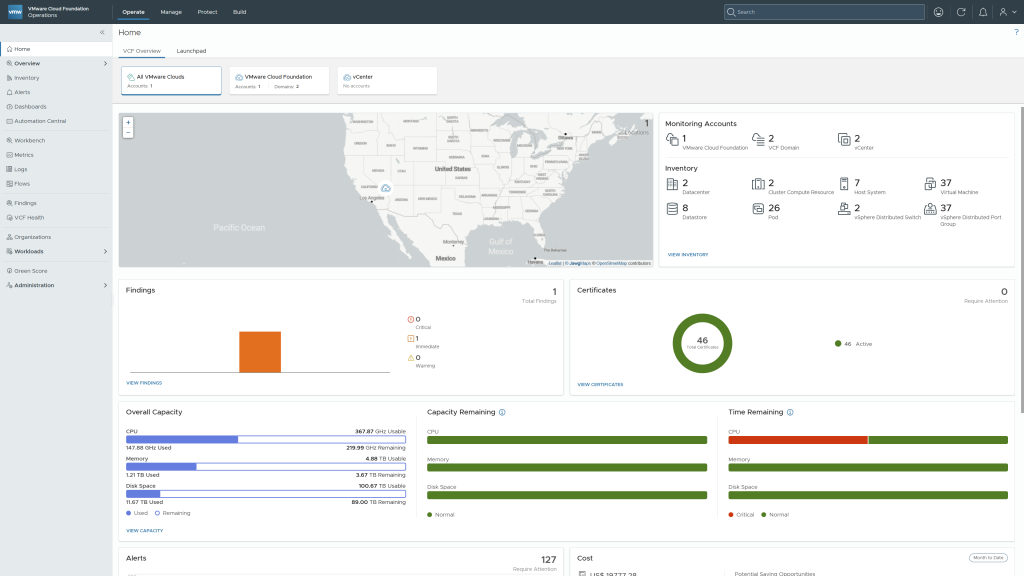
Figure 4. The VCF Operations dashboard in VCF 9.1 provides a global view.
VCF 9.1 will introduce several key enhancements to streamline adoption. Managing distributed infrastructure will not multiply your workload. VCF 9.1 will centralize control across your entire private cloud fleet, turning what was once dozens of separate tasks into unified operations.
For VCF 9.1 licensing, if a customer is in connected mode, there will be no more manual clicks required. In connected mode deployments, VCF 9.0 administrators previously had to manually acknowledge refreshed license files every 180 days or less. VCF 9.1 will implement automated license file downloads every 24 hours in connected mode. Once connected mode is selected, automation becomes the default behavior. License usage data transmits to Broadcom, and an updated license file is downloaded and applied automatically—with no administrator intervention required.
Streamlined Identity and Access Management will bring VCF-level role assignments with integrated SSO and Identity Provider configurations. No more juggling disparate authentication systems—you will manage access to your entire fleet from a single point of control.
Lifecycle and configuration management will give you fleet-wide policy enforcement with granular visibility into configuration changes and drift across VCF instances, vCenter, and individual clusters. To ensure your environment is fully prepared for an upgrade, you will see pre-checks to improve upgrades. VCF will run pre-checks to identify any issues that could cause an upgrade to fail. These comprehensive checks evaluate overall system health, verify adequate resource capacity, and other checks.
For VxRail environments, key Day 0, 1, and 2 capabilities previously handled by Dell VxRail Manager can be managed using VCF Operations on vSAN ReadyNodes.
Bulk operations will eliminate repetitive manual work. You will execute certificate operations, imports, renewals—across all VCF components simultaneously. What used to take hours will now take minutes.
Password vault integration will provide policy-based password management through standard public APIs, as well as a new CyberArk Vault password integration, ensuring that your password policy will be consistent with your other non-VCF infrastructure password policy if you will be using an external password vault. This will make all the steps for customers such as password rotations and maintenance easier for their VCF environment.
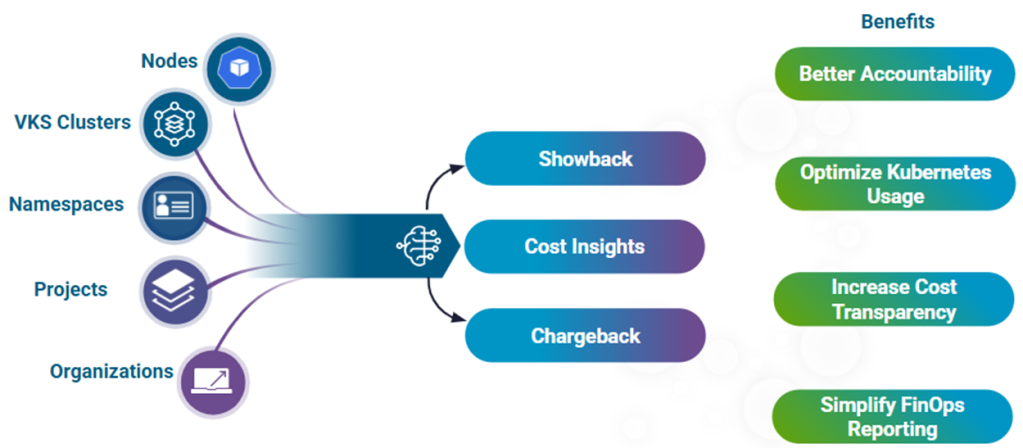
Figure 5. VCF 9.1 will provide VMware vSphere Kubernetes Service (VKS) cost details, which will improve analysis, billing, showback, and chargeback capabilities for modern workloads.
Intelligent capacity and cost optimization will deliver actionable insights. Memory tiering recommendations for NVMe clusters will quantify cost savings and VM density improvements. This release will also introduce What-If Analysis support for NVMe memory tiering. Enhanced VKS cost management will provide showback, chargeback, and real-time pricing estimates—giving you the financial visibility modern IT will demand. VCF follows the FinOps Open Cost and Usage Specification (FOCUS) operational framework for private cloud, which provides a standardized format for billing data, enabling improved cost allocation and faster analysis.
Simplify Day 2 Operations
Deep observability will be a foundation of reliable operations. VCF 9.1 will equip IT teams with the real-time visibility and AI-ready integrations needed to troubleshoot faster and keep mission-critical applications running.
Real-time observability will now collect metrics in seconds, with configurable collection down to as short as 2 seconds for ESX hosts. For critical workloads, you will have the timely data you will need to proactively run business applications better.
Centralized log management will unify log aggregation with enhanced dashboards and seamless forwarding to third-party solutions. The logs interface will now be completely integrated into VCF Operations. You will stop searching for issues across interfaces; instead, you’ll see everything in one place across the VCF components.
Proactive diagnostics will help predict problems instead of reacting to outages. VCF 9.1 will allow you to leverage improvements to VCF health dashboards and advanced vSAN diagnostics to surface potential performance issues. Diagnostics will highlight key issues for vCenter, ESX hosts, vSAN, and VCF Networking for NSX Manager and Edge nodes for issues such as connectivity, service health, resource usage, and more.
The Management Pack Builder will allow you to create third-party integrations with no code as needed to increase your visibility of the infrastructure. VCF 9.1 will also have direct integration with the Prometheus Server Management Pack to increase the metrics and data you will be able to utilize for visibility.
In VCF 9.1, VCF Operations is an AI-ready platform with APIs to integrate with a customer’s Retrieval-Augmented Generation (RAG) pipelines and Model Context Protocol (MCP) frameworks. This will allow customers to export infrastructure data lake insights to other AI destinations, such as LLMs or AIOps engines for predictive analysis. Out-of-the-box monitoring and log management for VMware vSphere Kubernetes Service (VKS) clusters will help ensure your modern Kubernetes workloads receive the same operational visibility as existing VMs.
Secure Operations
Security posture management will run comprehensive compliance assessments across your VCF fleet with easy remediation to align infrastructure to desired benchmarks. Compliance will be supported for the Payment Card Industry (PCI) and Security Baseline benchmarks. Security Posture Management will require the VMware Advanced Cyber Compliance add-on Advanced Service.
Distributed workloads and expanding AI initiatives will create an expanding attack surface. VCF 9.1 will bring the VMware Advanced Cyber Compliance add-on Advanced Service to the VCF Operations user interface. With the add-on you will get automated compliance tracking directly into your operational workflows.
VCF will provide audit trails to accelerate incident investigations using standardized log architectures and centralized historical findings. When security events will occur, you will have the forensic data to understand what happened and why. You will be able to look at the audit record to expand details by time intervals, then also export the information as a CSV file.
There will also be an enhanced SecOps dashboard which will provide views of security issues such as advisories, status of encryption such as workloads that will not be encrypted, or if capabilities such as confidential computing will have been enabled on eligible hosts.
From Reactive Tasks to Proactive Operations
VCF 9.1 goes beyond incremental upgrades. Broadcom, through VCF 9.1, will deliver consolidated management, deep observability, and easy compliance remediation — so your IT team spends less time on maintenance and more time on what matters.
See what VCF 9.1 can do for your infrastructure by reading the VCF 9.1 product announcement. You can also register for our webinar, “Modern Infrastructure: Streamlining Operations with VCF,” to see VCF Operations in action. Join us on Wednesday, May 27, 2026, at 10:00 – 11:00 AM PT.
Learn more:
Broadcom Announces VMware Cloud Foundation 9.1
Customer Story: Japan Racing Association
VMware Cloud Foundation: Launch Page VCF 9.1, Webpage
VCF Operations: Webpage, Datasheet, Solution Brief, Infographic
Documentation VCF 9.1: Release Notes, Build, Licensing, Lifecycle, Fleet Management, Infrastructure Operations, Observability, Cost and Capacity, Security and Compliance
Blog: VCF 9.1 Licensing: Programmatic, Centralized, and Built to Scale
Blog: Securing Your VCF 9.1 Infrastructure with the Symantec Identity Security Platform
VCF 9.1 Administration, SDKs, and CLI Guide with Technical implementation docs for building your development environment.
Discover more from VMware Cloud Foundation (VCF) Blog
Subscribe to get the latest posts sent to your email.