
At a Glance:
- 500 Clusters per Control Plane: Single Supervisor scale increases from 190 to 500 clusters, eliminating fragmented management planes.
- 70% Faster Provisioning: Fast Deploy leverages per-datastore caching and linked-mode delta disks to cut cluster provisioning from 37 to 11 minutes and upgrade times by 75%.
- Multi-NIC and Cilium Support: Isolate data and control planes, enable native multicast for streaming/finance feeds, and run Cilium via a managed CNI Addon Framework.
- Unified VM and Container Primitives: Manage boot-sequenced VM groups, Day-2 network mutability, and lightweight vSphere Pods directly on ESXi without full cluster overhead.
- Turnkey GitOps: Native supervisor integration with Argo CD and Harbor lets you declare both infrastructure and apps via Git.
- Free Lab Access: Test the core capabilities with the HOL-2704-07 lab.
If you are a Platform Engineer or SRE, you already know the pain of “Day 2” Kubernetes operations. What often starts as an initiative to speed up innovation quickly degrades into managing infrastructure silos, wrestling with fragmented toolchains, and bridging widening skill gaps. Scaling enterprise-grade clusters reliably while keeping developers happy is no small feat.
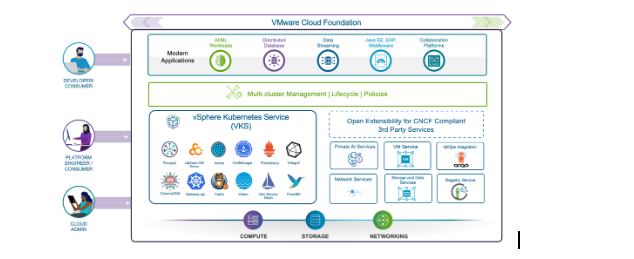
Enter VMware vSphere Kubernetes Service (VKS). With recent releases, the focus has shifted heavily toward developer autonomy, massive scalability, and eliminating operational toil.
To help practitioners get under the hood of these new capabilities, VMware has released a comprehensive Hands-on Lab HOL-2704-07 | Hands-on with Kubernetes: Deep Dive With the vSphere Kubernetes Service 3.6. Below is a breakdown of the architectural shifts that matter most to SREs, a look at the latest VKS 3.8 release, and how you can test the platform firsthand.
Architectural Highlights for Platform Engineers
1. Unprecedented Scale and “Fast Deploy” Speed
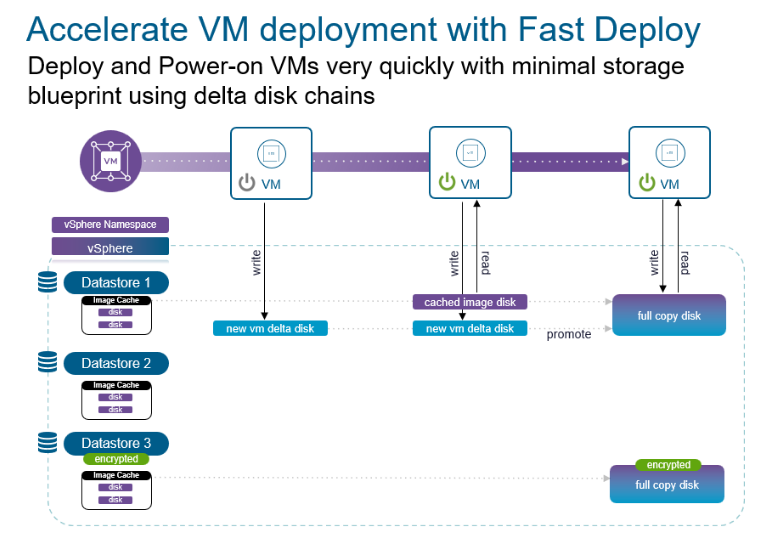
Managing cluster sprawl just got significantly easier. You can now scale up to 500 VKS clusters per supervisor control plane—a massive leap from the 190 limit in previous versions. Furthermore, VKS ships with upstream-aligned Kubernetes and 24 months of enterprise support, providing stability and reducing mandatory upgrade churn.
For SREs managing dynamic capacity or sudden traffic spikes, Fast Deploy is the real star. By combining per-datastore image caching and delta-disk technology (Linked Mode), cluster provisioning time drops by 70% (from 37 minutes down to 11 minutes), and cluster upgrade time is cut by 75%.
2. Extensible Networking and CNI Freedom
Historically, routing all cluster management, API traffic, and data planes through a single interface created critical performance bottlenecks. VKS introduces a multi-network architecture supporting multiple vNICs per worker node and pod:
- Native Multicast Support: Run real-time streaming and financial feeds directly inside VKS.
- Control/Data Plane Isolation: Decouple high-throughput application data planes from the Kubernetes control plane to eliminate noisy-neighbor issues.
- Direct Hardware Access: Use SR-IOV for low-latency, line-rate throughput without hypervisor software encapsulation.
On top of this, the CNI Addon Framework ends CNI lock-in. While Antrea and Calico remain supported out of the box, you can now deploy a managed Cilium add-on package during cluster provisioning without breaking VKS lifecycle boundaries.
3. Workload Flexibility: VMs and Containers Under One API
The platform unifies VMs, Kubernetes clusters, and raw containers under a single declarative framework:
- Day-2 Network Mutability: Modify, add, or delete VM network interfaces after deployment through the UI or API without rebuilding the workload (requiring only a simple reboot).
- VM Service Groups: Group sets of VMs together for orchestrated bulk actions, including staged power-on “waves” with configurable boot delays (e.g., ensuring a database tier initializes before web frontends).
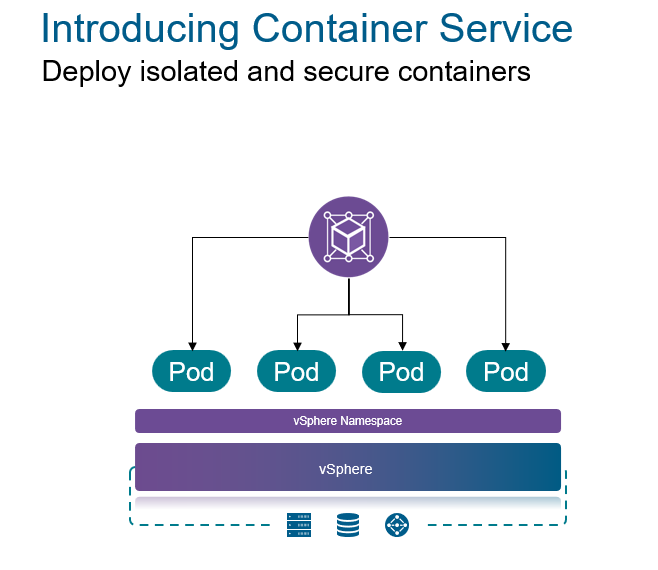
- vSphere Pod Container Service: For lightweight or legacy workloads that don’t justify a full Kubernetes cluster overhead, run isolated containers directly on ESXi nodes using vSphere Pods. They execute in a lightweight VM boundary (CRX) for hardware-level isolation, bypassing the guest OS layer entirely.
4. Native GitOps with Argo CD and Harbor
Declarative infrastructure is standard practice for modern platform engineering. Argo CD, Harbor, and GitLab integrate as Supervisor services. You can manage both cluster lifecycle manifests and application overlays directly from a Git repository, letting Argo CD reconcile desired infrastructure and workload states automatically.
What You Learn in the Hands-on Lab (HOL-2704-07-VCF-L)
The lab provides a preconfigured sandbox that walks through the core platform features over five distinct modules:
| Module | Title | Focus & Tasks |
| Module 1 (30 min) | What’s New in VKS & Supervisor Service | Architectural overview of the latest platform improvements and runtime updates. |
| Module 2 (45 min) | VKS Cluster Creation & New Features | Deploy a VKS cluster via VMware Cloud Foundation (VCF) Automation, configure node overrides, and attach secondary networks. |
| Module 3 (45 min) | VM Service New Features & Operations | Test Fast Deploy, configure VM groups with boot waves, perform self-service snapshots, and test Day-2 network mutability. |
| Module 4 (15 min) | Introduction to Container Service | Set namespace resource limits and spin up isolated vSphere Pods directly on ESXi. |
| Module 5 (15 min) | Continuous Delivery with Argo CD | Configure Harbor registry certificates, register destination clusters, and use Argo CD to reconcile application and infrastructure manifests from GitLab. |
Flexible, Self-Paced Access: You can start this lab at any point and complete the modules in any order; the modules are not dependent on one another. You can also exit and come back to the lab as often as you like.
By significantly reducing the Day-2 operational burden, VKS allows platform teams to step away from routine maintenance and focus on accelerating business outcomes.
Beyond the Lab: What’s New in VKS 3.8
While the Hands-on Lab gives you a robust sandbox for VKS 3.6, VMware has already released VKS 3.8 to further accelerate AI workloads and tighten security baselines. As detailed in the recent VKS 3.8 announcement, this latest release introduces several major capabilities:
- Automated Chained Upgrades: VKS 3.8 eliminates multi-hop upgrade scripting by orchestrating multi-version vSphere Kubernetes release upgrades automatically with built-in dependency checks. The system cordons and drains pods from worker nodes just once during the entire process, drastically reducing maintenance windows.
- Platform Hardening and Security Guardrails: SSH access is programmatically disabled across all Kubernetes control plane and worker nodes to elevate the security baseline. Additionally, an Advanced Intrusion Detection Environment (AIDE) periodically performs integrity checks across critical system directories to detect tampering.
- Granular Workload Placement: Platform teams can programmatically pin workloads to specific resources based on infrastructure policy. This allows you to explicitly exclude high-cost hardware (like dedicated GPUs) from control plane node scheduling or assign distinct node pools to specific sites for active-active stretched clusters.
- Centralized Credential Governance: The External Secrets Operator (ESO) add-on now dynamically synchronizes credentials from enterprise vaults like HashiCorp Vault, AWS Secrets Manager, Azure Key Vault, and GCP Secret Manager. This simplifies compliance audits and eliminates plain-text secrets in Git repositories and YAML manifests.
- Native CI/CD Pipelines: VKS 3.8 introduces Tekton for in-cluster continuous integration (CI) pipelines to automate code builds and testing without exposing clusters to external networks. These pipelines sync natively with Argo CD for continuous global fleet delivery.
- Kubernetes 1.37 Support: Decoupling its release cadence from core platform upgrades, VKS 3.8 supports Kubernetes 1.37 within 60 days of upstream releases, backed by Broadcom’s 24 months of extended support.
Ready to get hands-on?
- Test the core capabilities: Launch the free HOL-2704-07 | Hands-on with Kubernetes: Deep Dive With the vSphere Kubernetes Service 3.6 lab.
- First time user? Follow this Create an HOL Account Guide to get registered.
- Explore more: Browse the full catalog of 90+ labs at labs.hol.vmware.com.
Discover more from VMware Cloud Foundation (VCF) Blog
Subscribe to get the latest posts sent to your email.