
Keeping Databases Current, Resilient, and Secure
When we shipped VMware Data Services Manager 9.1 earlier this year, our headline was the native integration for Microsoft SQL Server data services. We also announced expanded support for open source PostgreSQL/pgvector and MySQL. All are production-ready to manage data services on VMware Cloud Foundation (VCF). That release answered the question of what you could run. With VMware Data Services Manager 9.1.1, available now, we are answering a different and equally important question: how do you keep those databases current, resilient, and secure as your environment grows?
This is not a patch release. It is a release built around the everyday realities of operating a database platform. Every feature in 9.1.1 targets a job that database and infrastructure teams already do, often by hand, and often under pressure: keeping database engines up to date, keeping services running when something fails, and keeping data protected and compliant. The goal is to take the toil out of those jobs so your teams can spend their time on work that matters.
If you’re interested in a deep-dive into each new feature and how to implement it, definitely check out the VMware Data Services Manager 9.1.1 Release Notes on Broadcom TechDocs. However, my focus here is the question most of you are really asking: what changed, and why does it matter to you and your stakeholders?
Keeping databases current, without the struggle
Start with the part of database management everyone dreads: upgrades and backups. In most environments, these are manual, high-stakes operations. Someone has to schedule downtime, run the upgrade, hope nothing breaks, and roll it back by hand if it does. Backups are similar. They get done, but they eat time and carry risk, and as a result they often get delayed. Delayed upgrades mean running on old versions with known security vulnerabilities. Delayed backups mean longer recovery windows when something goes wrong.
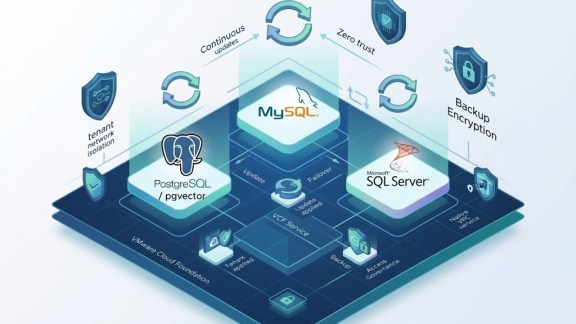
VMware Data Services Manager 9.1.1 brings next-generation lifecycle automation across all three database engines. You get PostgreSQL 18 support, automated major and minor upgrades for MySQL, SQL Server 2025 with cumulative update support, and API-driven, on-demand backups. Keeping your databases on current, secure versions stops being a project and becomes a routine. Your teams spend less time on maintenance windows and recovery drills, and you close the gap on version obsolescence and the security exposure that comes with it.
For the people who sign off on compliance and security posture, current database versions applied with minimal downtime, backed by on-demand backups, reduce the risk that sits in every audit conversation.
Databases: resilience throughout the lifecycle
The next change is about where database management actually happens. In 9.1.1, Data Services Manager is a native VCF Service. That means its lifecycle, upgrades, rollbacks, and recovery are managed as part of VMware Cloud Foundation itself, not as a separate tool bolted on the side.
This is the shift from DSM being something you integrate to something that simply belongs. You can initiate deployment, configuration, and ongoing management from within the VCF experience your infrastructure teams already know, rather than context-switching between separate consoles. Under the hood, 9.1.1 also adds support for VMware vSphere Kubernetes Service (VKS) 3.7 and multi-cluster Kubernetes, which abstracts away the Kubernetes complexity that has historically kept database teams away from modern data services.
The benefit for infrastructure leaders is straightforward. Database operations become part of the same operational model as the rest of your VCF environment. Your teams do not need to become Kubernetes experts to run modern databases. And because upgrades and recovery are built into the service, scaling your database footprint no longer means scaling your operational overhead at the same rate.
Availability gets a real upgrade in 9.1.1. Database services now get Supervisor cross-cluster high availability, so a failure in one host cluster does not take your databases down with it. Data Services Manager 9.1.1 also introduces global metrics target integration, which brings database and host health metrics together into a single, centralized view of your entire fleet.
If you have ever been in a war room trying to figure out whether a slowdown is a database problem or an infrastructure problem, you know why this matters. Today, those answers live in separate tools, and correlating them takes time you do not have during an incident. With unified observability, root-cause analysis gets faster because the database and infrastructure signals are already connected. And with cross-cluster resiliency, your databases stay available even when individual clusters do not.
For application owners and the business stakeholders they report to, the value is continuity. Fewer outages, faster diagnosis when something does happen, and a clearer picture of fleet health that does not require stitching reports together by hand.
Security and identity, built in
Then there is the concern that keeps security and compliance teams up at night. Data Services Manager 9.1.1 strengthens multi-tenant security and identity governance with key capabilities: tenant network isolation, automated Active Directory account management for SQL Server, and native SQL Server backup encryption. You can activate SQL Server native backup encryption for all databases on a SQL Server cluster through the Data Services Manager API. Additionally, the API allows importing certificates to manually enable TDE for individual databases via T-SQL where needed.
Each one replaces something that was previously manual: Tenant isolation enforces zero-trust separation between the groups sharing your infrastructure, so one tenant cannot reach another’s data. Automated Active Directory management takes the tedium out of identity governance for SQL Server, which is essential for organizations with Windows-based infrastructure. And direct TDE configuration simplifies encryption of data at rest, a requirement in nearly every regulated industry.
For CISOs and compliance officers, this is the difference between a platform that can be secured and one that is secured by construction. The controls are there, they are consistent, and they do not depend on someone remembering to configure them correctly on every database. Combined with the FIPS 140-2 certification DSM already holds, 9.1.1 gives regulated organizations in government, healthcare, and financial services a stronger, simpler path to compliance.
Why this release matters
Data Services Manager 9.1.1 is about lowering the ongoing cost of running a database platform that already delivers real results. The foundation has not changed. DSM still gives you unified lifecycle management across PostgreSQL, MySQL, and SQL Server. It still runs as a VCF Advanced Service, purpose-built for the platform rather than bolted on. The outcomes that motivated the 9.1 launch are all here too: faster time to market for application teams, operational efficiency for database teams, and meaningful cost savings compared to public cloud database services, all with the control and data sovereignty that private infrastructure provides.
What 9.1.1 adds is the difference between standing up a powerful platform and keeping it running smoothly as it grows. Current database versions applied with minimal downtime. Lifecycle management native to VCF. Resiliency that spans clusters. Security and identity that are there from the start. None of these are flashy features. They are the unglamorous, high-value work that determines whether a database platform earns its keep over the long haul.
If you have been running DSM, this release makes the platform you already trust easier to operate and more resilient by design. If you have been waiting for the right moment to evaluate Database-as-a-Service on your VCF environment, the platform was already proven. Now it is more complete.
Where to go next
If you want the full technical picture, start with the release notes, which walk through the 9.1.1 features in detail. From there, the product web page will help you plan an evaluation in your own environment.
The three databases that power most enterprise applications are production-ready on VMware Cloud Foundation. With 9.1.1, they are easier to keep current, keep running, and keep secure.
Learn more:
About the author:
Sue Ulintz is a Product Marketing Manager for VMware Data Services Manager at Broadcom, focused on helping customers understand the business value of database modernization on VMware Cloud Foundation.
Discover more from VMware Cloud Foundation (VCF) Blog
Subscribe to get the latest posts sent to your email.