
We are excited to announce new operations capabilities with the release of VMware Cloud Foundation (VCF) 9.1.1. By expanding visibility capabilities, giving you the option to configure a conversational AI assistant [Tech Preview] to assist your daily workflows, and hardening security, VCF 9.1.1 helps IT teams resolve issues faster and scale their infrastructure.
As private cloud infrastructure scales, operations teams face multiple hurdles: managing mixed virtual machines (VM), containers and Kubernetes environments, helping maintain fleet-wide security, and keeping mean time to resolution (MTTR) low. VMware Cloud Foundation Operations in VCF 9.1.1 provides AI-powered operations, full-stack Kubernetes observability, and enhanced security operations. Here are more details of the new capabilities available in VCF Operations for the VCF 9.1.1 release.
AI Assistant for VCF [Tech Preview]
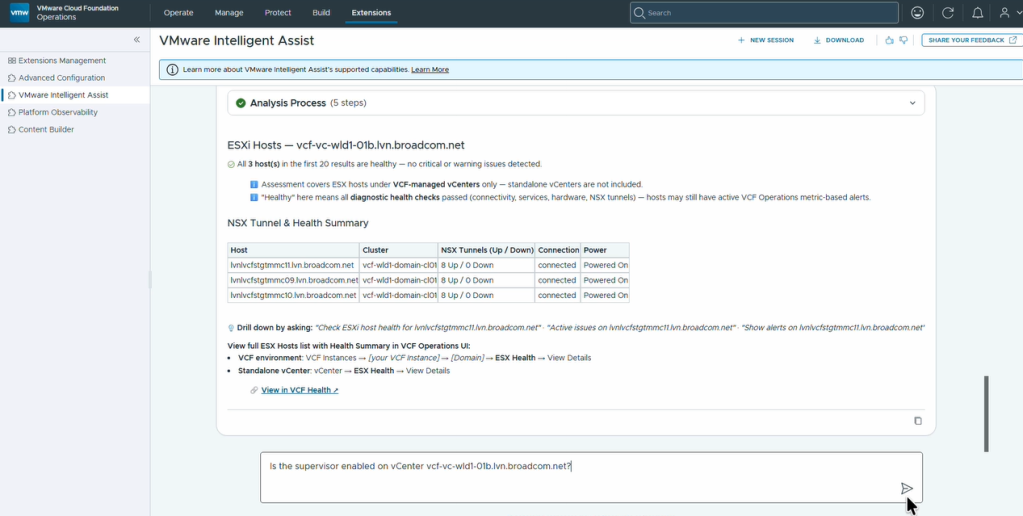
Figure 1. The AI Assistant for VCF [Tech Preview] simplifies Day-2 operations through conversational troubleshooting and diagnostics.
VCF 9.1.1 introduces a [Tech Preview] feature that gives you the option to bring an AI conversational chat interface directly into the VCF Operations UI that you configure locally with your model of choice. This feature natively supports different large language models (LLMs) running on Private AI Services (PAIS) or your private instance of Google Gemini. Whether an admin needs assistance troubleshooting infrastructure issues or managing third-party integrations, the AI Assistant for VCF [Tech Preview] feature can help with private cloud operations in a meaningful and secure manner.
Conversational diagnostics
The AI Assistant for VCF [Tech Preview] feature empowers admins of any skill level to operate private cloud environments using simple English queries.
Intelligent health visibility
The AI Assistant for VCF [Tech Preview] feature can also help an admin troubleshoot VCF health issues. The new capabilities provide diagnostics visibility for VMware vSphere and VCF management services. Admins can correlate proactive health alerts, configuration, and logs.
Management packs builder
Admins using the AI Assistant for VCF [Tech Preview] feature can increase their visibility of third-party infrastructure to help pinpoint root causes faster. The increased visibility helps map relationships between VCF and adjacent validated environments to reduce vendor finger-pointing when issues occur. Admins can also build management packs with AI without API expertise.
Watch this session recording from VMware Explore 2026 for more details.
From Tokens to Traces: AI Observability in VMware Cloud Foundation Operations [CLOB1168LV]
Full-stack visibility and Kubernetes observability
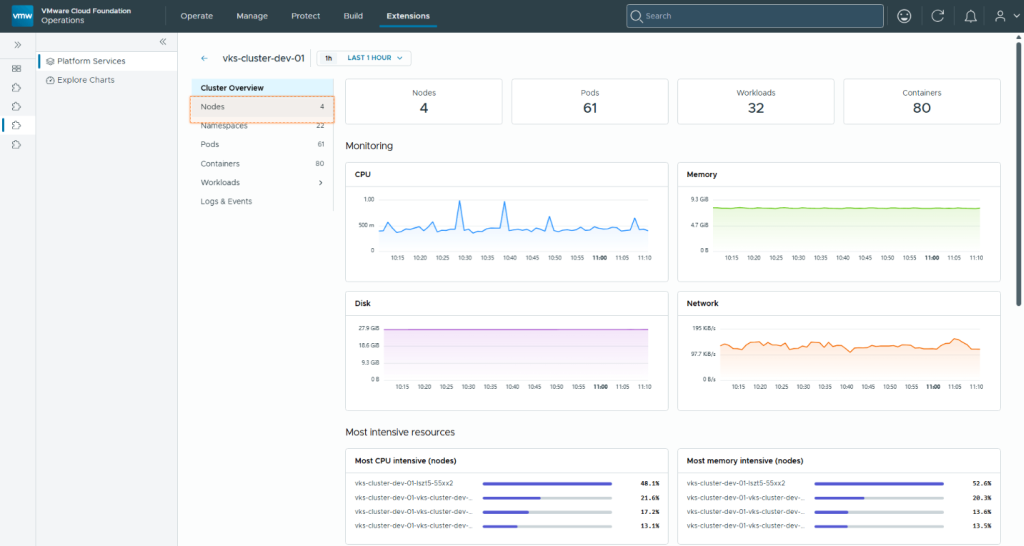
Figure 2. VCF Operations provides VKS observability and real-time troubleshooting.
Because containers scale and spin down rapidly, traditional infrastructure polling leaves blind spots. VCF 9.1.1 provides real-time Kubernetes operations in infrastructure management.
VMware vSphere Kubernetes Service (VKS) observability
Admins can correlate real-time compute, network, and storage metrics with system logs and events to rapidly isolate root causes. The standard 5-minute polling intervals can now be reduced to seconds. VCF Operations now features real-time, 2-second metric streaming for VKS clusters. Using the OpenTelemetry standard, teams can quickly detect short-lived pods, memory spikes, and transient performance bottlenecks.
Multi-cluster VKS monitoring
Admins can gain centralized visibility across all Kubernetes clusters using automated, zero-code OpenTelemetry collection.
Grafana dashboard import
Admins can seamlessly import existing Grafana dashboards or dashboards from the Grafana community library to monitor Kubernetes workloads from VCF Operations and view the native VKS dashboards at the same time.
Watch this session recording from VMware Explore 2026 for more details.
Enhanced security and identity
Managing access, credentials, and compliance at scale requires seamless, centralized control.
Dynamic on-demand identity management
When configuring Single Sign-on (SSO) for logins to the various VCF components, requiring pre-provisioned users is now a thing of the past. VCF 9.1.1 supports real-time Active Directory and OpenLDAP (Lightweight Directory Access Protocol) queries. User group memberships are evaluated dynamically at the exact moment of login, making it easy to grant temporary group access and maintaining that authorization reflects the current directory status.
Streamlined password management
VCF Operations is the central place to manage and enforce password policies across an entire fleet. Password policy enforcement is now easier with more components available in the workflow. Administrators can view credential freshness across components, now including application accounts for VMware vCenter, VMware Cloud Foundation Automation, VMware Cloud Foundation Operations fleet management, and VMware Cloud Foundation Operations for networks collectors.
Expanded certificate management
Certificate lifecycle management now covers NSX Edges, VMware vSphere Supervisors, License Servers, VCF Operations cloud proxy, and VCF Operations for networks collectors. The system provides continuous expiration tracking, automated alerts for auto-renewal failures, and integration with third-party Certificate Authorities (CA). There is also support for non-TLS certificates. This capability provides expanded visibility of VCF components and helps minimize disruption between configured components when third-party certificates expire. Admins can use VCF Operations to replace self-signed certificates with certificates issued from a Certificate Authority.
VMware Salt for VCF Component APIs
New to VCF, the VMware Salt for VCF Component APIs are based on VMware Salt and give teams comprehensive programmatic control for configuration management. By using native Salt constructs, this new capability leverages a number of built-in configuration settings that work seamlessly across VCF. With more than 300 settings exposed, it empowers administrators to maintain consistent operational states across the entire stack.
Watch this session recording from VMware Explore 2026 for more details.
What’s New in VMware Cloud Foundation Operations [CLOT1139LV]
Deployment flexibility and scale
Compact form factor
For organizations looking to deploy a smaller private cloud, VCF 9.1.1 offers a new compact form factor that reduces required CPU and memory by up to 40%. It includes a 2-node setup for high availability. Additionally, this streamlined architecture allows existing brownfield VMware vCenter instances to be imported into VCF without network portgroup reconfigurations.
Log Assist improvements
We’ve streamlined support connectivity in VCF Operations by enabling Log Assist by default. By removing the manual activation step on the Cloud Proxies page, Log Assist now works automatically out of the box which makes it easier to share log data and resolve support issues. Read this blog about Log Assist to learn more.
IPv6 licensing server support
Accelerate your modern private cloud deployments with native IPv6 support in the license server. This release also includes licensing health dashboards and licensing alerts in VCF Operations.
Watch this session recording from VMware Explore 2026 for more details.
Lifecycle Management in VMware Cloud Foundation 9.1 for VMware vSphere Admins [CLOB1568LV]
Ready to upgrade your operations?
VCF Operations in VCF 9.1.1 brings OpenTelemetry-based observability for Kubernetes, fleet-wide identity, and certificate automation. An integrated AI assistant [Tech Preview] helps you build, manage, operate, and protect your private cloud efficiently, and flexible LLM integration preserves data sovereignty. Check out the Broadcom documentation and Hands-on Labs for a comprehensive look at these new capabilities for VCF Operations.
Resources
- Blog: Announcing VMware Cloud Foundation 9.1.1 General Availability
- VMware Cloud Foundation product page
- VMware Cloud Foundation Operations product page
- Documentation for VCF 9.1.1
- VMware Salt for VCF Component APIs
- Hands-on Labs VCF Operations
Discover more from VMware Cloud Foundation (VCF) Blog
Subscribe to get the latest posts sent to your email.