A Brief Origin
Platform engineering didn’t emerge from a whiteboard — it emerged from pain. The DevOps era gave us shared ownership and the cultural conviction that “you build it, you run it”. Platform Engineering 1.0 systematized that foundation into golden paths, self-service Internal Development Platforms (IDPs), and platform-as-product thinking. Today, 90% of organizations have adopted platforms according to the 2025 Google DORA report, making a high-quality internal platform the essential foundation for AI success. That success, however, is also the setup for what comes next.
The Ceiling is Real
Platform Engineering 1.0 was built for a specific need: containerized workloads, developer-centric teams, and human-paced delivery.
Several structural limitations now constrain Platform Engineering 1.0. The architecture is AI-blind — with no first-class support for GPU and TPU provisioning, model serving, model registries, MCP gateways, or AI-specific governance. The developer-only focus leaves entire organizations underserved: ML engineers, data scientists, FinOps analysts, security teams, and AI agents all need the platform. Cost management is reactive, with cloud waste sitting at an industry baseline of 35% as per KPMG — and AI infrastructure and token costs amplifying it further. Security and compliance remain afterthoughts, treated as bolt-ons rather than substrate properties. Platforms have become rigid and static: compliance is a snapshot rather than a continuous guarantee, and swapping one component may cascade changes across the entire stack.
The established foundations Platform Engineering 1.0 remain stable. But the platform must now carry workloads for which it was not designed for. Left unaddressed, the platform that was designed to eliminate the bottleneck becomes the bottleneck itself.
Forces Driving the Next Evolution
The pressure on current platforms is not theoretical. Multiple converging forces have accelerated the structural strain.
With many developers using AI coding assistants and code volumes rising, the bottleneck has decisively shifted from writing code to delivering it. Simultaneously, AI agents are moving from research projects to enterprise workloads at exponential pace — and unlike every prior persona, they arrive with no existing platform support to inherit from. Cloud waste meets expensive AI infrastructure, creating CFO-level budget surprises that boards can no longer ignore. The EU AI Act, US executive orders on AI safety, and expanding data-residency requirements impose compounding compliance pressures on a platform never architected for them. And the platform engineering team — once focused on developers — is now being asked to serve the entire organization.
Infrastructure is not a supporting concern in modern platform engineering — it is the strategic foundation that determines how far any platform evolution can go.
The Five Pillars of Platform Engineering 2.0
The time has come for Platform Engineering 2.0. This is not a rebuild; it is a deliberate extension of what 1.0 established, across five fundamental pillars.
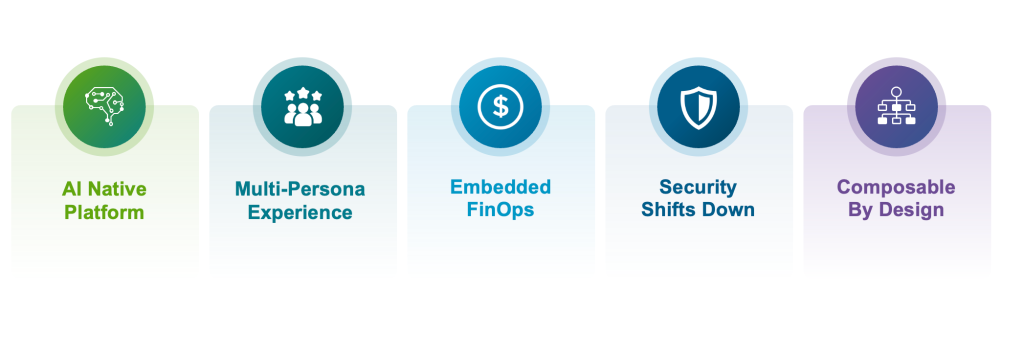
The emergence of the AI-Native Platform transforms the IDP into an Agentic Development Platform (ADP), adding GPU and TPU provisioning with dynamic allocation policies, model-serving infrastructure with versioned registries, MCP server infrastructure for agent-tool integration, and isolated execution environments with bounded autonomy guardrails. AI is both the forcing function and the opportunity. AI workloads and agents become native to the platform.
Multi-Persona Experience extends platform capabilities from developers and platform engineers to four new distinct personas — data scientists, security teams, engineering and business stakeholders, and AI agents — each requiring the right tools, the right abstractions, and the right intelligence. The discipline that built the platform for developer autonomy now builds the platform for enterprise-wide agentic autonomy.
Embedded FinOps moves cost intelligence from rear-view-mirror reporting to provisioning-time decisioning. Every developer and operator becomes a FinOps practitioner by default — not through training, but through platform design that surfaces cost at the point of action. A FinOps capability operating above the infrastructure layer can only report on spend; one embedded at the infrastructure layer can control it.
Security Shifts Down addresses the entirely new category of AI security challenges — shadow AI sprawl, prompt injection, model poisoning, and inference data leaks — that developer tooling alone cannot catch. Security embeds into infrastructure itself, not as an overlay, but as an immutable substrate property. It complements the shift-left security that Platform Engineering 1.0 established.
Composable Architecture by Design answers the pace of change across a 200+ project CNCF ecosystem and many new commercial tools. The future of platform engineering is not build versus buy — it is compose. API-first, repaveable building blocks connected through well-defined contracts deliver the architectural flexibility that AI workloads and rapid experimentation demand.
Infrastructure Is the Platform’s Most Foundational Layer
At the heart of every platform engineering initiative lies infrastructure — the foundational substrate of compute, storage, networking, GPU resources, automation and embedded security and cost controls that makes everything else possible. A modernised infrastructure runs through all five pillars as the unifying substrate: what the AI-Native Platform provisions for GPU and model workloads, the foundation that Embedded FinOps governs and optimizes, the enforcement layer where Security Shifts Down becomes immutable and invisible, and the composable building blocks that give architecture the flexibility to adapt at AI’s pace. No pillar delivers its full value without a modern, capable infrastructure layer beneath it.
The Call to Action
Platform Engineering 2.0 is AI-native, multi-persona, cost-aware, secure by construction, and composable by design. The starting point is honest self-assessment: which ceiling is creating the most friction in your organization today? Audit your platform against the five pillars, mandate a business case tied to developer velocity, cloud cost reduction, and AI readiness metrics, and commit to infrastructure as a first-class strategic concern. The platforms that evolve will define the enterprises that lead.
Go deeper with the full whitepaper, Platform Engineering 2.0: An Evolution for the AI Era, jointly developed by Broadcom and PlatformEngineering.org — the community trusted by 280,000 platform engineers worldwide.
References
- 2025 DORA State of AI Assisted Software development
- KPMG: As cloud over-spending rises, look to cost optimization
Discover more from VMware Cloud Foundation (VCF) Blog
Subscribe to get the latest posts sent to your email.