
We are excited to announce enhanced support for SAP applications like SAP HANA or SAP NetWeaver based AnyDB (Any Database) systems with the release of VCF 9.1. Following the vSphere as part of VCF 9.0 support introduced in February 2026, VCF 9.1 now enables the deployment of 2-socket Intel Xeon 6 CPUs with P-core systems (Granite Rapids-SP) on VMware vSAN.
The Value of VMware vSAN for SAP on VCF 9.1
While Intel Xeon 6 hosts could previously be used in VCF 9.0 workload domains with Fibre Channel (FC) or Network File System (NFS) storage, the new VMware vSAN 9.1 support is a significant advantage. Leveraging vSAN, which is included in VCF, organizations can simplify storage management and lower the Total Cost of Ownership (TCO) for deploying SAP Virtual Machines (VMs) on VCF 9.1 and VMware vSAN, all while preserving the required operational KPIs and performance for SAP HANA.
VMware vSAN for SAP Applications
- SAP AnyDB Applications: Unlike SAP HANA, no additional validation is required for SAP applications (such as SAP ERP) utilizing databases like Oracle or Microsoft SQL Server (referred to as AnyDB) when deployed on vSAN ready systems from vendors that support both SAP and VMware vSAN.
- SAP HANA Applications: Using vSAN with SAP HANA requires a system certified for both SAP HANA and vSAN, along with a successful VMware vSphere and vSAN validation. After this validation, an SAP hardware partner can build an SAP ICC-certified, vendor-specific Hyper-Converged Infrastructure (HCI) solution based on VCF. Customers can then purchase and implement these certified and tailored SAP HANA and vSAN systems. The vSAN 9.0 and 9.1 validation allows Intel Sapphire-, Emerald-, and Granite Rapids-based systems to be deployed as VCF workload domain systems leveraging vSAN.
SAP HANA HCI Certified Systems
In addition to the new Granite Rapids (GNR) systems, Sapphire Rapids and Emerald Rapids based systems are also supported with vSAN 9 and 9.1, allowing them to be incorporated into VCF Workload Domain Systems. For more details, please refer to SAP note 3703816 – SAP HANA on VMware vSphere and vSAN in VCF 9. For certified VCF based systems please refer to the SAP Certified and Supported SAP HANA® Hardware Directory.
The first available SAP HCI certified, GNR-based system to be available is a Lenovo ThinkAgile VX650 V4 2-socket GNR system. Additional hardware vendors are expected to follow.
What is a SAP HANA HCI Certified System?
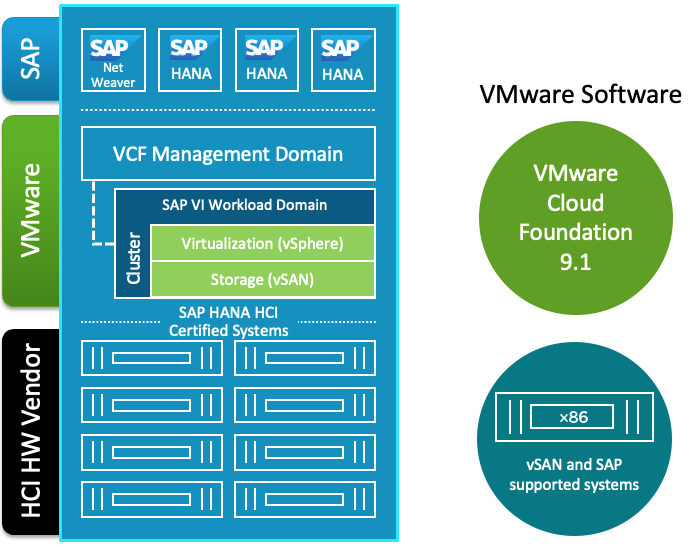
An SAP HANA HCI certified system represents a comprehensive private cloud infrastructure that integrates compute, storage, and networking into a specialized, vendor-specific solution based on VCF. These turnkey platforms undergo rigorous validation to meet SAP performance KPIs, utilizing only SAP-supported servers and VMware vSAN-certified components to guarantee enterprise-grade stability.
The value of these systems extends to a unified support model involving the hardware partner, SAP, and Broadcom. By leveraging VMware vSAN on VCF, organizations can simplify management and lower TCO for both SAP HANA Scale-Up and Scale-Out environments, combining local storage economics with the robust capabilities of shared storage. The following diagram illustrates a certified SAP HANA HCI solution powered by VCF on validated partner hardware.
VMware Cloud Foundation (VCF) Architecture for SAP Applications
VMware Cloud Foundation (VCF) forms the backbone of the private cloud solution for SAP applications, integrating key components like vSphere, vSAN, NSX, and VKS (Kubernetes). VCF structures the infrastructure using Virtual Infrastructure (VI) Workload Domains (WLDs).
Each VI WLD is a dedicated, logical environment for hosting specific applications. It comprises a group of SAP supported ESXi hosts managed by a dedicated vCenter Server and NSX Manager instance, all configured according to VMware best practices.
VCF utilizes different types of WLDs for SAP workloads:
- Dedicated SAP HANA WLDs (represented as red/blue in the diagram) are tailored for SAP HANA, potentially using distinct storage configurations.
- Mixed Application WLDs (represented as grey) can host a mix of SAP and non-SAP applications with varying Service Level Agreements (SLAs). These may include hosts that are not certified for SAP HANA.
- Kubernetes WLDs (not shown) are also possible for Kubernetes-based applications.
A single VCF management domain, shown in green, governs all Workload Domains (WLDs). This centralized domain contains all operational, automation, and management tools, namely VMware Cloud Foundation Operations and Automation. In addition, it houses the dedicated vCenter and NSX Manager instances for each WLD. This structure ensures that the compute, memory, and storage resources within the WLD systems are fully dedicated to the actual workloads, with the only resource consumption being that required by ESX.
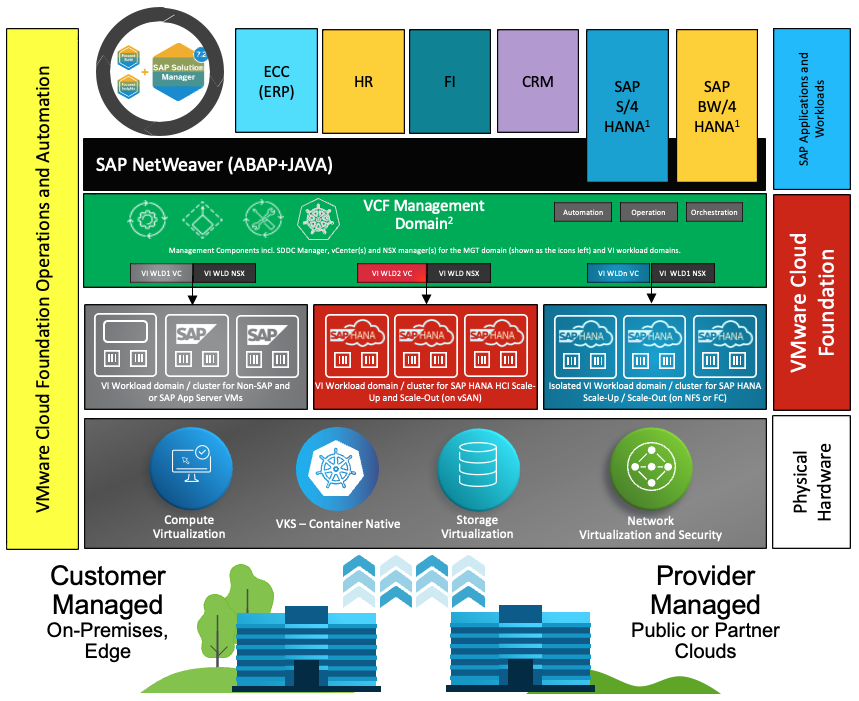
1SAP HANA Scale-Up up to 16 TB and Scale-Out up to 48 TB* VMs, details: SAP Note 3663150. 2VCF version 9 and later.
Key Advantages of Running SAP Applications on VCF
Deploying SAP applications on VMware Cloud Foundation (VCF) delivers a uniquely secure, cost-effective, and optimized environment, offering benefits often absent in physical or typical public cloud setups. These advantages include:
Cloud Readiness and Compliance:
- Adoption of a public cloud operating model and cloud readiness through software-defined data center (SDDC) SAP application deployments.
- Future-proof infrastructure for Kubernetes-based applications and workloads. Run VMs and Containers side-by-side.
- Fulfillment of regulatory demands for cloud neutrality.
Security and Control:
- On-premises security and complete control over the environment.
- Increased security utilizing VMware NSX as a zero-trust platform.
- Sovereignty over business transactions and data.
Performance and Availability:
- Consistent and predictable performance due to data locality, rightsizing and full control
- Higher Service-Level Agreements (SLAs) achieved by tools like vSphere vMotion, which facilitates the live migration of SAP HANA instances before hardware maintenance or host resource contention.
- Standardized high availability solution based on vSphere HA.
Operational Efficiency and Modernization:
- Integrated lifecycle management provided by VMware Cloud Foundation Operations and Automation.
- Automation, standardization, and streamlining of IT operations, processes, and tasks.
- Higher hardware utilization rates.
- Easier hardware upgrades or migrations thanks to the abstraction of the hardware layer.
- Built-in multitenancy support via the encapsulation of the SAP HANA system in a VM.
- Embedded Cost Control – Chargeback, showback, cost management and predictability dashboards turn resource consumption into invoice-ready numbers for each tenant or business unit.
Integrating SAP Certified HCI Systems with VCF
The integration of vSAN-based, SAP HANA HCI certified systems into an existing VCF 9 configuration is dependent on the specific HCI system vendor and their VCF integration offerings.
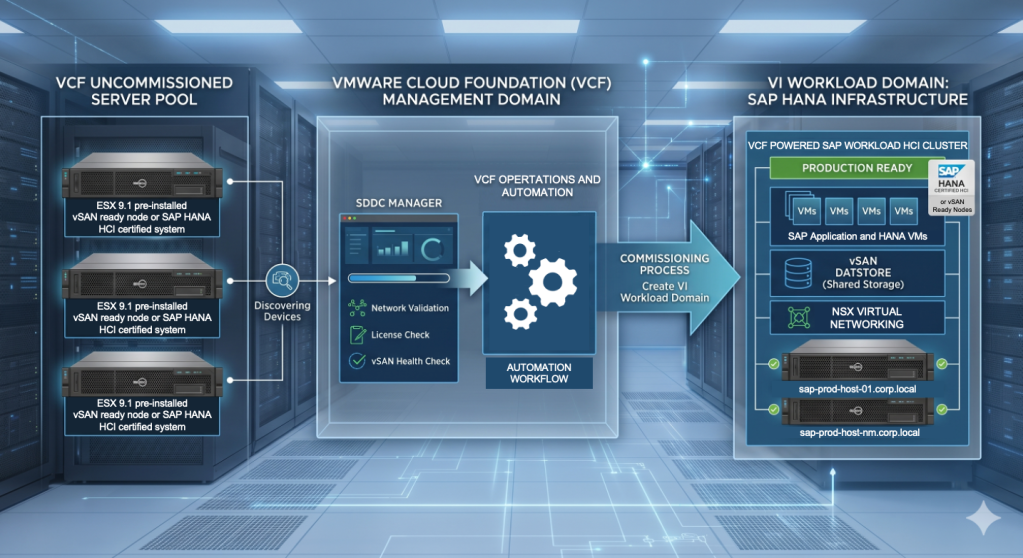
Assuming the HCI vendor’s VCF hosts have been physically installed and ESXi is running in its basic configuration, the hosts can be commissioned into the VMware Cloud Foundation inventory.
Once commissioned, these hosts can be deployed in the following ways:
- As a new Workload Domain (WLD).
- As an additional cluster within an existing workload domain.
- To extend an existing cluster.
Important Considerations Pre- and Post-Deployment:
- Cluster Expansion: When expanding an existing vSAN SAP HCI cluster, the new hosts must meet or exceed the hardware specifications of the existing systems, particularly for CPU model and memory. The vSAN storage and network configurations must be identical to the current setup.
- vSAN Policies and Settings: After deployment as a new WLD or cluster addition, the vSAN policies and settings defined by the HCI solution vendor for their certified configuration must be applied.
- HANA Health Check Script: In addition to the vendor-certified vSAN policies and settings, the SAP HANA HCI VMware vSAN Detection Script, available here, needs to be deployed on the hosts.
Note: Consult your SAP HANA HCI solution provider regarding available commissioning options and the required vSAN policies and settings.
The figure below illustrates the commissioning process for vSAN ReadyNodes or certified SAP HANA HCI systems.
Future Plans:
- Validation: Conduct vSphere and vSAN validation for the 4-socket Xeon 6 platform utilizing P-Cores (GNR) and vSAN 9.1 re-validation of Ice Lake or Cascade/Copper Lake systems.
- Memory Support: Expand support for larger memory configurations (exceeding 2 TB per CPU socket), pending the availability of necessary memory DIMMs.
- VKS: Integrate VKS (VMware Kubernetes Service) support for SAP Kubernetes-based applications like EIC, depending on final SAP approval.
References:
- What Is VMware Cloud Foundation?
- VCF 9.1 Is Here. See It in Action
- SAP note 3663150 – SAP HANA on vSphere in VCF and VVF 9
- SAP note 3703816 – SAP HANA on VMware vSphere and vSAN in VCF 9
- SAP HANA on vSAN Health Check VIB, Broadcom KB Article ID: 444260
Discover more from VMware Cloud Foundation (VCF) Blog
Subscribe to get the latest posts sent to your email.