In today’s data center, IT is facing unprecedented challenges for their storage infrastructure; they need to deliver performance, resilience, and efficiency for data that continues to grow at a much faster rate than budgets. In the past, the price for storage and memory would decline over time, limiting the budget impact of data growth, but the current memory supercycle is bucking that trend. Data reduction techniques, lower CPU and memory requirements, and new storage media can enable IT to mitigate the impact of rising prices across their entire storage estate.
Additionally, IT is experiencing rapid growth in the scale of applications as well as the number of applications in the data center. AI workloads in particular require enormous amounts of data, and their adoption is putting pressure on IT to embrace new storage interfaces, such as object storage and high-performance file services. Also, IT needs an easier way to enable application development teams to consume storage infrastructure. Today, admins often struggle with ticket-based systems for provisioning resources; the processes are often manual, time-consuming and error prone. Administrators want a way to provide access to critical storage services while also ensuring governance and compliance, so developers can move at the pace required by the business.
But the pressure doesn’t stop there. Security threats are evolving faster than ever, with ransomware attacks forcing IT teams to rethink the fundamental resilience of their storage infrastructure. Recovery times for mission-critical applications are becoming a much higher priority. IT needs data to be protected with immutable snapshots, encrypted at-rest and in-transit, and recoverable during cyber events.
Finally, IT teams need help managing the growing complexity in their data center. As the scale of infrastructure rapidly increases, IT needs infrastructure providers to streamline or automate processes, enabling administrators to manage more infrastructure with fewer resources. Administrators need their storage infrastructure to self-manage, self-monitor and surface critical diagnostic information to guide rapid remediation.
That’s why more customers than ever are moving away from legacy, three-tier architectures to a fully integrated private cloud. vSAN is a critical, integrated component of VMware Cloud Foundation (VCF) that enables advancements in new and existing VCF capabilities. With vSAN in VCF 9.1, we will deliver capabilities that make it easier to lower storage infrastructure costs, accelerate modern application development, run and protect workloads in VCF-based private cloud, and simplify VCF storage operations.
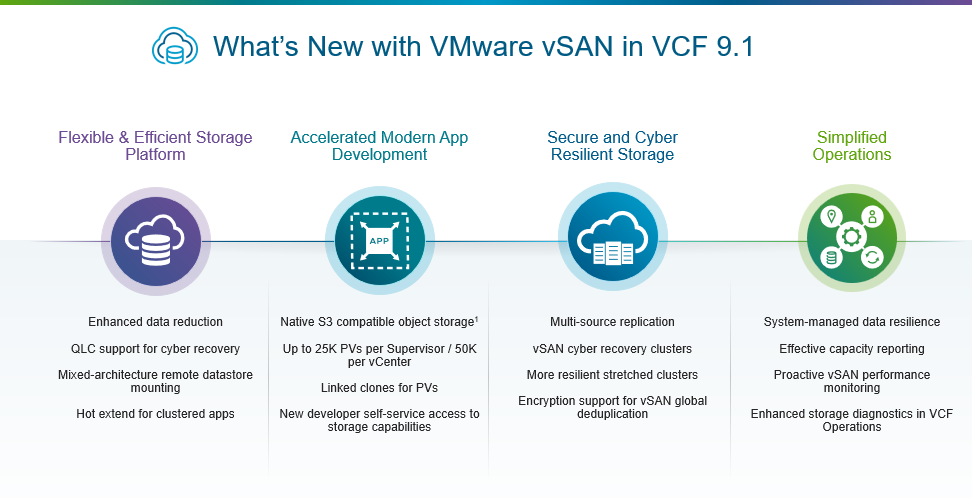
Flexible and Efficient Storage Platform
Cost efficiency has always been a vSAN strength, but vSAN in VCF 9.1 takes it further with smarter compression and cost-effective hardware options.
Global Deduplication
In VCF 9.1, vSAN global deduplication will be generally available! vSAN global deduplication enables customers to reduce utilized capacity by up to 8x — a critical capability when capacity costs are rapidly rising and procurement times are lengthening. vSAN’s global deduplication is designed to have minimal CPU impact and can be applied to all data within a cluster. It is a post-process dedupe, so it runs in the background opportunistically when CPU needs are low. Unlike traditional storage, where deduplication is limited to the storage behind a pair of I/O controllers, vSAN’s deduplication domain scales with the cluster, potentially offering better efficiency. If you’d like to dive deeper, check out the following blogs:
Advanced Compression
In vSAN in VCF 9.1, we’ve introduced new compression techniques that deliver significantly better compression ratios. The new technique is both fast and efficient, as our engineering team optimized it to balance data reduction and resource utilization. VCF 9.1 can now deliver greater compression ratios with minimal performance impact.
What makes this particularly valuable? Our new compression only applies to new writes, so it can be applied non-disruptively into your environment, and it is enabled by default.
When combined with global deduplication, this enhancement contributes to a 39% lower TCO compared to traditional external arrays.
Cyber Recovery ReadyNodes with QLC Devices
Recovery use cases—disaster recovery, operational recovery, and cyber recovery—have unique infrastructure requirements from primary storage, with lower CPU and memory resources but higher capacity requirements. While IT has historically prioritized cost when investing in recovery infrastructure, the changing nature of business has also demanded that performance and recovery times be elevated factors when making investment decisions. VCF 9.1 introduces ReadyNodes optimized for cyber recovery with QLC (Quad-Level Cell) storage devices that deliver the right balance of density, performance, endurance, and cost for the cyber recovery use case.
These certified configurations provide greater storage density and server consolidation, lowering your cost per gigabyte for all-flash storage while reducing power, cooling, and rack space requirements compared to HDD-based recovery targets. It’s a practical answer to the challenge of expanding cyber recovery infrastructure without expanding budgets.
Greater Flexibility for vSAN Storage Clusters
Many vSAN users evolve their storage infrastructure over time, so often they are using a mix of vSAN Express Storage Architecture (ESA) and Original Storage Architecture (OSA). However, customers want the ability to invest in new infrastructure while using their older vSAN clusters to their end of life. VCF 9.1 removes previous limitations, allowing you to mount newer ESA datastores to OSA clusters and enabling compute-only clusters to mount both OSA and ESA datastores. Customers can expand the infrastructure for their apps running on OSA clusters without having to invest in previous generations’ technology.
Even more significant: vSAN storage clusters can now be shared across vCenter boundaries, just like traditional external arrays. This means you can maximize capacity utilization, consolidate deployments, and increase density, while keeping TCO low.
Accelerated Modern App Development
Modern IT teams support everything from traditional databases to containerized applications and contemporary devops practices, all while meeting strict SLAs. vSAN in VCF 9.1 expands its flexibility to meet these diverse demands.
Native vSAN S3 Object Storage (Tech Preview)
For the first time, vSAN delivers native S3-compatible object storage, bringing a third storage type—alongside block and file—directly into VCF. This preview release targets DevOps and CI/CD pipeline use cases where developers need fast, self-service access to scalable object storage.
The implementation includes multi-tenancy, S3 buckets-as-a-service, and foundational security and compliance features, all accessible through VCF Automation. The result? Developers get the agility they need while IT retains governance and control—and it’s included with VCF licenses, delivering 34% lower TCO compared to standalone on-premises object storage products.
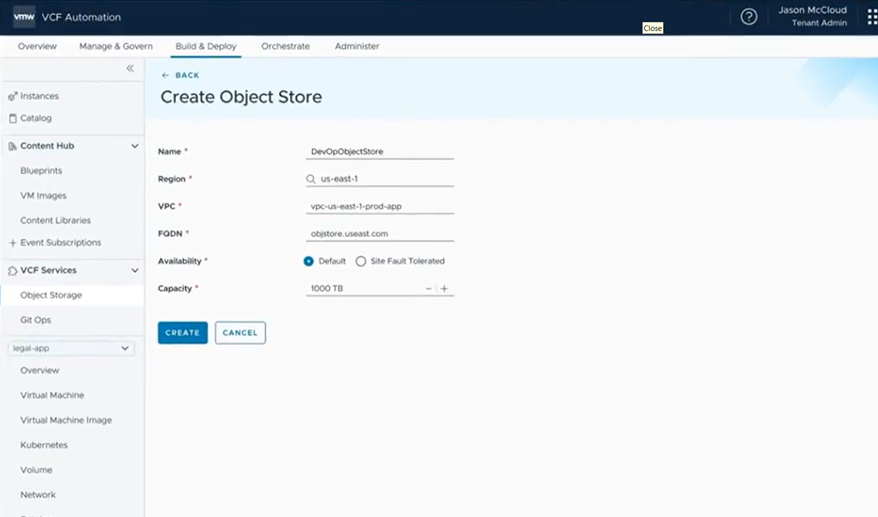
New Developer Self-Service Access to Storage Capabilities
Dramatic Scale Increases for Persistent Volumes
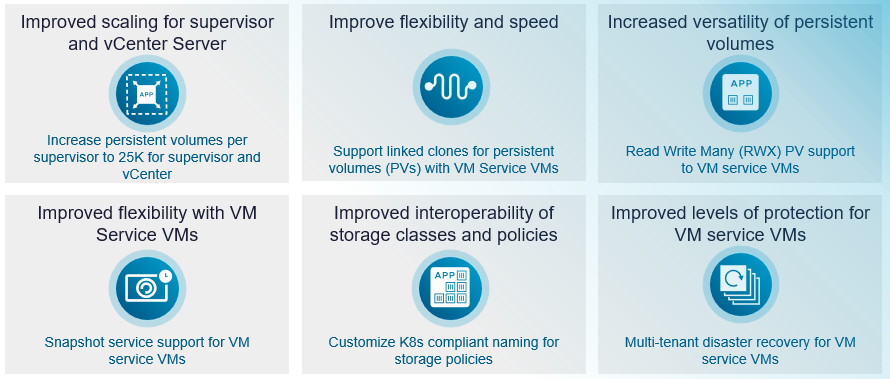
vSAN in VCF 9.1 greatly increases the scale of container volumes for VCF environments. The maximum number of Read Write Once (RWO) persistent volumes per Supervisor jumps from 7,500 to 25,000—a 233% increase . At the vCenter level, the limit rises from 30,000 to 50,000 persistent volumes, a 66% increase . These expanded limits eliminate scaling constraints for large Kubernetes deployments and multi-tenant environments.
Efficient Provisioning with Linked Clones
Full clones are too storage intensive and inefficient for most use cases. VCF 9.1 introduces linked clone support for persistent volumes with First Class Disks, dramatically reducing provisioning time and improving operational flexibility. Linked clones share common base data, making them ideal for development environments, testing, and scenarios where you need to rapidly spin up multiple similar workloads without the storage penalty of full clones.
Read Write Many (RWX) Support for VM Service VMs
While file-based RWX volumes could be used in some scenarios, they weren’t available for workloads, such as vSphere Pods and VM Service VMs, in the Supervisor namespace. VCF 9.1 closes this gap, enabling VM Service VMs to mount and consume RWX volumes . This opens up new workload possibilities, particularly for applications that require shared access to storage across multiple pods or VMs.
Consistent Snapshot and Recovery Operations
VM Service VMs can now take advantage of simple VM snapshot recovery operations, bringing them in line with traditional VMs. This consistency simplifies backup and recovery workflows regardless of whether you’re running standard VMs or VM Service VMs—one approach for all workloads.
Kubernetes-Compliant Storage Policy Naming
VCF 9.1 allows administrators to specify customized Kubernetes-compliant names for storage policies at creation time. This removes previous naming restrictions that complicated storage policy to StorageClass mapping, making it easier to align vSAN policies with Kubernetes conventions and improving the developer experience.
Multi-Tenant Disaster Recovery for VM Service VMs
Cloud-native environments often serve multiple teams or tenants, each requiring independent protection and recovery capabilities. VCF 9.1 introduces foundational multi-tenant disaster recovery (MTDR) for VM Service VMs, giving provider admins and tenant admins the ability to protect Supervisor-based VMs for VCF-to-VCF protection scenarios.
Security and Cyber Resilience for Today’s Threats
Ransomware and data breaches demand storage that doesn’t just perform—it protects. vSAN in VCF 9.1 expands data protection capabilities to address long-term retention and comprehensive recovery scenarios.
Flexible Snapshot Schedules
In a previous release, vSAN’s native snapshots have included an ability to make them immutable, and they have always been performant at scale with deep snapshot chains, supporting up to 200 snapshots per VM. vSAN in VCF 9.1 introduces flexible scheduling—commonly known as “Grandfather-Father-Son” (GFS)—that lets you extend snapshot history for long-term retention use cases like cyber recovery.
Instead of keeping every sequential snapshot, you can retain specific snapshots over time—for example, hourly snapshots with only one retained every 24 hours. This approach manages capacity efficiently while providing the extended protection timeline that compliance and recovery requirements demand.
Multi-Source Replication
Previously, replication in VCF could only replicate VMs running from a vSAN datastore to another vSAN datastore. In VCF 9.1, we’ve removed that limitation, enabling you to replicate any VCF-based VM—including those on external arrays or other software-defined storage—to a vSAN datastore.
This capability delivers policy-based replication across your entire VCF estate, simplifying recovery workflows and ensuring consistent protection regardless of where VMs currently reside. You can combine replication with a vSAN-powered cyber recovery cluster to accelerate cyber protection and recovery.
Encryption for vSAN Global Deduplication
Data security now extends to vSAN’s global deduplication, ensuring that data benefits from space efficiency without compromising security. Whether data is at rest or in transit, it’s protected with FIPS 140-3 validated encryption from unauthorized access.
Enhanced Stretched Cluster Capabilities
Stretched clusters have long provided site-level resilience for vSAN deployments. VCF 9.1 introduces two critical enhancements that improve operational flexibility.
First, you can now place an entire site into maintenance mode through a guided workflow with extensive pre-checks, ensuring graceful entry and exit without service disruption. Second, in multi-failure scenarios—when one site is in maintenance mode followed by a simultaneous second site and witness failure—you can now self-recover the healthy site without requiring Global Support assistance. Built-in pre-checks guide the recovery process, reducing downtime and putting control back in your hands.
Simplified Operations That Scale
The best infrastructure is infrastructure you don’t have to think about. VCF 9.1 delivers automation and intelligence that reduce the operational burden on IT teams.
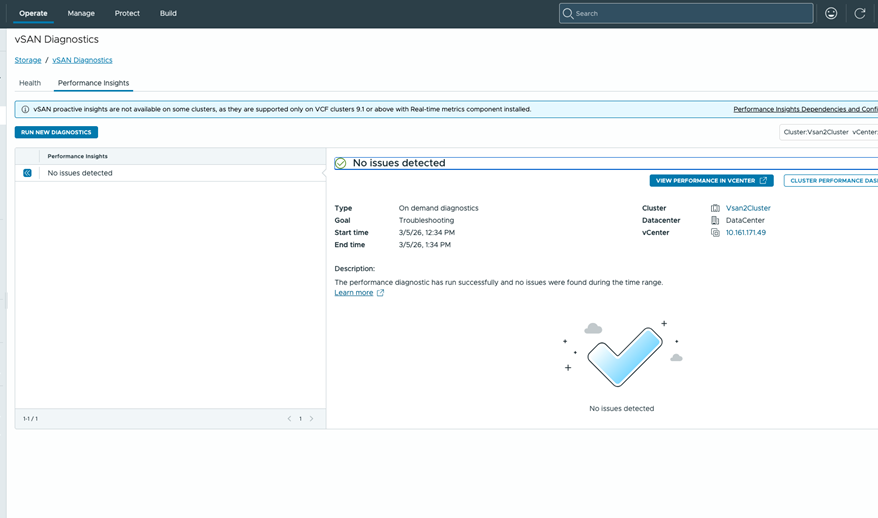
Proactive vSAN Performance Insights
Troubleshooting performance issues in software-defined infrastructure can be complex. Where’s the bottleneck? Is it the storage, compute, or network resources? VCF 9.1 takes a proactive approach by continuously monitoring storage performance patterns, establishing baselines, and alerting you to deviations.
When performance drifts from the baseline, VCF Operations uses advanced analytics to identify root causes and provide actionable remediation steps—all within the Performance Service UI. This algorithmic approach to troubleshooting correlates data points, identifies patterns, and surfaces insights that would take hours to discover manually.
Automated Storage Policy Management
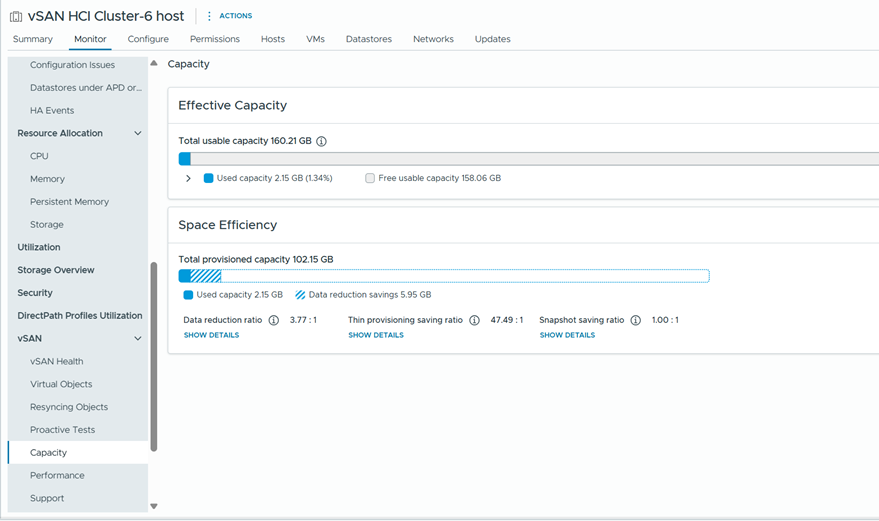
vSAN in VCF 9.1 automatically applies the highest fault tolerance level and optimal erasure coding possible given your cluster size. This removes guesswork from storage policy configuration and ensures you’re maximizing both resilience and efficiency without manual tuning. Combined with improved effective capacity reporting, you gain clearer visibility into actual usable capacity, making capacity planning more accurate and straightforward.
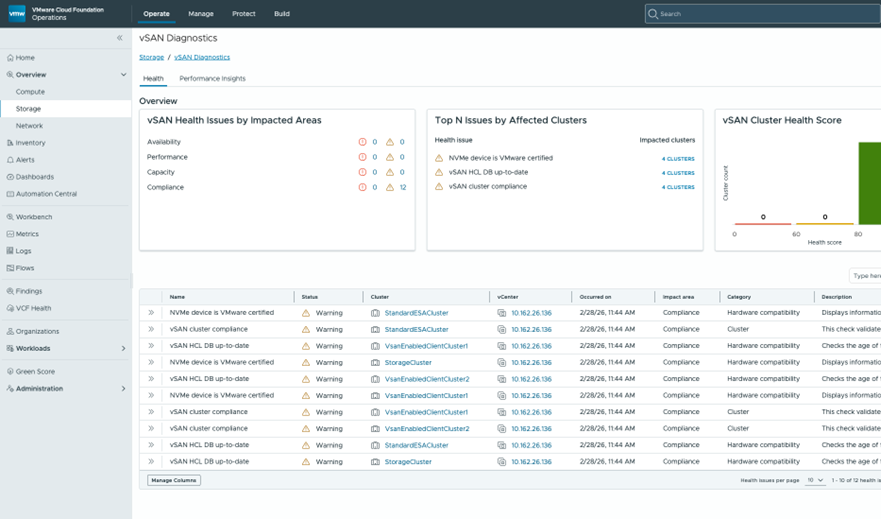
Enhanced vSAN Storage Diagnostics
In a previous release, we we provided a storage dashboard in VCF Operations that included important metrics like health scores, capacity consumed and other metrics. In vSAN in VCF 9.1, VCF Operations will provide significant new information and the ability to take action on vSAN Diagnostic issues within the VCF console. Users won’t have to manually navigate across the UI to identify the root causes of low health scores or determine how to remediate the issue, reducing the number of clicks by up to 60%.
Ready to Experience vSAN 9.1?
vSAN in VCF 9.1 represents a significant step forward in making private cloud storage more efficient, flexible, secure, and intelligent. Whether you’re optimizing TCO, supporting diverse workloads, strengthening resilience, or simplifying operations, this release delivers practical capabilities that address real IT challenges.
Visit the vSAN website to learn more about vSAN 9.1, explore technical documentation, and discover how vSAN can transform storage for your private cloud.
Discover more from VMware Cloud Foundation (VCF) Blog
Subscribe to get the latest posts sent to your email.