
The shift to modern, composable applications demands that engineering teams operate more like a seamless internal ecosystem. APIs, microservices, and common authentication services are developed by one team, but they must be able to be consumed quickly and securely, using a standardized API contract to drive a reusable and scalable architecture. If this consumption process is manual, ad hoc, or undocumented, you’re looking at instant friction and will bring developer velocity to a grinding halt.
This challenge is what the VMware Tanzu team aims to address by offering the new service publishing feature in Tanzu Platform 10.3. We recognize that scaling a platform isn’t just about deploying code; it’s about establishing trust and standardization by facilitating a true exchange between developers. Service publishing is the foundation for an InnerSource marketplace, allowing application teams to transform reusable components via APIs—whether a data service, a microservice, or a Model Context Protocol (MCP) server for a code assistant—into a first-class, governed offering within the Tanzu Marketplace.
For developers consuming APIs, this means you need to move past manual configuration headaches like generating API keys and access curated services with a simple integration mechanism, using trusted commands like cf create-service and cf bind-service. For platform engineers, this becomes another step toward standardization and the necessary control to manage internal service dependencies, ensuring security, performance, and resource predictability across the entire organization.
What is Tanzu Platform service publishing?
At its core, service publishing formalizes the relationship between the service provider (the team that builds and deploys a shared service) and the service consumer (the team that uses it). In Tanzu Platform 10.3, this means that any deployed application can now be designated for consumption through the Tanzu Platform marketplace. This goes beyond just sharing a URL; it turns the deployed application into a first-class service instance. Tanzu Platform handles the complexity of authentication, network configuration, and environment variable injection automatically via service bindings.
This fulfills the promise of InnerSource. Internal teams now build reusable components, complete with documentation and API specifications for consuming them, and manage and consume them with the same benefits as public cloud services. The difference is that you deliver this from your own private application platform, with complete sovereignty and control.
Increasing developer velocity and trust
For developers building next-generation AI-augmented applications, service publishing transforms the experience of dependency integration from a chore into a seamless, self-service process.
- Easier consumption – One of the biggest hurdles for cross-team collaboration and consumption of deployed services is documentation and context. With Tanzu Platform, developers no longer need to search for documentation on how to consume services via API or manually configure endpoints and credentials. They simply browse the Tanzu Marketplace, find the needed service (i.e., a product catalog API, a payment service, or even a shared AI context server), and execute two familiar Cloud Foundry commands, cf create-service and cf bind-service. The platform handles the necessary network bindings and routes, manages environment variables, and scaling. This allows developers to focus on core business logic alone.
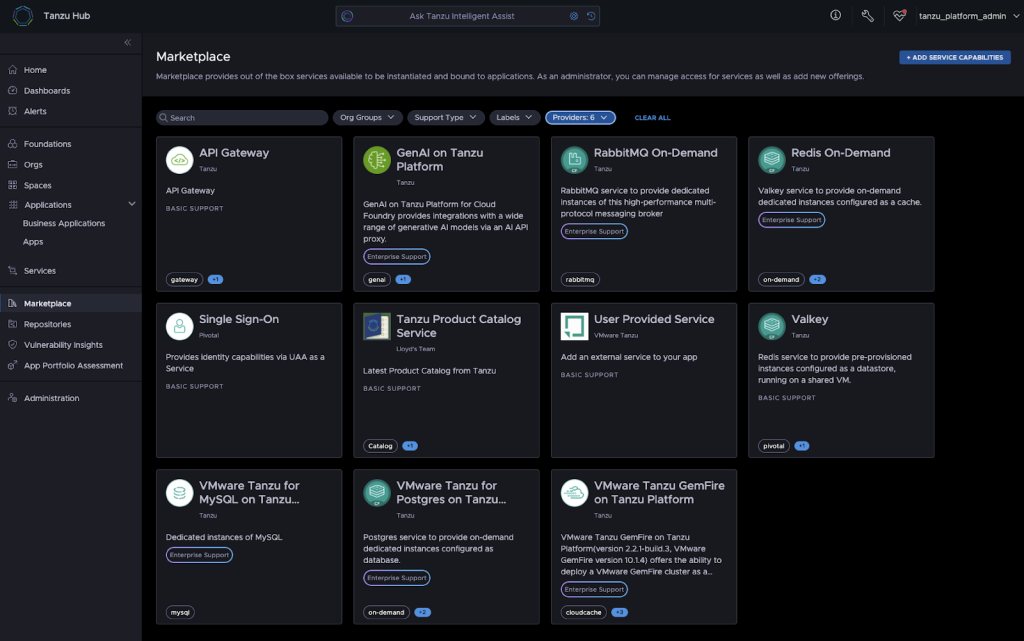
The Tanzu Marketplace provides developers self-service access to services that can be bound to applications. Marketplace services and offerings are curated by platform engineering teams.
- Trust and consistency – When developers choose a service from a marketplace, they know it’s been vetted and curated by their platform team. They can trust that:
- The service is running on the platform with necessary and specified operational characteristics.
- The API contract is stable and correctly versioned.
- Security and access controls are handled automatically by the platform, reducing the risk of insecure integrations.
- Internal marketability – Service publishers can market their service offerings with clear documentation, how-to guides, API specifications, and a personal logo to give their offering some personality and make it easier to discover within the marketplace.
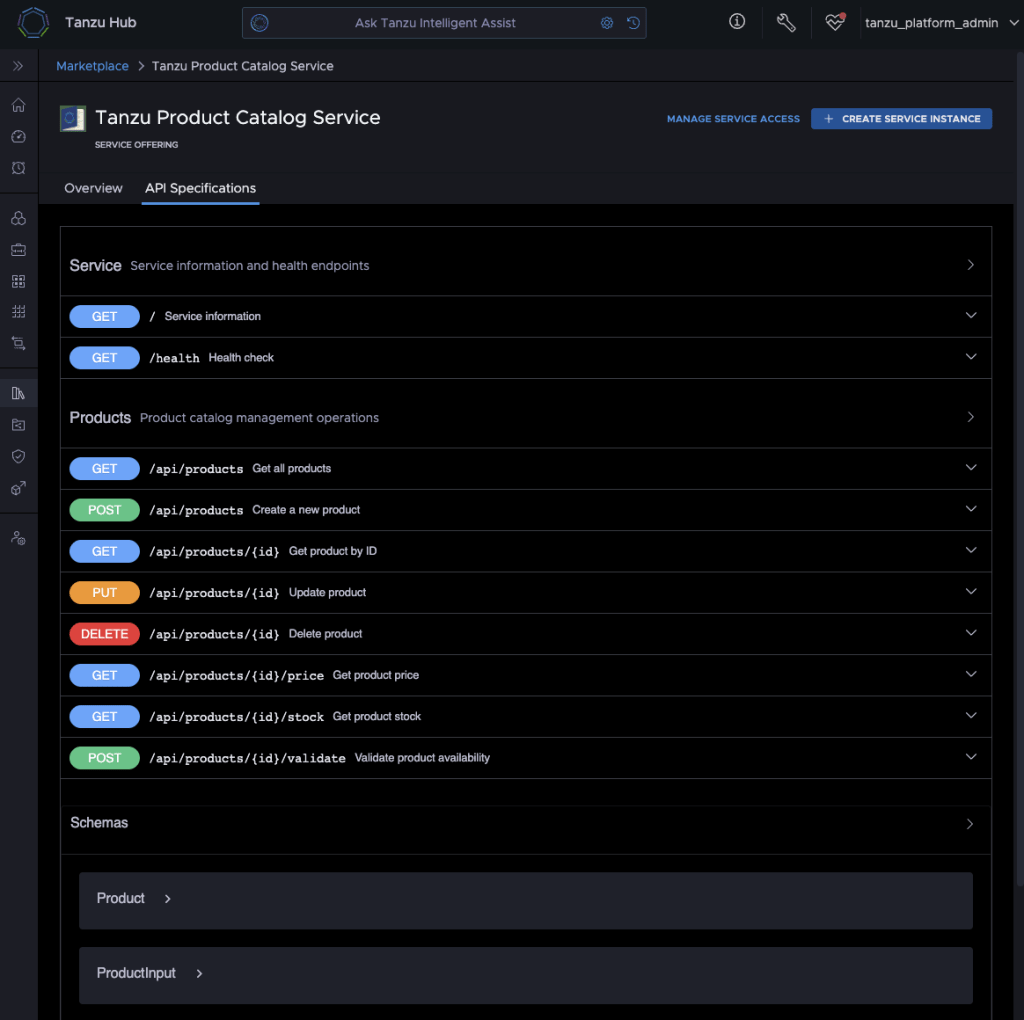
Service publishers can provide service consumers guidance on how to utilize APIs with documentation, how-to guides, and API specifications
Governance and scale without compromise
For platform engineering teams, service publishing provides a crucial governance layer over the entire internal ecosystem, turning ad hoc integrations into a manageable, scalable portfolio of applications and services.
- Centralized approval and curation – Platform teams gain immediate, centralized visibility into all shared internal applications. They can curate which services are exposed through the marketplace with service access, and they can ensure that teams are always using supported, secure, and optimized components. This means that the deprecation or upgrade process for published services is dramatically simplified, reducing technical debt and operational burden.
- Advanced operational security and control – The platform integrates API gateway functionality directly into the publishing process, giving platform engineers control over service interactions for both security and operational risk management. This includes the ability to configure authentication policies, usage quotas and rate limits, monitoring and logging, and more.
- Tracking usage and capacity analysis – Platform teams need to know who service consumers are, and how much is consumed. Service publishing provides:
- Clear metrics on service consumption by organization, space, and application.
- Better forecasting of necessary resources for high-demand shared services, and improved capacity balancing across foundations.
- Embedded rate limiting within plans to give greater controls to both the service publisher and platform engineer.
Make InnerSource the future of enterprise IT
Service publishing in Tanzu Platform 10.3 fundamentally changes the way internal teams can share, consume and govern reusable components. By embedding the API ecosystem within the platform, this eliminates the friction for developers while providing the essential control and transparency required by platform engineering.
This capability is the connective tissue for scaling modern, composable, and AI-native applications in a secure, governed way, driving the entire organization toward an efficient InnerSource operating model that enables greater developer collaboration.
Are you ready to transform your internal service delivery?
- Read the GA announcement to get a full overview of the most exciting features of Tanzu Platform 10.3.
- Dive deeper and explore features in our technical documentation.
- Visit the official product page to learn more about Tanzu Platform.