
We’re excited to announce the first VMmark benchmark results using new AMD EPYC™ 9006 Series Server CPUs. Submitted by Dell Technologies across 1-socket PowerEdge R9815 and 2-socket PowerEdge R9825 configurations, these two server platforms set a number of records in both performance and power-performance: see the VMmark Results page for more information.
Here are some of the highlights:
- The PowerEdge R9815 and R9825 lead the VMmark 1-socket and 2-socket server performance categories, respectively.
- They also have the top-ranked VMmark Performance-Per-Kilowatt (PPKW) scores in both Server Power-Performance and Server and Storage Power-Performance categories, which were added in VMmark 4.1. For more information, see: Introducing VMmark 4.1: Enhanced Power Efficiency Benchmarking for Private Cloud Infrastructure
- These systems are powered by new 6th Generation AMD EPYC 9996 “Venice” CPUs featuring 256 cores, 512 threads, and 1024 MB L3 cache.
- By enabling the latest CPU architectures, Broadcom, through VMware Cloud Foundation, brings each new CPU generation to private cloud infrastructure with scale and efficiency you can measure.
Let’s compare a 5th Generation AMD EPYC “Turin” VMmark result to one on the new 6th Generation AMD EPYC “Venice” platform to see how performance scales across generations:
| VCF Version | Server Description | Processor Model | Total Hosts | Total Cores | VMmark 4.1 Score |
| 9.1.2 | Dell PowerEdge R9815 | AMD EPYC 9996 | 2 | 512 | 5.42 @ 5.8 tiles |
| 9.1.0 | Dell PowerEdge R7715 | AMD EPYC 9845 | 2 | 320 | 3.18 @ 3.8 tiles |
VCF 9.1.2 enables support for these new CPUs, but performance across 9.1 maintenance releases remains virtually unchanged. The significant score jump is driven entirely by the new hardware generation.
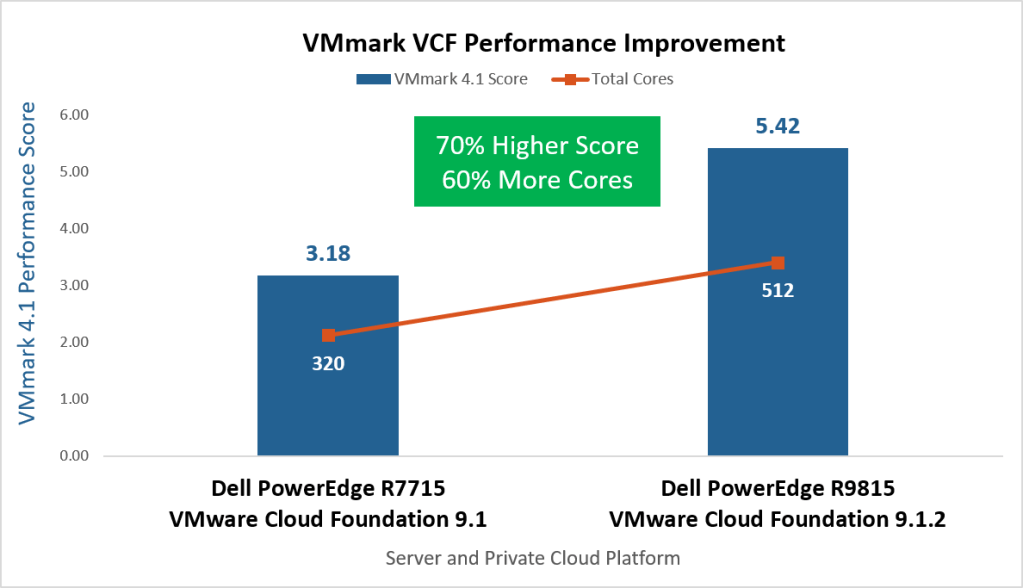
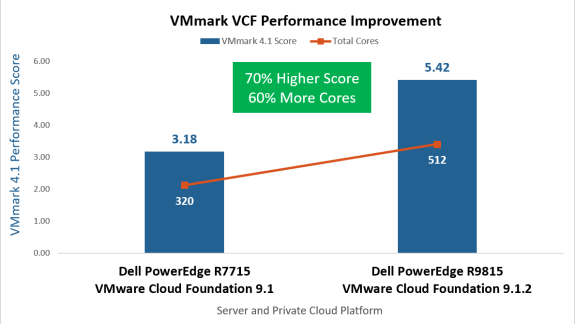
A 60% increase in core count translates directly into a 70% higher VMmark score. By sustaining 5.8 tiles (121 VMs) compared to the R7715’s 3.8 tiles (77 VMs)—where each tile simulates a realistic mix of modern data center workloads—the R9815 drives a 57% increase in workload capacity. For private cloud environments, this means organizations can handle significantly higher compute demand while consolidating onto fewer physical servers during a hardware refresh.
Here are some resources to learn more:
- VMmark 4
- VMmark Community
- VMware Cloud Foundation 9.1
- Dell PowerEdge R9815, R9825
- AMD EPYC 9006 Server CPUs
These comparisons are based on all VMmark results published as of 11/10/2026. VMmark is a free benchmarking tool provided as-is by Broadcom and used by partners and customers to measure the performance, scalability, and power consumption of virtualization platforms.
Discover more from VMware Cloud Foundation (VCF) Blog
Subscribe to get the latest posts sent to your email.