
Enterprises spent the last two years proving that generative AI (GenAI) works in pilots. Moving those same workloads into mission-critical production is where most deployments stall.
As organizations scale AI, they quickly discover that “Public clouds charge consumption-based rates for every token generated and every gigabyte transferred, which is ideal for bursty experimentation but expensive for always-on production services.”1 The operational and financial barriers are real, and they are systemic.
Building on our recent announcements at VMware Explore 2026, where we unveiled the VMware Private AI Cloud built on VMware Cloud Foundation (VCF), we turn to insights from Jevin Jensen, Research Vice President of Infrastructure and Operations at IDC, to investigate why enterprise AI deployments hit these walls.
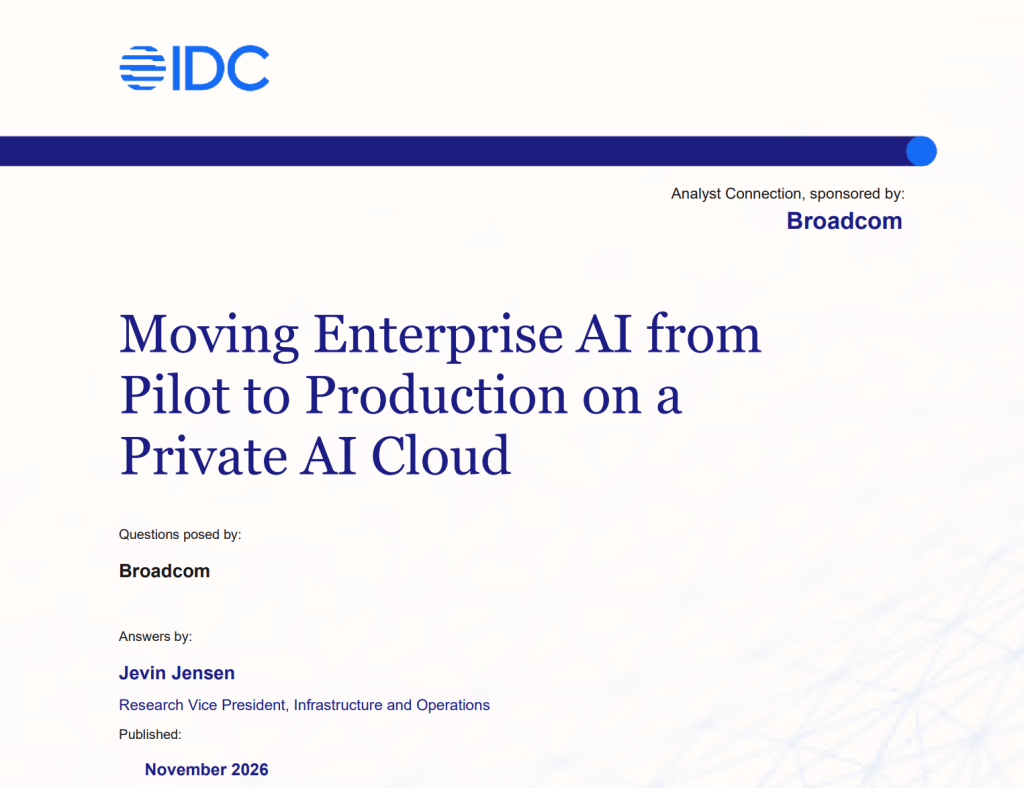
The result is an IDC Analyst Connection, sponsored by Broadcom, report titled “Moving Enterprise AI from Pilot to Production on a Private AI Cloud” (Doc #US54945526, November 2026). It maps the systemic barriers IT leaders face and lays out an architectural blueprint for scaling AI securely and cost-effectively.
The Cost Trap in Public Cloud AI
Per-token model execution costs are falling. However, aggregate enterprise AI spend is climbing fast as agentic workflows multiply.
IDC’s August 2026 Intelligent Cloud Survey, cited in the paper, found that “89% of organizations reported unexpected AI-related costs on public cloud or SaaS after go-live.” When workloads shift from occasional testing to round-the-clock inferencing, consumption-based billing, “GPU scarcity” premiums, and data “egress charges” erode projected margins.
The Sovereignty Mandate and Workload Placement
Beyond economics, data sovereignty and privacy compliance have become strategic mandates for IT leaders and boards. Because modern agentic applications and direct tool integrations, such as the Model Context Protocol (MCP), grant AI agents deep access to an organization’s most sensitive data, routing this information externally can introduce complex compliance and extraterritorial jurisdiction risks.
However, mitigating these risks does not require abandoning the public cloud. Instead, this IDC Analyst Connection recommends that organizations “Define tiers for data sensitivity (public, internal, confidential, restricted) and map which AI use cases require private infrastructure” and “Prioritize private cloud deployment for workloads that involve personally identifiable information (PII), financial data, or IP-sensitive processes.”1
The Architecture That Works
According to IDC’s August 2026 Intelligent Cloud Survey, “91% of organizations planning to increase private cloud investment in 2027.” Scaling AI on private infrastructure does not require building bare-metal clusters that fragment operations and need hyper-specialized teams.
When data sovereignty or predictable TCO dictates a private AI deployment, “It’s a unified, software-defined platform that supports traditional virtual machines (VMs), containerized applications, and AI workloads under a single operating model.”1
From Variable Costs to Capital Efficiency
We believe the IDC Analyst Connection’s economic analysis indicates that for sustained, predictable enterprise inference, private digital infrastructure provides better cost predictability than consumption-based public cloud models.
Capitalizing and amortizing compute infrastructure removes runaway operational spending. Consolidating AI infrastructure onto VCF also lets enterprises retire fragmented toolsets. Global 2000 companies typically manage four to five separate automation and monitoring tools. Converging onto a standardized VCF platform cuts administrative overhead, speeds up developer velocity, and produces a dependable total cost of ownership (TCO).
Read the IDC Analyst Connection
The Questions and Answers from IDC Jevin Jensen covers the three systemic barriers halting enterprise AI pilots, frameworks for categorizing data tiers to determine private versus public AI deployment, and actionable strategies to implement AI FinOps and curb runaway token consumption.
Download the IDC Analyst Connection Q&A: “Moving Enterprise AI from Pilot to Production on a Private AI Cloud.”
.
1 IDC Analyst Connection, “Moving Enterprise AI from Pilot to Production on a Private AI Cloud,” Doc #US54945526, November 2026.
Discover more from VMware Cloud Foundation (VCF) Blog
Subscribe to get the latest posts sent to your email.