
As infrastructure demands outgrow IT budgets and staffing, leaders face a brutal reality: the stakes for unplanned downtime and AI-powered cyber threats have never been higher. IT infrastructure teams are addressing this crisis by transforming traditional infrastructure into efficient, secure, and scalable platforms that drive efficiency at scale.
In that environment, the economics of your infrastructure platform matter. Not just as a procurement decision, but as a strategic one. The question many IT leaders are asking right now is not whether they need to reduce infrastructure costs. It is how to do that without disrupting what is already running, or committing to a full platform overhaul before the organization is ready. Organizations worldwide are facing critical IT talent shortages. VMware vSphere Foundation 9.1 is designed to close that gap.
VMware vSphere Foundation 9.1 gives organizations enterprise-class infrastructure capabilities, including compute virtualization, software-defined storage, intelligent operations, and Kubernetes management, without the full cost and complexity of a comprehensive private cloud buildout. The result is measurable TCO reduction from day one.
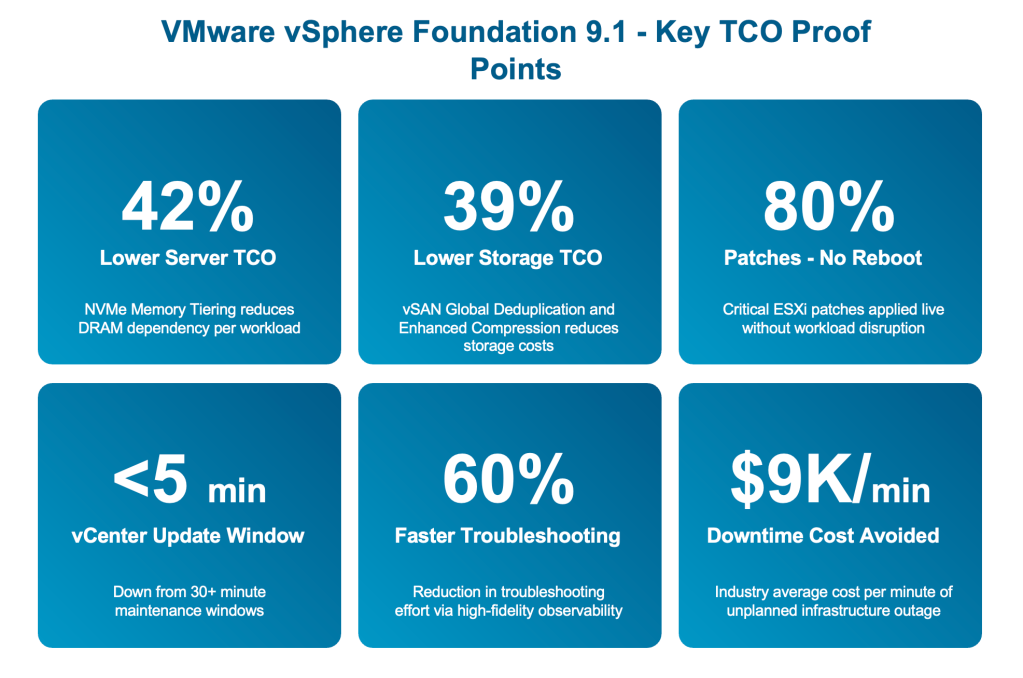
Figure 1: vSphere Foundation 9.1 Key TCO Proof Points (source: Broadcom internal testing, May 2026)
Memory Is One of Your Largest Infrastructure Costs. vSphere Foundation 9.1 Changes the Math
DRAM has become one of the most volatile line items in data center procurement. Prices surged 80 to 170% year over year in 2026 due to AI-driven demand and constrained global memory supply [1]. For organizations running memory-intensive workloads, including databases, analytics, virtual desktop infrastructure, and AI inference, the cost of scaling memory capacity has become a meaningful constraint on growth.
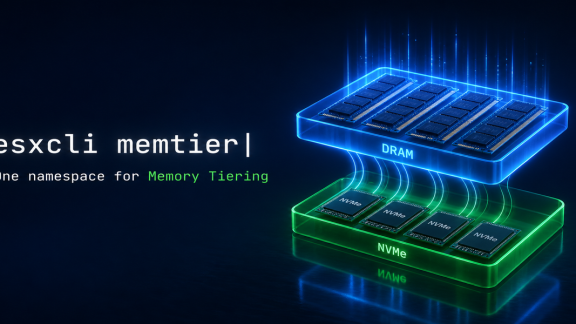
VMware vSphere Foundation 9.1 addresses this with enhanced NVMe Memory Tiering. By using high-performance NVMe as a second memory tier, the platform offloads 20 to 25% of memory accesses, expands effective memory capacity, and reduces server TCO by up to 42% [2]. The transition is transparent to running workloads. No changes to VMs or guest operating systems are required. Organizations can increase workload density per host, defer hardware purchases, and weather DRAM price volatility without operational disruption.
For database workloads specifically, the updated NVMe Memory Tiering in 9.1 delivers up to 15% better performance compared to version 9.0, driven by zero-downtime activation and software-based mirroring [2].
Storage TCO: Consolidation Without Compromise
Storage is the second major cost lever. VMware vSphere Foundation 9.1 includes vSAN global Deduplication and enhanced compression, delivering up to 39% lower storage TCO compared to traditional external arrays [2]. vSAN’s global Deduplication is a post-process deduplication, meaning it runs opportunistically in the background, which protects application performance while enabling cluster-wide efficiency across up to 64 hosts.
vSAN storage cluster enhancements further consolidate the storage estate by sharing high-performance ESA storage with vSAN Original Storage Architecture (OSA) clusters and vice versa. Organizations can mount both OSA and ESA datastores to maximize existing infrastructure, eliminate stranded capacity silos across management and vCenter boundaries, and support incremental modernization.
Every licensed vSphere Foundation deployment includes 250GB of vSAN capacity per core, pooled across the environment for flexible allocation. The full vSAN feature set, including data-at-rest and in-transit encryption, deduplication and compression, stretched clusters, vSAN storage clusters, and comprehensive data protection, is included.
Operations Costs Are Infrastructure Costs
The financial case for vSphere Foundation 9.1 extends beyond hardware. Operational overhead, including the labor, time, and tooling consumed by routine maintenance, is a significant cost center that often goes untracked.
Quick Patching for vCenter reduces maintenance windows from 30 minutes to under 5 minutes, an 80% reduction in time-on-platform for one of the most common maintenance activities [2]. Native diagnostic analysis reduces administrative troubleshooting effort by up to 60% by surfacing root causes and guided remediation directly within the operations console, eliminating the need for disconnected tools and scheduled diagnostic tests [2].
High-fidelity telemetry at two-second intervals catches performance anomalies before they escalate into costly incidents. Zero-touch elastic provisioning automates host discovery and imaging, eliminating manual configuration and truck rolls. This is especially valuable for distributed environments and edge deployments.
The operational efficiencies translate into measurable savings. For interviewed customers, S
A Strong Foundation. A Clear Path Forward
VMware vSphere Foundation is a foundational stack for running VMs and containers from a single platform. Combining vSphere Enterprise Plus, vCenter, vSphere Kubernetes Service (VKS), vSAN, and VCF Operations (including logs and diagnostics), it delivers infrastructure efficiency with streamlined operations while securing the platform against the full spectrum of cyber-threats. VMware vSphere Foundation provides an architectural advantage that lets you seamlessly transition to the full stack VMware Cloud Foundation (VCF) whenever you’re ready.
vSphere Foundation 9.1 reduces your infrastructure costs today while allowing your organization to make the transition on your terms, at your pace, without disruption. The economics are straightforward: lower server TCO, lower storage TCO, lower operational overhead, and a validated ROI that compounds over time.
These benefits combine to make VMware vSphere Foundation an ideal destination for organizations that are looking to upgrade existing vSphere 8 environments but are not quite ready to deploy the full VCF stack.
Work with your Broadcom team to get to vSphere Foundation 9.1
Broadcom is focused on delivering the most cost-efficient platform possible for our customers. The new reality is that organizations must address rising infrastructure costs with urgency. Upgrading to 9.1 puts the cost-reduction capabilities you need in place now. Contact your Broadcom account team or Broadcom partner to conduct a vSphere Foundation 9.1 TCO assessment and accelerate the process through professional services.
Explore the latest resources:
- VMware vSphere Foundation Product Page
- VMware vSphere Foundation Resource Page
- VMware vSphere Foundation 9.1 Customer FAQ
- VMware Cloud Foundation 9.1 Announcement
Sources
- [1] “What’s Driving the Global RAM Shortage and Why it’s So Expensive.” SHI Resource HUB, 2026
- [2] Broadcom internal testing
- [3] Forrester Consulting, “New Technology: The Projected Total Economic Impact™ of Broadcom VMware Cloud Foundation 9,” August 2026. A commissioned study conducted by Forrester Consulting on behalf of Broadcom. Results represent a high-impact scenario and are for a composite organization based on interviewed customers.
Disclaimer: All performance and cost improvement claims based on Broadcom internal engineering estimates and hardware test results, 2026, unless otherwise specified. Results subject to change.
Discover more from VMware Cloud Foundation (VCF) Blog
Subscribe to get the latest posts sent to your email.