
In the modern software development lifecycle, the transition from code commitment to meaningful feedback is often where momentum stalls. Developers, tasked with shipping features at high velocity, frequently hit a wall when it comes to environment provisioning, manual deployment coordination, and the tedious administrative overhead of managing infrastructure access. These bottlenecks don’t just delay releases; they interrupt the flow of innovation, leaving QA teams and stakeholders waiting for environments that should have been ready on demand.
Our “Code-to-URL” reference architecture is designed to obliterate these friction points, establishing an automated, secure, and instant feedback loop that activates as soon as a GitHub Pull Request is created.
The Security-First Foundation: VKS and OIDC
At the heart of this solution is VMware vSphere Kubernetes Service (VKS). To help ensure a robust, production-ready foundation, our VKS environment is pre-configured using a custom ClusterClass specifically architected to support OIDC authentication.
By prioritizing OIDC (OpenID Connect) over traditional, static, and risky long-lived credentials (like Kubeconfigs), we ensure that GitHub Actions authenticates via short-lived, identity-verified JWTs. This approach mitigates the risk of credential leakage while simultaneously simplifying operational management. As depicted in our architecture diagram below, the system maintains strict security boundaries, keeping infrastructure shielded while enabling seamless deployment.
Below is an overview of the CI/CD pipeline architecture:
The Code-to-URL Pipeline Workflow Experience
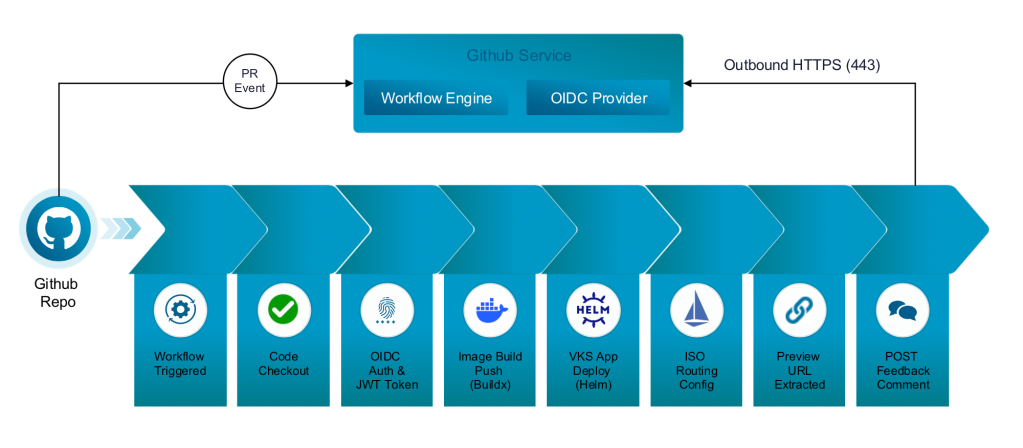
The above diagram illustrates our end-to-end automated pipeline, detailing each critical stage from the initial Pull Request trigger through secure OIDC authentication and deployment, culminating in the automated generation of the live preview URL. The goal is simple: eliminate the wait. When a developer pushes code and opens a Pull Request, the CI/CD pipeline triggers an automated sequence:
- Containerization: The application is built and pushed using secure OCI workflows.
- Identity Handshake: The runner securely exchanges OIDC tokens for temporary, scoped access to VKS.
- Deployment: A Helm release is installed directly into a dedicated, isolated namespace.
- Instant Exposure: Istio ingress routing is configured automatically to generate a unique, live URL for that specific branch.
Within minutes, reviewers receive a comment in their PR timeline containing a live, fully functional instance of the feature branch. This allows stakeholders to inspect, test, and approve changes without ever needing to manually provision or configure an environment.
Looking Ahead: The Roadmap to Phase 2
While the current architecture delivers a powerful, secure, and immediate deployment experience, we view this as the first step. Our upcoming Phase 2 roadmap focuses on introducing advanced automation for dynamic, lifecycle-managed environments. This evolution will further abstract infrastructure management, enabling teams to spin up and tear down complex, full-stack sandbox environments on-demand with zero manual overhead.
Start Your Journey Today
Stop waiting for environments. Start delivering features. By adopting this OIDC-based CI/CD pattern, you can reduce your QA lead time from days to minutes while simultaneously hardening your security posture.
Ready to transform your development workflow? Explore the full implementation details, configuration templates, and manifest examples in our reference repository and documentation Code to URL with GitHub Actions CICD Workflow
Discover more from VMware Cloud Foundation (VCF) Blog
Subscribe to get the latest posts sent to your email.