
The AI boom reinforces Singapore’s status as a global digital hub, but its immense demand for data center infrastructure challenges the Singapore Green Plan 2030. This whitepaper examines the transition toward a “Compute-per-Watt” paradigm. By leveraging modern software-defined cloud innovations, organizations can shrink their carbon footprint while scaling critical infrastructure—effectively balancing digital growth with national net-zero targets.
Introduction: Data Centers as Economic Engines for the Singapore Digital Economy
Data centers are no longer just utilities, but the bedrock of Singapore’s digital economy, which contributes approximately 18.6% to the national GDP(1). To support the evolution of this digital economy into the AI age, Singapore is investing an additional S$1 billion in AI R&D between 2025 – 2030(2).
- Investment and Capacity: The Singapore data center market, valued at US$3.25 billion in 2025, is projected to reach US$5.11 billion by 2031(3). To fuel this growth sustainably, the government recently released 300 megawatts (MW) of additional capacity, with a further 200 MW earmarked for operators who pioneer green energy solutions(4).
- Beyond Infrastructure: The sector is a massive economic multiplier, adding over $2 billion annually to the economy. It supports approximately 25,000 jobs, with 7,000 direct roles that offer wages 35% above and labor productivity 2.6 times the national average(5)
- Regional Anchor: Approximately 4,200 regional headquarters in Singapore depend on local low-latency data center infrastructure to serve the broader Asia-Pacific region(6).
The Strategic Crossroads: Growth with Sustainability
Singapore stands at a pivotal crossroads in its journey as a Smart Nation and the digital “command center” for Southeast Asia. In an era where data and AI are the primary engines of value creation, Singapore’s digital leadership must be reconciled with a physical reality: Singapore is a resource-constrained city-state committed to a net-zero future.
The Singapore Green Plan 2030(7) was launched in 2021 as the nation’s compass toward net zero emissions by 2050. But the subsequent AI boom necessitated a surgical approach to infrastructure growth, resulting in the announcement of the Green Data Center Roadmap(8) in 2024. This roadmap is a strategic framework to ensure that digital infrastructure growth aligns with existing environmental commitments.
Singapore’s Constraints and their Mitigations
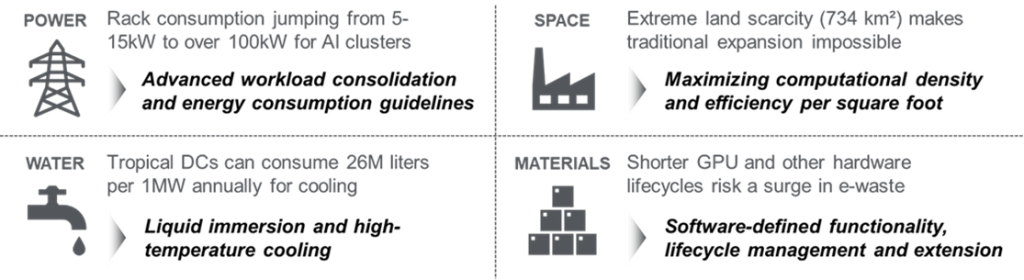
The footprint of a modern data center is not just defined by its physical size, but also by its environmental impact. The proliferation of AI workloads has fundamentally altered the factors of production of data centers, challenging Singapore’s constraints as a location. The following snapshot summarizes these challenges(3)(4)(5)(8) and constraints and the possible mitigation strategies for Singapore to ensure long-term sustainability.
Policy Evolution: Navigating the AI Explosion
Singapore’s policy response to this challenge has been characteristically strong. The Singapore Green Plan 2030 initially set broad industrial targets, including a 15% reduction in energy consumption for residential and industrial segments, which accounts for 60% of national greenhouse gas emissions.
However, the May 2024 launch of the Green Data Center Roadmap represented a significant policy evolution as a direct response to the generative AI surge, which had rendered the 2021-era projections insufficient. The roadmap introduced the SS 715:2025 standard(9), which demands a 30% reduction in IT equipment energy consumption—shifting the focus and the onus for energy and operational efficiency from the data center building and facility to the compute infrastructure itself.
The Paradigm Shift to “Compute-per-Watt”
For years, the industry relied on Power Usage Effectiveness (PUE) to measure sustainability. While the Green Data Center Roadmap targets a PUE of 1.3 or lower, PUE only measures the relative efficiency of the building and facility (e.g. cooling, lighting overheads), and not that of the IT equipment itself.
The new sustainability paradigm is thus “Compute-per-Watt“, which measures actual work (AI inferences/transactions) delivered by the data center’s IT infrastructure per watt of power consumed.
Orange France provides a practical case in point, leveraging software-defined platforms to maintain agility and rapid service delivery while significantly lowering its energy footprint(10).
But the rigidity of specifications and hard limits of the hardware layer constrain the potential of true IT infrastructure efficiency. The next frontier of sustainability is thus optimizing the software layer. As an illustration, a “perfect PUE” facility can still miss its objectives if servers run “zombie” workloads or use non-optimized software or obsolete hardware-based solutions. Several functionalities can be efficiently and flexibly addressed by the software layer, significantly improving the Compute-per-Watt KPI.

For a real-world example, Dubai Airports manages the world’s busiest international hub while cutting over 7,800 tons of carbon emissions since 2016 through optimized software-defined infrastructure(11).
Enabling Sustainable Digital Infrastructure for the AI Era
As AI adoption accelerates, organizations face the dual imperative of scaling compute capacity while meeting Singapore’s Green Plan 2030 sustainability mandates. Reconciling these goals requires a shift from physical hardware-dependency to software-defined operations.
By abstracting compute, storage, and networking into a unified, optimized resource pool, software-defined platforms enable automated workload consolidation and maximized hardware utilization. This software-first approach directly reduces the physical data center footprint, power consumption, and cooling overhead.
Optimizing resources in this manner delivers superior Compute-per-Watt performance and can improve IT infrastructure TCO by 30-50%(12). Consequently, sustainability becomes a driver of operational excellence rather than a constraint on growth.
Operational success is measurable: Shintao Natural Gas optimized CPU resource allocation by 70%, boosting capacity while directly reducing energy consumption per workload(13).
Conclusion: Scaling Responsibly for 2030
The tension between Singapore’s AI ambitions and its Green Plan 2030 is not a zero-sum game. The path forward is “Green Compute.”
By adopting software-defined cloud infrastructure, organizations can achieve three business outcomes:
- Operational Resilience: Modernizing infrastructure to software-defined platforms makes it agile, more resilient against security threats and minimizes downtime in case of issues.
- Cost Competitiveness: Consolidating workloads to maximize hardware utilization while minimizing physical footprint. The net result is a significant reduction in TCO and maximization of Compute-per-Watt.
- Sustainability Compliance: Aligning IT operations with the Green Plan 2030 to ensure long-term, regulatory-compliant growth.
Platforms such as VMware Cloud Foundation (VCF) 9 operationalize these requirements, helping organizations modernise their data centers to balance AI-driven growth with national sustainability commitments.
We invite you to reach out for a consultation to discuss how your organization can achieve a 30-50%(12) TCO reduction while scaling responsibly and sustainably to meet the demands of the AI era.
References
1. Singapore Digital Economy Report 2025. IMDA Factsheet (2025)
2. MDDI Press Release – 24 January 2026. Ministry of Digital Development and Information (2026)
3. Singapore Data Centre Market – Investment Analysis & Growth Opportunities 2026-2031. Research and Markets (2026)
4. Singapore to expand data centre capacity by at least one-third. Economic Development Board (EDB) Singapore (2024)
5. The Digital Engine Room: Unlocking APAC’s Economic and Digital Potential through Data Centres Asia Pacific Data Centre Association (2023)
6. Multinationals Pick Singapore over Hong Kong for Asian Headquarters Bloomberg Intelligence (2024)
7. Singapore Green Plan 2030. Singapore Green Plan 2030 Official Site (2026)
8. Green Data Centre (DC) Roadmap. Infocomm Media Development Authority (IMDA) Singapore (2024)
9. SS 715:2025 – IT Energy Efficiency Standard for DCs. Infocomm Media Development Authority (IMDA) Singapore (2025)
10. Orange France Stays Ahead with Sustainable IT. Customer Case Study
11. Dubai Airports Elevates its Private Cloud with VMware Cloud Foundation and vDefend. Customer Case Study
12. The Business Value of VMware Cloud Foundation – VCF TCO Study. Broadcom Technical White Paper (2025)
13. Shintao Natural Gas Implements VMware Cloud Foundation to Streamline Workflows and Improve Service Efficiency. Customer Case Study
Discover more from VMware Cloud Foundation (VCF) Blog
Subscribe to get the latest posts sent to your email.