
As data center fabric speeds surge from 100Gbps toward 400Gbps, a silent bottleneck threatens virtual infrastructure: the hypervisor networking stack. Traditional packet handling introduces a linear serialization tax, consuming excessive CPU cycles just to parse, classify, and apply security rules.
For modern enterprise clouds running on VMware Cloud Foundation (VCF), the Enhanced Data Path (EDP) Standard feature provides an out-of-the-box architecture that decouples packet velocity from CPU overhead. Let’s explore how this technology strips latency out of your data path and reclaims vital compute capacity for your business applications. For a deeper dive into the design and implementation of Enhanced Data Path (EDP) in VMware Cloud Foundation deployments, please refer to the Enhanced Data Path technical paper.
Architectural Evolution: Moving Past the “Slow Path”
To appreciate the design of EDP Standard, it helps to examine the two primary modes operating within the ESX kernel subsystem.
The Standard Datapath (The “Slow Path”)
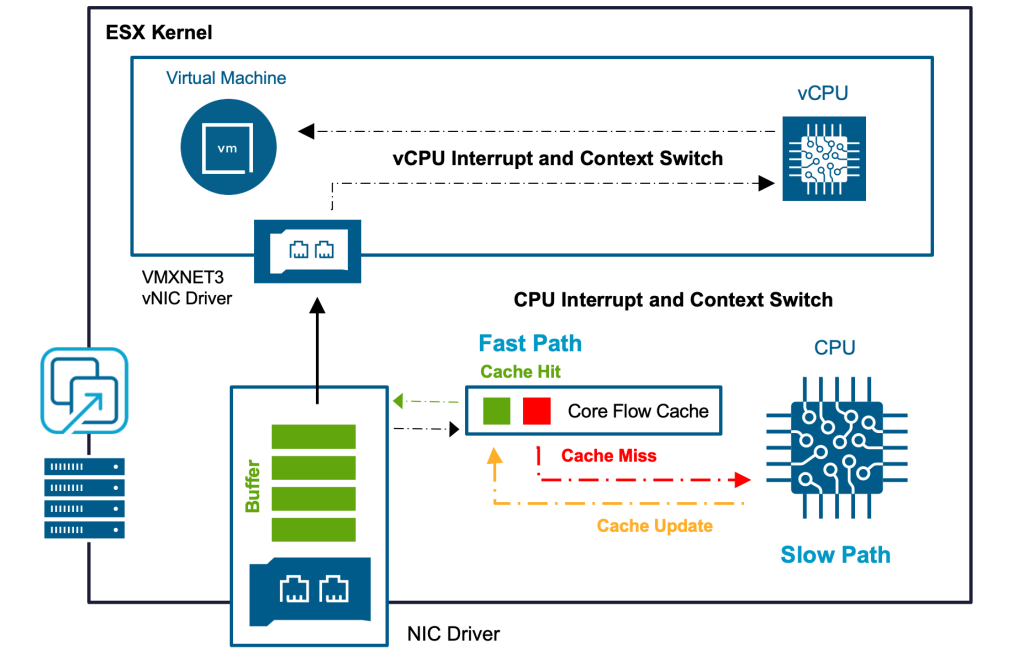
The legacy network stack relies on an interrupt-driven mechanism called the IOChain. Every packet traversing the switch goes through discrete modules for header parsing, policy checks (ACLs/Firewalls), routing lookups, and stateful processing. Under high packet rates, this serial pipeline establishes a performance ceiling and drives up host latency.
EDP Standard (The “Fast Path”)
The EDP Standard mode introduces a state-of-the-box mechanism called Fast Path. Instead of re-evaluating every single packet in a stream, the system monitors the initial packet of a new flow via the traditional IOChain. Once resolved, the required handling rules are committed to a localized Flow Cache.
Subsequent packets matching that exact flow signature bypass the slow IOChain completely. They are processed using a rapid, single-lookup cache match—delivering complex routing and security policies at true line rate.
What about EDP Dedicated?
VCF has another mode called EDP Dedicated which operates on a poll-mode mechanism that locks down 100% of assigned CPU cores strictly for Telco/5G workloads. Because those cores are entirely unavailable for general enterprise computing when idle, EDP Standard is the recommended choice for dynamic, “bursty” enterprise applications.
The Three Core Pillars of EDP Standard
EDP Standard doesn’t achieve its 2.5x efficiency boost over the standard stack via a single trick. It relies on three tightly integrated software-defined core technologies:
1. Flow Cache Management
To keep the Flow Cache accurate and lightweight, entries use an automated eviction algorithm with a staggered expiration timer between 90 and 150 seconds. Staggering prevents mass cache evictions and forces long-lived streams to periodically revalidate behavior safely. Furthermore, rather than a single global table, EDP allocates an independent flow cache table (storing up to 128K entries) per active packet-processing thread.
2. The Thread Load Balancer (TLB)
EDP handles packets using dedicated hypervisor processing threads called EnsNetWorlds. The TLB acts as an intelligent traffic cop, evaluating thread utilization on a continuous 4-second polling cycle. If a thread hits 70% utilization or virtual machine topologies shift, a bin-packing algorithm redistributes queues smoothly across underutilized threads.
3. The Mbuf Framework
In legacy architectures, a data format called pktHandle occupies 256 bytes (four hardware cache lines) per packet. EDP Standard completely swaps this for the Mbuf Framework. Based on the high-performance DPDK library, Mbuf shrinks this structure to a lean 128 bytes. This 50% footprint reduction permits far more packet references to reside entirely within the CPU’s ultra-low-latency L3 hardware cache.
Strategic Hardware Offloads
For EDP Standard to function optimally, your virtual software layers must synchronize with physical server silicon:
- Exclusive to VMXNET3: The advanced software innovations within EDP Standard are optimized exclusively for the para-virtualized VMXNET3 virtual adapter. Traditional emulated adapters (like E1000) will operate but fail to yield performance improvements.
- Native NUMA Enforcement: Local memory lookups yield the highest bandwidth and lowest latency. EDP Standard dynamically binds EnsNetWorld threads to the corresponding physical NIC socket. Administrators should leave the ESXi NUMA scheduler at default settings to allow this auto-alignment to work.
- NetQueue Optimization: Rather than forcing a single vCPU thread to sort incoming switch packets, NetQueue pushes the sorting logic down into the physical NIC hardware. The physical adapter classifies inbound streams via MAC addresses and VLAN tags, dropping them straight into the receive queue mapped to the target VM.
- Shared NetQueue RSS: To avoid exhausting host hardware resources, VCF recommends a Shared NetQueue RSS architecture. This allows multiple virtual machines to share an RSS processing engine, striking a near-perfect equilibrium between high throughput scaling and core efficiency.
Operational Impact: Real-World Benchmarks
What does this mean for a live production deployment? Technical studies conducted using a high-stress UDP profile (2 million concurrent flows over dual 100G ports) illustrate the massive delta between a manually tuned heritage stack and out-of-the-box EDP Standard.
Resource Reclamation and Raw Power
For 1518-byte frames, raw data throughput jumped from 34 Gbps using the standard stack to 64 Gbps under EDP Standard. More impressively, while the standard stack required up to 28 host cores to sustain maximum load, EDP Standard maintained a flat, optimized footprint of just 16 cores. This represents a 40% reduction in CPU consumption, giving you more processing headroom to run application VMs on your hypervisors.
The Telemetry and Visibility Tax
Deep observability features like VMware vDefend Distributed Firewall (DFW) or VDS IPFIX logs are critical for compliance, but they traditionally levy a heavy performance tax. When deep monitoring is active on a heritage network path, throughput can crater by more than 50%. EDP Standard limits that drop to as low as 18.4%, helping ensure complete data plane security without choking application performance.
Deployment and the Path to VCF 9
Getting started with EDP Standard varies depending on where you stand in your lifecycle journey:
- VCF 5.2.X Environments: EDP Standard is available as an option. The recommended deployment baseline is vSphere 8.0 Update 3i & NSX 4.2.3.2, which includes stability improvements for Network I/O Control (NIOC).
- VCF 9.X Implementations: EDP Standard steps forward as the default out-of-the-box virtual switch mode for all new deployments.
- Seamless Upgrades: Moving from VCF 5.2 to VCF 9 preserves your active network state. Legacy clusters remain on their current stack unless you explicitly transition them.
- Automated Activation: Rather than managing legacy, CLI-driven enablement scripts, administrators can change their datapath switch mode directly inside the NSX Transport Node Profile (TNP). When vSphere Configuration Profiles (VCP) are active, VCF automates host remediation sequentially by placing nodes into maintenance mode safely across the cluster.
Ultimately, embracing EDP Standard prepares your network backbone for the next generation of accelerated infrastructure, including advanced VCF 9.1 hardware features like Uniform Passthrough (UPT) and Enhanced DirectPath (EDPIO) for NVIDIA accelerated smartNICs. By standardizing on this optimized pipeline, you eliminate hypervisor data path ceilings entirely—from silicon to application.
Discover more from VMware Cloud Foundation (VCF) Blog
Subscribe to get the latest posts sent to your email.