A recent independent study, conducted by Principled Technologies, compared Kubernetes pod density and pod readiness speed between two environments – VMware Cloud Foundation (VCF) 9.0 with vSphere Kubernetes Service (VKS) 3.6 and Red Hat OpenShift 4.21 on bare metal. This is a benchmark/stress-testing study. In this blog, we take a look at the results oh this study that highlight VCF’s superior scalability and better latency for running Kubernetes at enterprise scale, using kube-burner – a Red Hat developed tool.
Understanding K8s Pod Density
As per CNCF, a pod acts as the smallest deployable unit for containerized application. Each pod contains a single application instance with one or more containers sharing compute, storage and network resources.
Pod density measures the number of pods a node can support while maintaining stability.
Key Results
First, let’s look at the results of this study.
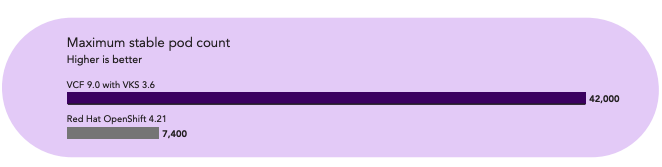
Pod Density: vSphere Kubernetes Service (VKS) supported 42,000 Kubernetes pods before reaching stability limits. Red Hat OpenShift environment on bare metal supported only 7,400 pods on identical hardware. This shows that VCF 9.0 achieved 5.6x more pods per node/host than Red Hat OpenShift using kube-burner tool1.
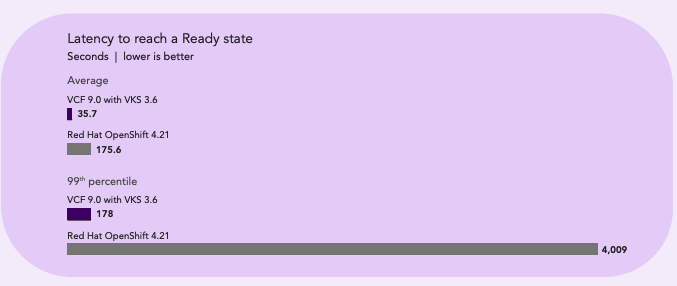
Pod Readiness Speed: On average, VCF 9.0 achieved 4.9x better latency than Red Hat OpenShift using kube-burner tool. And at the 99th percentile, vSphere Kubernetes Service (VKS) was 22.5X faster using the same tool while sustaining nearly 5x the pod count1.
Testing Methodology
Now, let’s look at the methodology and tools researchers used for this study
Hardware: Four Dell PowerEdge R640 servers with identical processors, memory, and storage across both platforms.
Testing Tool: Kube-burner, a CNCF open source tool that is primarily developed by Red Hat, which conducts performance and scale stress testing of Kubernetes clusters.
Method: Kube-burner tool gradually increased pod counts in each environment until it reached maximum stable pod density – the point where additional pods would cause performance degradation or cluster instability.
Failure Modes:
- Red Hat OpenShift: The worker nodes began transitioning to a “Not Ready” state when pod counts exceeded threshold levels, causing pod termination and cluster instability.
- VCF 9.0: It continued scaling without node instability. Ultimately memory utilization approached performance degradation levels.
Want to learn more?
Check out the full report – Run more Kubernetes pods and applications on VMware Cloud Foundation 9.0 with VMware vSphere Kubernetes Service
Check out the detailed science behind this report
1 Principled Technologies Report (Mar 2026): Run more Kubernetes pods and applications on VMware Cloud Foundation 9.0 with VMware vSphere Kubernetes Service
Discover more from VMware Cloud Foundation (VCF) Blog
Subscribe to get the latest posts sent to your email.