
The potential of generative AI (GenAI) to revolutionize business processes is undeniable. From automated customer service agents to complex internal business intelligence, the use cases for this technology are expansive. However, for most enterprises, the immediate challenge isn’t just finding an AI model—it’s finding the right data without compromising intellectual property (IP) or regulatory compliance.
Feeding your organization’s critical, proprietary data—such as IP, PII, or financial records—into public AI models is often a non-starter for security-conscious businesses. This dilemma of balancing innovation with data protection has given rise to the concept of Private AI. To successfully implement a Private AI strategy, you need an architecture that brings AI compute capacity directly to your data, rather than moving your data to the compute. This journey begins with a secure on-premises data layer.
Data Sovereignty: The Solution to the Private AI Dilemma
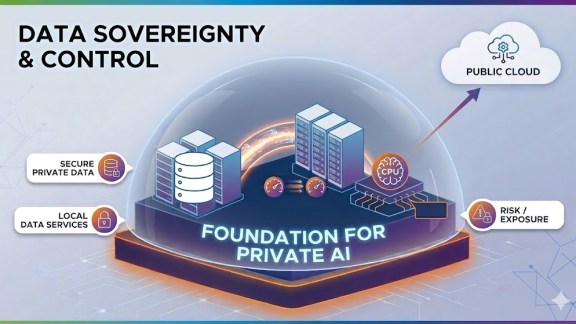
When data leaves your control, so does your competitive advantage. Data sovereignty is not merely about geographical placement; it is about absolute ownership and governance across your entire data lifecycle. By building your AI infrastructure on a private cloud powered by VMware Cloud Foundation (VCF), you help ensure:
- Zero external exposure – Your intellectual property never traverses the public internet to train a third-party model.
- Compliance by default – Highly regulated industries, such as Healthcare and Financial Services, can maintain strict adherence to data residency and privacy laws while still leveraging AI capabilities.
- Avoidance of public cloud costs – You eliminate the high costs associated with moving and storing massive datasets in public clouds (egress fees), improving the long-term TCO of your AI initiatives.
Why Locality Wins: The Case for Data Gravity
AI training and inference workloads are notoriously data-intensive. Attempting to run compute in the public cloud against data stored on-premises introduces excessive latency, which can cripple the performance of real-time applications.
The “Physics of Data Gravity” dictates that AI compute must reside adjacent to the data source to achieve the required performance. By managing your data services on VCF with VMware Data Services Manager (DSM), you place your enterprise databases (PostgreSQL and MySQL) on the same high-performance vSAN infrastructure hosting your GPU-enabled compute clusters. This locality ensures minimum latency, maximizing the performance of your Retrieval-Augmented Generation (RAG) and inference workflows.
DSM: The Secure, AI-Ready Data Layer
VMware Data Services Manager (DSM) provides the key capability that transforms standard databases into AI-ready infrastructure: Native support for pgvector. PostgreSQL with pgvector enables organizations to store and manage “vector embeddings,” the specific mathematical representations of data that allow AI models to understand relationships and context.
By managing pgvector-optimized PostgreSQL through DSM, you gain:
- Validated infrastructure – DSM automates the provisioning of validated PostgreSQL templates specifically optimized for vector search workloads on VCF.
- Enterprise security and DR – Every AI database inherits the full spectrum of DSM security, continuous backup, and automated high-availability (HA) capabilities. This helps ensure your critical AI inputs are as protected as your traditional transaction systems.
- Developer self-service – Data scientists and application developers can provision AI-ready vector databases in minutes via UI or API. This accelerates AI development cycles while IT retains control over the underlying infrastructure and data governance.
Conclusion: No Strong AI Without a Strong Data Foundation
Your AI strategy is only as effective as your data layer. By prioritizing data sovereignty and leveraging an automated on-premises DBaaS layer like VMware Data Services Manager, you can confidently build a future-proof Private AI foundation. This approach provides the agility of the public cloud while maintaining the security, compliance, and absolute control required for your most critical business data.
_________________________________________________________________________________________________
Read more blogs in this ongoing series about VMware Data Services Manager for IT practitioners and managers. Recent posts include:
| Rest Easy: Why Manual Database HA/DR Belongs in the Past – VMware Cloud Foundation (VCF) Blog | VMware Data Services Manager automates database HA/DR within VMware Cloud Foundation, replacing manual scripts with policy-driven governance, one-click provisioning, and point-in-time recovery. |
| The 75% Productivity Gain: Moving to Policy-Based Database Management | Focuses on the pain of manual ticketing and provisioning. Explains how DSM automates Day 2 operations like patching and scaling, providing cloud-like agility on-premises. |
| The CFO’s Case for On-Premises DBaaS: Repatriation and Cost Control | Analyzes the financial imperative of modernizing private cloud to cut TCO. Discusses leveraging capitalized assets to eliminate egress fees and licensing premiums. |
Discover more from VMware Cloud Foundation (VCF) Blog
Subscribe to get the latest posts sent to your email.