
In the world of enterprise analytics, we’ve reached a tipping point. For years, organizations have been caught in a tug-of-war between the massive processing power of traditional data warehouses and the agile, “fail-fast” nature of cloud-native development. You either had the stability of a heavyweight database or the speed of Kubernetes—rarely both at the same time.
But our latest jointly validated solution on VMware vSphere Kubernetes Service (VKS) with Tanzu Greenplum highlights that compromise is officially a thing of the past. By bringing Greenplum’s massively parallel processing (MPP) engine into the world of VMware Cloud Foundation (VCF), with an in-built CNCF-certified Kubernetes runtime, businesses are finding that these two technologies aren’t just compatible—they’re a “better together” powerhouse.
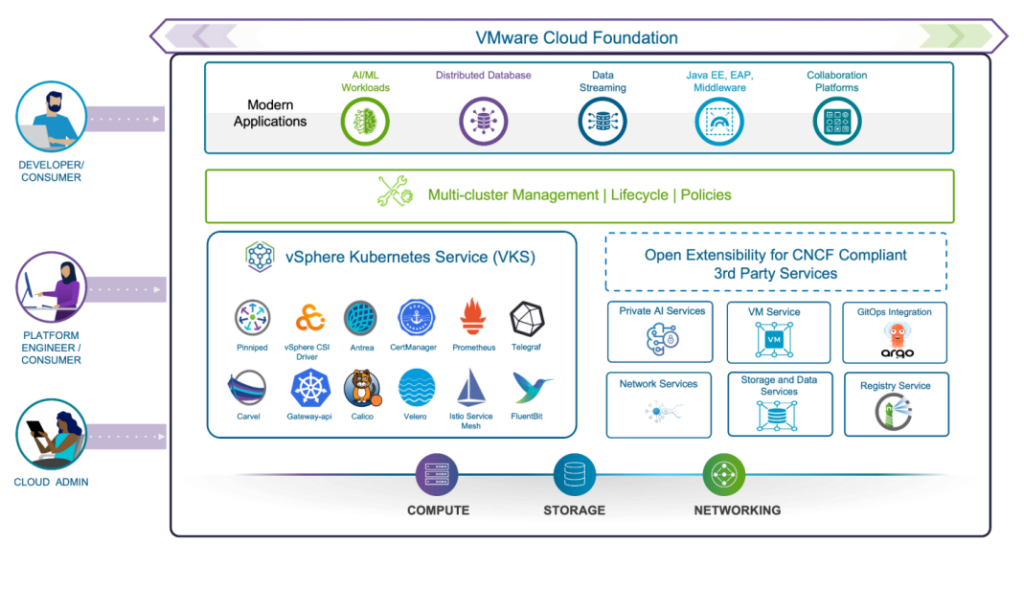
Figure: VKS on VCF Ecosystem
Here is why this combination is changing the game for data-driven enterprises:
1. Speed to Value: From Weeks to Minutes
By using the Greenplum Operator on VKS, the provisioning of containers, configuring complex networking, managing dependencies- basically the entire lifecycle is automated.
Think of the Operator as a “digital DBA” that understands exactly how Greenplum should be deployed. Whether you need a small environment for a Proof of Concept or a massive 100-node cluster for production, the turnaround time is now measured in minutes. This agility allows teams to experiment, iterate, and onboard new customers much faster.
2. Operational Simplicity (Finally!)
One of the biggest headaches for IT teams is “tool sprawl.” Managing a database environment with one set of tools and a Kubernetes environment with another leads to silos and inefficiency.
The beauty of VKS is that it’s built directly into VCF and the VMware tools your team already knows. VKS operates containers at the same level as virtual machines. This means Cloud Admins get a unified view of their entire fleet. Whether a workload is running in a VM or a container, the policies, security controls, and management workflows remain consistent. You don’t need to retrain your entire staff to handle “modern apps”—you just extend the enterprise-grade stability of vSphere to the world of Kubernetes.
3. Dedicated Performance with “Workload Zones”
A common fear with shared infrastructure is the “noisy neighbor” effect—the idea that a runaway application might hog resources and slow down your critical analytics. Greenplum is a high-performance engine; it needs consistent access to CPU and memory to crunch through terabytes of data.
With VCF 9.0, Admins can define specialized Workload Zones. These allow you to carve out dedicated infrastructure specifically optimized for Greenplum’s MPP architecture. By dedicating resources to these zones, you ensure that your analytical queries run at peak performance every single time, completely isolated from other applications in the cluster. It’s the best of both worlds: the efficiency of shared infrastructure with the guaranteed performance of a dedicated environment.
4. Enterprise-Grade Resiliency (The “Self-Healing” Database)
In a traditional setup, if a database node fails, it usually requires manual intervention to restore service. In the VKS environment, reliability is built-in.
Because Greenplum on VKS uses StatefulSets, the platform handles failure detection and recovery automatically. If a pod crashes or a node goes under, Kubernetes detects it instantly. The Greenplum Operator then kicks in, spins up a new pod, and reattaches the existing Persistent Volumes (PVs). Your data remains intact, and the cluster restores itself to a healthy state without a DBA having to wake up at 3:00 AM. This level of automated recoverability is a massive win for organizations running mission-critical analytics.
5. Secure Airgap Deployments
For industries like finance, healthcare, and defense, security isn’t just a feature—it’s a mandate. These organizations often operate in “air-gapped” environments with zero outside connectivity.
The integration of VMware NSX within VCF allows Greenplum clusters to be exposed to end-users in a highly secured, regulated way. You can maintain stringent network isolation while still providing dynamic infrastructure agility. Using Kubernetes features like Namespaces and Role-Based Access Control (RBAC), you can mitigate the “blast radius” of any security incident, ensuring that sensitive data stays exactly where it’s supposed to be.
6. Optimized Resource Consumption and Lower TCO
Let’s talk about the bottom line. Traditional database deployments often lead to “over-provisioning”—buying more hardware than you need “just in case.”
Greenplum on VKS allows for much more granular resource allocation. You can scale compute and storage independently, ensuring you only pay for what you use. Furthermore, because Greenplum can share underlying infrastructure with other Kubernetes services, you see a significant reduction in hardware requirements. This synergy leads to a lower Total Cost of Ownership (TCO) and, importantly, a smaller environmental footprint.
The “TL;DR”
The combination of VMware vSphere Kubernetes Service (VKS) and Tanzu Greenplum represents the next evolution of the data platform. It takes the “brute force” analytical power of a world-class MPP database and wraps it in the “smart” automation of a modern Kubernetes CNCF-certified runtime.
For the business, this means faster insights and lower costs. For the IT team, it means simplified operations and enterprise-grade security. It’s a rare win-win in the world of enterprise tech, proving that when it comes to big data, we really are better together.
Interested in the technical details? You can read the full Reference Architecture to see how to start building your own high-performance analytics environment today.
Discover more from VMware Cloud Foundation (VCF) Blog
Subscribe to get the latest posts sent to your email.