
In the world of modern software delivery, we have successfully automated almost everything. We spin up containers in seconds. We tear down ephemeral environments with a single command. We treat compute and networking as code, defined in YAML and managed via GitOps.
But then, there is the database.
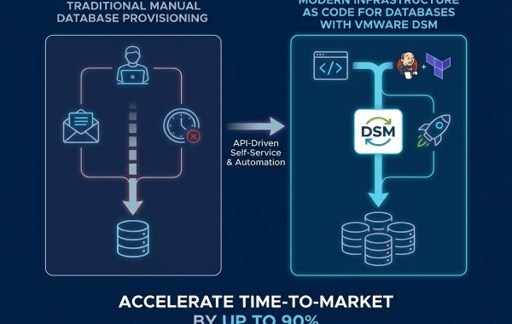
For too many Platform Engineers and Developers, the database remains the “last mile” problem. While your application code deploys in minutes via a CI/CD pipeline, provisioning the persistent storage required to run it often involves a context switch: logging a ticket, sending an email, or waiting for a specialized DBA to manually carve out a LUN and install an engine. This impedance mismatch—fast code, slow data—is the primary bottleneck in accelerating time-to-market.
It is time to treat your data layer with the same rigor as your compute. It is time to apply Infrastructure as Code (IaC) principles to your databases using VMware Data Services Manager (DSM).
The API-First Approach to Data
VMware Data Services Manager is not just a GUI for IT administrators; it was architected with an API-first mindset designed for the modern platform engineer. Running as a native Advanced Service for VMware Cloud Foundation, DSM exposes database operations—provisioning, cloning, patching, and scaling—as programmatic endpoints. This allows you to integrate database lifecycle management directly into the tools you already use, such as Terraform, Jenkins, or VCF Automation.
This integration shifts the paradigm for your internal developer platform (IDP) by first enabling true self-service. Through VCF Automation, you can curate a catalog of approved database services—including PostgreSQL, MySQL, and Microsoft SQL Server—that developers can consume on demand. Instead of filing a Jira ticket and waiting days for a connection string, a developer triggers a build or makes an API call, and a compliant, production-spec database is provisioned automatically.
This API-driven approach also solves one of the biggest challenges in CI/CD: testing against realistic data. DSM supports rapid cloning, allowing your pipelines to provision fresh database clones from gold images or sanitized production backups instantly. You can run a full suite of destructive integration tests and then destroy the instance immediately after, ensuring high-fidelity testing without the storage overhead of permanent instances.
Critically, this model replaces rigid “gates” with automated “guardrails.” The friction between Devs (who want speed) and Ops (who want stability) usually results in slow manual approvals. DSM eliminates this by allowing Platform Engineers to define infrastructure policies once—setting strict boundaries on storage classes, compute limits, backup frequency, and maintenance windows. Developers are then free to consume resources within those boundaries. They get their database immediately, but they are technically prevented from accidentally provisioning a massive 64-vCPU instance or deploying a service without a backup policy.
The “Shadow IT” Antidote
When internal provisioning is too slow, developers often turn to public cloud databases using personal credit cards, creating “Shadow IT” risks regarding cost and data sovereignty. By offering a cloud-like, API-driven DBaaS experience on-premises, you provide the agility developers crave with the governance the business requires. You aren’t forcing them to use the internal platform; you are making the internal platform the easiest path to getting their job done.
The Metric That Matters: 90% Faster
This isn’t just about convenience; it’s about velocity. By moving from manual ticketing to API-driven self-service, organizations using DSM have accelerated the time-to-market for new applications by up to 90%1 When you remove the week-long wait for a connection string, you allow your developers to focus on what they do best: shipping code.
Next Steps for Platform Engineers
- Explore the API: Look at how you can hook DSM into your existing Terraform or Ansible playbooks.
- Try the Lab: Get hands-on with the self-service capabilities in the VMware Data Services Manager Hands-on Lab.
- Read the Docs: Dive into the VMware Data Services Manager documentation to see how to configure Data Service Policies for your team.
Stop treating your databases like pets. Start managing them as code.
- Broadcom finance office
Announcing the newest DSM release: 9.0.2
Click here to see what’s new in the Release Notes
Discover more from VMware Cloud Foundation (VCF) Blog
Subscribe to get the latest posts sent to your email.