
In a VMware Cloud Foundation webinar, Lee Sustar (Forrester), Audrey Bian (Broadcom), and Natalie Fisher (Broadcom) discussed application modernization and the evolving role of Kubernetes within. Their insights focused on the challenges enterprises face and the emerging technologies reshaping cloud operations, security, and risk.
Lee began the webinar by addressing application modernization acceleration and innovation:
Cloud native technology is gaining momentum, beyond public cloud. While cloud native security and observability are still top of mind, the enterprise is embracing technologies like Kubernetes at the edge, service mesh, and WASM. They are focused on adopting new technologies to enable their diverse environments as they continue to modernize. While public cloud has momentum, cloud leaders say they plan to increase spending on private cloud also, due to myriad reasons including AI sovereignty, cost management, and building on existing data centers.
AppMod is everywhere. Enterprises are increasingly using containers for not just new projects, but existing projects. Containers are a critical part of application modernization and private cloud. Leaders are leaning on domain-driven design for modernization to modernize in ways that understand domain requirements, establish context and boundaries, legacy decomposition, and more.
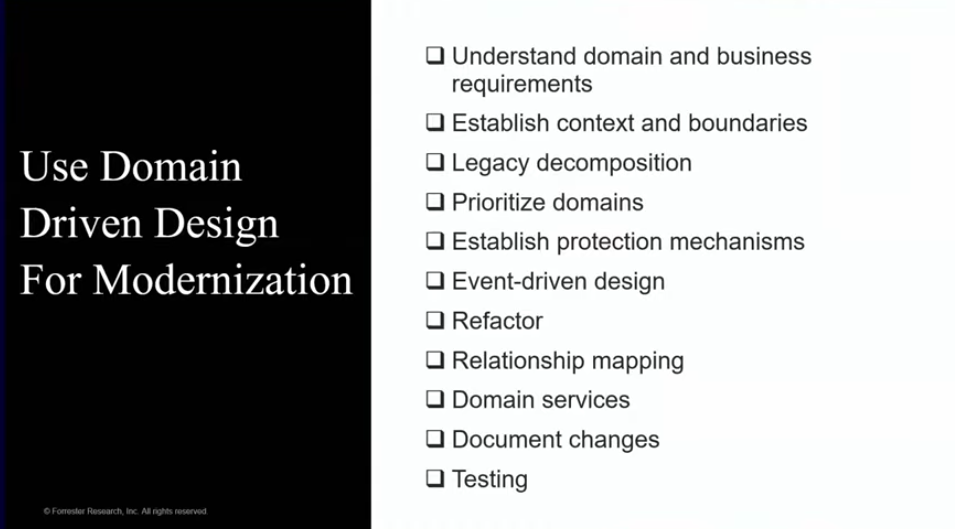
The image highlights how domain-driven design enables modernization by helping teams understand business domains, establish clear boundaries, decompose legacy systems, and incrementally refactor applications while maintaining appropriate protection and testing mechanisms.
Open-source flexibility, security and ecosystem maturity continue to drive Kubernetes and container adoption, across enterprise environments. Kubernetes has become the core infrastructure abstraction that can be applied consistently across data centers, clouds, and the edge. Enterprises can increasingly modernize applications by leveraging Kubernetes as a common horizontal platform, enabling consistent operations across domains, teams, and environments.
Key drivers of Kubernetes and containers in private cloud include security and compliance, infrastructure and optimization, scalability and performance with horizontal and vertical scaling, modernization efforts, developer productivity and application portability. With Kubernetes working in conjunction with open-source, enterprises can expect these benefits to lead to reductions in operational task labor, developer efforts for release, and developer time spent on non-coding activities.
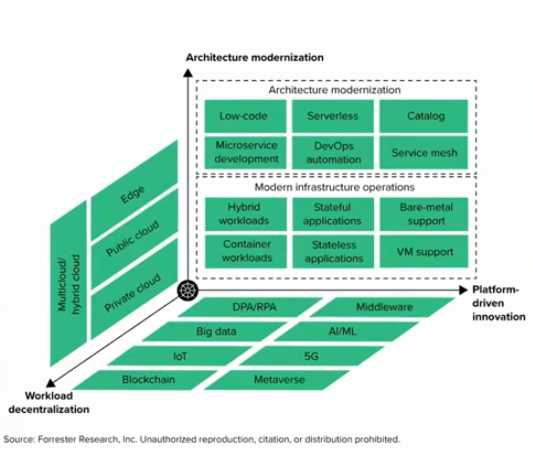
The image highlights the multidimensional intersection of how architecture modernization is a natural complement to workload decentralization on the road to platform-driven innovation with emerging technologies.
Governments increasingly require private cloud deployments in many contexts. European and North American government mandates and geopolitical fragmentation are contributing to rising regulatory pressure and difficulties in obtaining the proper solutions to assist in modernization.
The future of cloud is abstracted, intelligent, and composable. AI-assisted code development, such as TuringBots, is advancing rapidly and will only continue to accelerate. At the same time, platform operations are becoming increasingly intelligent, driven by innovation across the Kubernetes and cloud-native ecosystem. We believe this represents a major hinge point in technology and how the market is thinking about AI. Much of this transformation is powered by a Kubernetes-based ecosystem that enables consistent infrastructure abstraction and platform intelligence.

The image highlights how the future of cloud lies with the Kubernetes ecosystem and platform as it is abstracted, composable, and intelligent through emerging technology and data use.
Following Lee’s thoughts on AI adoption, Audrey Bian from Broadcom spoke about how vSphere Kubernetes Service (VKS) provides a Kubernetes runtime in VCF and the roles that can benefit from VCF.
VMware Cloud Foundation: A Unified Platform for Modern Apps
Modern enterprises need a platform that simplifies operations while supporting both traditional and modern workloads. VCF is designed to provide a single, secure, and extensible platform for running both VMs and containers.
The Foundation
At its core, VCF provides compute, storage, and networking layers, ensuring performance, security, and efficiency. vSphere Kubernetes Service (VKS) is a CNCF-certified Kubernetes runtime that delivers an enterprise-ready Kubernetes platform while avoiding vendor lock-in and enabling flexibility through support for multiple Kubernetes versions.
Comprehensive Services
VCF integrates VM Service, Network Service, Data Service, and Private AI capabilities, making it ideal for modern workloads like AI/ML and distributed databases. Multi-cluster management simplifies lifecycle operations, policy enforcement, and governance—critical for scaling Kubernetes across environments.
Who VCF Empowers
Cloud Admins: Single platform for running VMs and containers with consistent, simplified Kubernetes operations, centralized governance and policy, and flexible Kubernetes versions supported giving flexibility for upgrades.
Platform Engineers: CNCF-Certified Kubernetes runtime with 24 months standard support to run all apps, scalable multi-cluster management, and consistent set of APIs to provision and manage all building-block services, easily integrated into your existing ecosystem of tools.
Developers: Access APIs and self-service tools to accelerate delivery of modern apps without complexity.
Why Decision Makers Choose VCF
Decision makers appreciate the benefits available through VCF as they support the larger enterprise from multiple positions. Enterprises can expect lower cost and faster ROI due to consolidated infrastructure reducing silos and licensing costs while enabling faster app delivery. They can also expect improved security and compliance from end-to-end encryption and isolated clusters meet strict regulatory requirements. And since teams can leverage familiar VMware skills to manage Kubernetes, enterprises can close skill gaps and reduce the need for retraining.
Open Source: The Foundation of Innovation
For platform teams modernizing private cloud environments, open source—through projects like Kubernetes, Harbor, etcd, and Cluster API (CAPI)—is the primary engine of innovation and interoperability. Over 90% of organizations rely on open source in their cloud-native stack (CNCF). These projects deliver:
- Innovation Velocity: Upstream tools like Prometheus, Argo, and Harbor evolve rapidly through community-driven development.
- Enterprise Flexibility: Open APIs and standardized tooling enable portability across clouds, clusters, and CI/CD pipelines.
- Operational Trust: Enterprises require predictable lifecycles, security posture, and governance to run open source at scale.
Natalie then explained the value of open source as the foundation of modern private cloud:
Open Source: The Foundation of Modern Private Cloud
Open source isn’t just part of VMware’s architecture, it’s an ecosystem we actively participate in and help sustain. From Kubernetes to tools like Harbor, Etcd, and Cluster API (CAPI), open source drives the innovation customers need as they modernize private cloud environments.
Why It Matters
Platform teams are increasingly expected to deliver public cloud–like outcomes—fast provisioning, secure pipelines, GitOps, observability, and AI/ML—while meeting internal compliance requirements. Open-source powers nearly every building block of this experience. According to CNCF, over 90% of organizations rely on open source in their cloud-native stack.
But adopting open source at scale isn’t easy. Reliability, lifecycle management, and governance matter as much as features. Through active upstream participation and enterprise-grade integrations, Broadcom helps customers adopt these projects securely and operate them reliably at scale.
To watch this webinar, please visit The New Cloud Playbook: Kubernetes, Private Cloud, and Open Source and click here for more information on vSphere Kubernetes Service.
Discover more from VMware Cloud Foundation (VCF) Blog
Subscribe to get the latest posts sent to your email.