
For years, the “cloud first” directive assumed that modernization required exiting the data center. That binary thinking is now obsolete. The industry has realized that private cloud is not a location, but an operating model. Instead of viewing on-premises infrastructure as a legacy anchor, forward-thinking IT leaders are using it to deliver the same agility and automation as the public cloud—but with 61% faster workload deployment and significantly lower risk.
This shift is most critical at the data layer. While infrastructure has modernized, databases often remain stuck in legacy ticket-based workflows. This is where VMware Data Services Manager (DSM) changes the game.
The Private Cloud Renaissance
As we look at the landscape in 2026, the tide has turned. We are witnessing a private cloud renaissance. Organizations are no longer moving to the public cloud by default. Instead, we are seeing a “boomerang effect”—a strategic repatriation of workloads. Why?
Because the “cloud first” bill has finally come due. CFOs are realizing that while the public cloud is excellent for elastic, bursty workloads, it is economically punishing for steady-state, data-intensive applications. As Forrester recently noted, “Multicloud is muscle, not fat.” Smart leaders are realizing that true agility isn’t about being in one cloud—it’s about placing workloads where they fit best.
And for your most critical, data-heavy applications, that “best fit” is increasingly sitting inside your own data center.
The “Rental” Trap and Data Gravity
The primary driver of this shift is data gravity. Data is heavy. Moving it into the public cloud is easy; moving it out (high egress fees) or moving it between regions (latency) is where the friction lies. When you run your core transaction processing systems in the public cloud, you are effectively paying a premium “rental tax” on your own data.
Furthermore, with tightening regulations like Digital Operational Resilience Act (DORA) in Europe and increasing data sovereignty laws in APAC, the risks of having sensitive customer data sitting in shared public infrastructure are growing.
The market is demanding a new model: sovereign private cloud.
The Missing Piece: The Database Operational Experience
So, if the economics and compliance favor on-premises, why haven’t more companies repatriated faster?
The answer is the developer experience.
Many developers fell in love with the public cloud not because services like AWS RDS or Azure SQL made their lives easier. They could click a button and get a patched, backed-up, HA-ready database in minutes.
Conversely, the on-premises database experience has historically been painful. It involved tickets, weeks of waiting for hardware provisioning, and manual patching. This is where many cloud repatriation initiatives often stall.
Enter VMware Data Services Manager: Public Cloud Experience, Private Cloud Economics
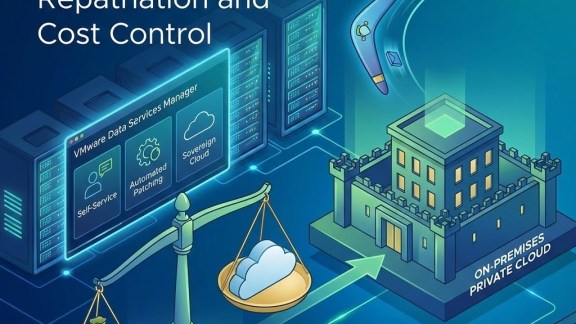
VMware Data Services Manager (DSM) is the catalyst that makes repatriation viable.
DSM allows IT leaders to offer the exact “click-button” database experience developers love—self-service provisioning, automated patching, and instant cloning—but on your own VMware Cloud Foundation (VCF) infrastructure.
By decoupling the experience from the location, DSM unlocks massive value:
- Sovereign by design: Your data never leaves your security perimeter. You control the encryption keys, the backup locations, and the access policies. This isn’t just compliance; it’s a competitive advantage in a trust-based economy.
- Private cloud economics: Broadcom’s own internal analysis of VMware Cloud Foundation performance has shown that a modern private cloud can deliver up to 40-50% lower TCO compared to native public cloud for steady-state workloads. With DSM, you eliminate the markup on database management fees and egress charges.
- Real-world proof: Broadcom’s own IT organization recently migrated critical workloads from public cloud DBaaS to DSM, saving over $10 million while maintaining the same developer velocity.
- Performance proximity: By running your databases next to your applications on VCF, you eliminate the latency tax of traversing the public internet or WAN links.
Conclusion: Cloud is an Operating Model, Not a Location
The era of “cloud first” is over. We are now in the era of “cloud smart.”
Being cloud smart means recognizing that you don’t have to rent your infrastructure to get modern automation. You can build a sovereign cloud that offers the agility your developers need with the economics your CFO demands.
The most modern, cost-effective cloud for your data might just be the one you already own.
To learn more, please visit VMware Data Services Manager or speak with your VMware sales contact.
- Forrester: Announcing our Top 10 cloud trends of 2025
- VMware Data Services Manager, Broadcom IT case study
Discover more from VMware Cloud Foundation (VCF) Blog
Subscribe to get the latest posts sent to your email.